rise 360
11819 TopicsRise 360 Sorting Activity-issue
Hi, We’ve received quite a lot of feedback about the sorting activity in Rise 360. Many participants struggle to drop cards accurately because targets register based on the mouse pointer position rather than the card’s frame. As a result, a drop can fail if the pointer (or a finger on iPad) isn't inside the drop-target frame when released. Request: Please update the drop-target logic so hits are detected using the dragged card’s bounding box/frame instead of the pointer location. Why this matters: Reduces failed drops and user frustration Improves accessibility and touch interactions (iPad/phones) Aligns with common drag-and-drop UX patterns Also, providing the option to let the learner see the activity-progress would be a useful addition. Thanks for considering this improvement. Happy to provide examples or help test a fix.Solved91Views1like4CommentsOrdered and unordered list colouring
I noticed that when you change the colour of text that sits in an ordered/unordered list, the colour of the bullets or numbers remains the same (i.e. changing to white text on a black background, the bullets and numbers remain black). Is there a way to change the colour of the bullets/numbers or is there an appetite to update the software so that text colour changes affect these lists?Solved72Views0likes5CommentsContextual Feedback
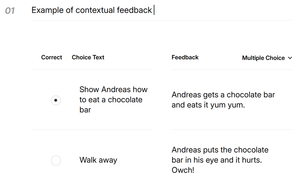
I’m currently reading Chapter 7 of Map It! by Cathy Moore and have a question about designing knowledge checks in Rise. I’d like to create knowledge checks with contextual feedback that doesn’t display “Correct” or “Incorrect” to the learner. It appears that Rise doesn’t currently support this functionality. The answers can still be tracked as correct or incorrect for reporting purposes, but I don’t want the learner to see those labels. I’ve attached two images as examples. I used the Feedback by Choice option, which is great because it allows custom feedback based on the learner’s decision. Is this functionality something Articulate is planning to add? It would be a big upgrade. As Cathy Moore writes: “A surprisingly large percentage of e-learning tools and quiz plugins don’t support contextual feedback... The tools’ creators seem to assume that the only time we’d want to ask a question is to see if the learner can correctly regurgitate a fact.” (Map It, p. 167) Screenshot from Editing a multiple choice question Screenshot from the Preview of the multiple choice question, showing that the "Correct" still pops up for the learner21Views0likes2CommentsNew in Rise 360: AI-Generated Captions (Beta)
We’re thrilled to introduce a new way to make your Rise 360 content more accessible with less effort. You can now generate closed captions for course videos with AI Assistant, saving time and effort while supporting learners of all abilities. Whether you’re uploading a new video or working with existing media, AI Assistant can create captions automatically during upload or with a single click later. And if you want to make changes, the built-in captions editor makes it simple to fine-tune wording, timing, splits, merges, and more—all while previewing how your captions will appear in context. Check out the user guide to learn more. Give Feedback AI-generated captions are in beta, and we’d love your feedback. After generating captions, you can use the thumbs-up or thumbs-down option that appears in the lower-right corner to let us know how it went. You can also share your experience in the comments below. Happy captioning!89Views2likes0CommentsRise Flashcard Activity - FONT size
I have several flashcard activities (duplicated for use again and again) but my problem is that the text size when highlighted and hovered over shows size 14 on all "back" of cards. however, the font appears very large in some instances and very small in others, with no consistency. You would think it's because some have more text than the other, but not the case. the ones with more text add a scroll bar and show a font larger than the 14 that is "appears" to be using. the font size on the next one without a scroll bar is tiny text, even though the font size also shows as 14. Has anybody seen this before? All cards on this attachment show font size 14 on back of card.126Views0likes13CommentsSCORM Sync Issues with Yoobic LMS
Hi there! I'm currently experiencing a couple of issues with SCORM packages downloaded from Articulate and integrated into our LMS (Yoobic). I’d appreciate your guidance on the following: Completion Tracking: When downloading SCORMs with completion rates included, the progress isn’t syncing correctly with our LMS. The completion shown in the e-learning module does not match what is reflected in Yoobic. Large SCORM Packages: Some larger SCORM files are returning an error (see image below). Could this be related to how we’re downloading or exporting the SCORM packages? I'd appreciate any advice or best practices to ensure SCORM packages integrate seamlessly and report accurately to our LMS. Thank you for your support!How I Built This: How I Vibe-Coded a People Manager Simulation
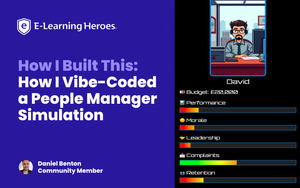
When the new Rise 360 Code Block (Beta) feature launched, I wanted to see just how far it could be pushed. Could you build something more than static content? That’s how the People Manager Simulation came to life – a fully playable, story-driven experience built entirely inside a single Rise code block, using only HTML, CSS, and JavaScript. In this video, I explain how it was created and how you can repurpose this approach in your own projects. Why I Made This In my day job, I design learning experiences for real teams, often around leadership, people management, and workplace decision-making. I wanted to create something that shows how these kinds of soft-skills topics can be transformed into immersive simulations without needing heavy development tools. The result is a game where you step into the shoes of a brand-new team leader, navigating real-world decisions that impact morale, performance, retention, and stress. Each choice has a trade-off, and yes, you can get “sacked” if you mismanage your stats. In the video, I mention that this project was built gradually, late evenings, after work, once my son was asleep. There were plenty of failed tests, odd bugs, and “why won’t this work” moments along the way. I did consider going back and documenting every single prompt and adjustment… but honestly, that would read like an increasingly impatient diary of me negotiating with ChatGPT! So instead, I wanted to share a simpler, more practical way for you to repurpose what already works. How I Built It Rather than starting from scratch, the method I show in the walkthrough involves: Uploading the existing working code of the simulation. Giving ChatGPT a single clear prompt that explains: This is for Rise 360’s custom code block. It should learn the structure and logic of the original simulation. It should rewrite the theme, dialogue, and characters for a new scenario. In the video, I demonstrate how to use the current People Manager Simulation code as context; use the download attached below. 📁 Download: People Manager Simulation HTML; attached below. You then give this to your LLM of choice as an attachment and provide your repurposing prompt; the one I used can also be downloaded below. 📁 Download: GPT Prompt for Repurposing Existing Demo; attached below. Key Takeaways Start from a working simulation instead of a blank page. Use a single, focused prompt to repurpose the entire code and story. Attach your full code as context so the model understands structure and logic. Re-use this workflow to adapt learning scenarios quickly—no coding expertise required. The Result Here’s the outcome of my own repurposing test from the walkthrough: a completely new narrative built using the same base code and single prompt. Is it perfect? No. But it’s a solid foundation—and all this came together in about ten minutes. 📁 Download: The Result — Full New HTML Code; attached below. Final Thought The best part of this approach is accessibility: you don’t need to be a coder to build something that feels custom. By starting with a working framework and iterating through clear, focused prompts, you can turn any learning scenario into a playable, data-driven experience. Whether it’s leadership, compliance, or customer service, this structure gives you the foundation to explore how choices shape outcomes, all inside Rise 360. My final ask is: please repurpose and improve on any of the ideas shared in this article. Let me and the wider community know how you get on. 💬 Ask Me Anything! I’d love to hear your feedback and answer any questions about the build. Drop your thoughts in the comments below—I’ll be checking in and responding! Want to Share Your Build? Do you have a project you’d love to share with the community? We’re always looking for more How I Built This stories. Whether it’s a game, interaction, or unique design, we’d love to feature your process. Drop a note in the comments or reach out to the community team if you’re interested!877Views10likes4Comments