storyline
151 TopicsYou're Hired!
Rather than make a series of clickable objects, I tried to create a more dynamic experience where the user can actually meet fellow employees, each with their own personality, voice, and knowledge base. In this example, the user can select a team member, meet them in their office, and through an AI interface, ask them real-time questions just as they would in a live onboarding session. I tried to give each character their own personality that comes through in their responses, so feel free to ask whatever you want -- you should get a coherent response. The ultimate goal is to create an onboarding experience feels more "human" and engaging, but is also scalable, with avatars that can be retrained as company knowledge grows. Link: You're Hired!267Views7likes8CommentsBeyond Click-and-Read: Crafting Engaging E-Learning with AI Assistant
Unlock the power of AI Assistant in Articulate 360 to enhance your e-learning courses. Learn how to transform linear content into dynamic, interactive experiences. Discover practical ways to use AI features for creating impactful images, engaging interactive blocks, and effective quizzes that truly resonate with your learners.773Views0likes0CommentsOverview of AI Assistant in Storyline
Speed up content creation and unleash your creativity with AI Assistant in Storyline. In this session, you’ll learn how to partner with AI Assistant to improve writing, generate content and images, create text-to-speech narration, add sound effects, and more.4Views0likes0CommentsImage Editing and Special Effects in Storyline 360
You don’t need a design team to produce gorgeous e‑learning. The tips presented in this webinar will show you how to do simple edits in Storyline 360 to get just the right look for your courses, whether you’re working with stock photos or inserting your own.1.3KViews0likes0CommentsOverview of AI Assistant in Storyline
Speed up content creation and unleash your creativity with AI Assistant in Storyline. In this session, you’ll learn how to partner with AI Assistant to improve writing, generate content and images, create text-to-speech narration, add sound effects, and more.1.1KViews0likes0CommentsStoryline 360: Tabs Interactions
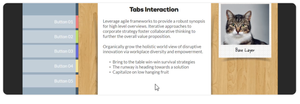
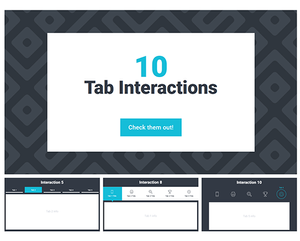
Get 10 ready-to-go tabs interactions you can quickly add to any project. See this project in action. *This template will work for folks using Storyline 360, the continuously updated version of Storyline included in Articulate 360. Want to try it out? Get a free trial of Articulate 360 right here.1.9KViews1like37CommentsAlways on top
I just set myself the challenge of having elements that are "always on top". I've worked on a handful of courses in the past, that had an irregular shaped header graphic (sometimes with drop shadow), where it would have been great to be able to set some elements in the Master Template to appears always on top of other elements within the module. For those courses, I had to create a slice of the header (the irregular shaped part) and paste on each slide, where the header appeared over another element on the slide. I have had some success, and of course it is a JavaScript implementation. This is very much an ALPHA release. Here's the implementation if interested in having a play with it or extending it. I'm sure there will be some elements, that I haven't played with, that may need some extra logic in the JS. For each element you would like to appear always on top, add the string "{AOT}" in the "Alternative text" field. If the element is decorative, you can just add "{AOT}". This will be taken care of during processing (removed, and set to aria-hidden=true). If the element is non-decorative, for example an exit button, you would just add "{AOT}Exit" to the alternative text. This would also be process, and "{AOT}" removed and "Exit" retained in the ALT text. Add the following script to the "timeline starts" on the SLIDE MASTER. This ensures that the script will process on every slide. const init = () => { // inititial value for z-index let z = 999; // get all elements with data-acc-text attribute starting with "{AOT}" const elements = document.querySelectorAll('[data-acc-text^="{AOT}"]'); // loop through each element elements.forEach(element => { // get the modelId and accText from the element's dataset const { modelId, accText } = element.dataset; // get the root element with the same modelId const rootElement = document.querySelector(`[data-model-id="${modelId}"]`); // set the z-index of the root element (incrementing by 1 each time) rootElement.style.zIndex = z++; // get the alternative text by removing "{AOT}" from accText and trimming the result const alt = String(accText).replace('{AOT}', '').trim(); // get the alt element with the id "acc-${modelId}" const altElement = document.getElementById(`acc-${modelId}`); // set the alternative text to the element's dataset element.dataset.accText = alt; // re-write the inner text of the alt element altElement.innerText = alt; // if the alternative text is empty (decorative), set the aria-hidden attribute to true and the z-index to -1 if (!alt) { altElement.setAttribute('aria-hidden', 'true'); altElement.style.zIndex = '-1'; } else { if (altElement.hasAttribute('aria-label')) altElement.setAttribute('aria-label', alt); } }); }; requestAnimationFrame(() => { init(); }); I've also including a very simple example file. This just demonstrates that the designated "Always on top" elements will appear over the image on the slide.149Views2likes4Comments