mobile
23 TopicsStoryline 360: Restricting Which Mobile Device Orientations Learners Can Use
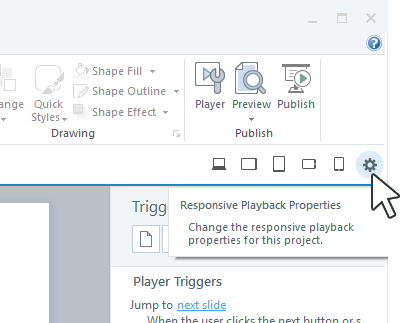
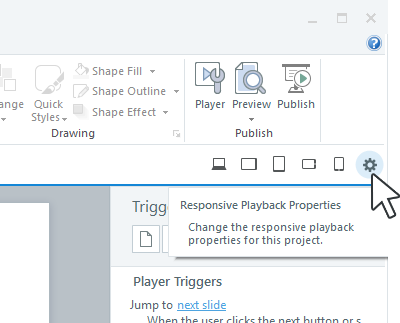
With the responsive mobile player in Storyline 360, we’ve optimized learners’ experience on tablets and smartphones by moving the player out of the way and maximizing screen real estate for your slide content. Even better, you can now control how learners hold their mobile devices as they view your courses. Just set responsive playback restrictions. For example, let’s say you build a course that's meant to be viewed in landscape mode on tablets and smartphones, and you don’t want learners to have a subpar experience by holding their mobile devices in portrait mode. No problem. Just limit playback to landscape mode before you publish. Click the gear icon at the end of the responsive preview toolbar in the upper right corner of the Storyline app. Use the Tablets drop-down menu to choose which orientation(s) learners can use when they view your course on tablets. Use the Phones drop-down menu to choose which orientation(s) learners can use when they view your course on smartphones. Click OK, then publish your course. Tip: Playback Restrictions Don't Apply to Rise 360 and Review 360 Responsive playback restrictions won't work when you publish to Review 360. Storyline blocks always rotate with the Rise 360 courses where they're embedded, giving learners an intuitive experience on mobile devices. And Storyline courses always rotate with the Review 360 interface so stakeholders have a consistent experience when leaving feedback.2.3KViews0likes0CommentsEverything You Need to Know About Creating Mobile Learning with Articulate 360
Articulate 360 has everything an e-learning professional needs to quickly and easily develop courses for desktop computers, tablets, and smartphones. It includes industry-leading mobile technology that frees course developers from endlessly tweaking their courses for every device a learner might use. Let’s take a closer look at Articulate 360's technology—and how it makes developing mobile learning so much easier. Publish Storyline 360 and Studio 360 Courses to a Responsive Player Articulate 360 includes our award-winning authoring apps Storyline 360 and Studio 360. Create any interactive e-learning imaginable with Storyline 360. And Studio 360 makes it easy to transform PowerPoint presentations into engaging e-learning. Both of these apps use our responsive mobile course player, which adapts course content for any device. Here’s how it works: When a learner opens a Storyline 360 or Studio 360 course on their mobile device, the responsive player automatically adapts to make the most of the screen real estate while preserving course content. There’s no need for e-learning developers to tweak courses for different devices or aspect ratios. They simply publish content and the technology does the rest. See the player in action in this video. To provide a seamless experience for learners on the go, our responsive mobile player automatically provides intuitive mobile navigation and supports mobile gestures such as swipe and pinch-to-zoom. Explore this example on your mobile device to see what we mean! Create Truly Responsive E-Learning with Rise 360 In addition to the responsive player in Storyline 360 and Studio 360, Articulate 360 includes Rise 360—a web-based app that was built with mobile in mind. Rise 360 lets course creators build inherently responsive e-learning right in their web browser. They can kickstart course creation by customizing a pre-built course template or create a completely custom course by adding lessons and blocks. Because it’s Rise, all course content adapts beautifully to any device. Take a look at this example on your mobile device to see what we mean. You’ll notice how course content reflows and looks great no matter the device size or orientation (try looking at the example in both portrait and landscape modes). Rise is responsive e-learning the way it should be—totally effortless! More Resources for Learning About Mobile E-Learning E-Learning Heroes is chock-full of resources that’ll help you create m-learning easily. The Definitive Guide to Multi-Device E-Learning: This comprehensive e-book will walk you through everything you need to know to create multi-device e-learning. Why Rise 360 Is a Kick-Butt Multi-Device Authoring Tool: Learn more about creating responsive e-learning with Rise 360. Comparing the Storyline 360 Responsive Player with Adobe Captivate’s Responsive Solution: See how the responsive player in Storyline 360 differs from Captivate’s responsive approach. 4 Tips for Making Your E-Learning Course Content Mobile-Friendly: Learn more about optimizing your e-learning for learners using mobile devices. Take Articulate 360 for a Spin Interested in learning more about Articulate 360? Get a free, 30-day trial to try your hand at creating multi-device learning today.2.3KViews0likes70CommentsStoryline 360: Publishing a Course for Mobile Devices
Storyline 360 makes it easy to deliver courses to learners with tablets and smartphones. Here are answers to common questions about publishing mobile-ready courses. How do I publish courses for mobile devices? How do learners view courses on tablets and smartphones? Are published courses responsive? Do they adapt to different screen sizes? Can courses be viewed on iPads? Can courses be viewed on iPhones? Can courses be viewed on Android devices? How do I track learners' progress when they view content on mobile devices? How do I publish courses for mobile devices? It's easy! Since Adobe discontinued Flash, simply publish your course for web or LMS/LRS. You don't have to do any extra work. You'll get HTML5-only output that works beautifully in all major browsers on desktop and mobile devices. How do learners view courses on tablets and smartphones? Give learners a link to your published course, as described in the following table. When learners click the link, the HTML5 output will launch in their default web browser. If you publish for... Then do this... Review 360 Open your web browser to your Review 360 home page and click your course to open it. Click Share in the upper right corner. If you want to password-protect your course, mark the box to Set a password and enter a password in the field provided. Copy the shareable link, then send it to your viewers. Be sure to give them the password, too, if you added one. Web Upload your published course to a web server, then send learners a link to the story.html file. LMS/LRS Upload your published course to your LMS/LRS. Each LMS/LRS uses a different process for this. Contact your LMS/LRS administrator if you need help uploading, launching, or tracking content. Are published courses responsive? Do they adapt to different screen sizes? HTML5 courses published with Storyline 360 use the responsive mobile player when viewed on tablets and smartphones. The responsive player dynamically adapts to different tablets and smartphones, providing an optimized view of your course on every device—no extra work required. It fluidly responds to different mobile screen sizes and orientations, hiding sidebar menus till you need them, eliminating browser chrome, and delivering mobile-friendly playback controls. The responsive player moves out of the way to maximize the screen real estate for your slide content. Your content will maintain its aspect ratio, but it’ll scale to fill as much of the screen as possible on tablets and smartphones. Visit these responsive mobile player FAQs for details. Can courses be viewed on iPads? Yes. When learners launch your course, it’ll automatically open in their default browser. Can courses be viewed on iPhones? Yes. When learners launch your course, it’ll automatically open in their default browser. Can courses be viewed on Android devices? Yes. When learners launch your course, it’ll automatically open in their default browser. How do I track learners' progress when they view content on mobile devices? Publish your course for LMS/LRS. Storyline 360 supports AICC, SCORM, xAPI (Tin Can API), and cmi5 output. Then follow the steps for your LMS/LRS to upload the published output and enroll learners. When learners launch the course, it'll automatically open in their default web browser. The HTML5 output works beautifully in all major browsers on desktop and mobile devices.1.8KViews0likes0Comments3 Steps for Getting Started with Multi-Device E-Learning
Making desktop computer–only e-learning is a thing of the past. Today’s learners are device-agnostic. They use whichever device they have on hand at that moment, whether it’s a laptop, a tablet, or a smartphone. If you want to get your training into the hands of the people who need it, when they need it, you have to make sure it works on any and every device. If you’re reading this article, you’re probably already as convinced of this as I am. But just because you’re on board with the idea of multi-device e-learning doesn’t mean you know how to make it a reality in your organization. Follow these three steps to get started and ensure a smooth transition into multi-device e-learning creation. 1. Ask the Right Questions It’s tempting to forego any planning and dive right into building multi-device courses, but before you take the plunge it’s important to understand the impact of these changes in order to ensure you’ll be successful. Here are two fundamental questions to consider: Are your learners ready for multi-device e-learning? Use this helpful checklist to find out. Is your organization prepared for multi-device e-learning? Fill out this table to get your answer. Shifting your organization to multi-device e-learning doesn’t have to be a huge undertaking, but it’s crucial to think about these things ahead of time if you want to ensure a smooth transition. 2. Determine Your Approach The two most widely used approaches in multi-device e-learning are web-based and slide-based learning. But how do you know which approach to adopt? Great question! The good news is, you don’t have to use the same approach for every project. Rather, you can switch between the two depending on your content and the learner’s needs. Let’s take a closer look at these two approaches and how to decide which is best suited for your project. Slide-Based E-Learning Slide-based e-learning has been the standard for a long time and is still commonly used today. You can create slide-based courses using apps like Storyline 360, which allow course designers to design content by placing text, images, videos, and other multimedia objects in specific spots on a slide. Often, the relative positioning of objects is important in slide-based learning. For example, in the customer service course shown below it wouldn’t make sense for one of the characters to suddenly appear above the other instead of side by side: Explore and download course template For this reason, slide-based courses can be scaled up or down depending on screen size, but the objects on the slide should stay in the same position. Here are a couple of examples of projects where it makes sense to favor a slide-based approach: Courses where the relative positioning of objects on the screen is important, like in the above example. Projects requiring a high level of design customization. One of the downsides of web-based e-learning is that because the content reflows automatically, you have less control over what your content looks like on each device. So if, for example, your client wants the logo to always appear in a specific position, a slide-based approach might be a better fit. Web-Based E-Learning Web-based e-learning is a more modern form of online training that’s become popular in recent years. Web-based courses look and behave like mini-websites instead of a series of slides where learners click Next to advance. In addition to being more intuitive, web-based e-learning is often fully responsive, meaning the content dynamically adapts and reflows depending on the screen size. Some authoring apps, like Rise 360, allow you create inherently responsive courses without any programming skills. Why is responsive design unique to web-based courses? Because unlike with slide-based e-learning, the relative positioning of text and objects in web-based courses doesn’t matter. This makes it easy to reflow the content based on screen size and orientation without distorting the message. If that all seems a little abstract to you, check out this example of a web-based e-learning course made in Rise 360 to get a better idea of what a responsive learning experience is like: Explore and copy example Here are some types of projects where a web-based approach would be appropriate: Simple, straightforward courses where relative positioning of objects is irrelevant. For example, if you have a text and an associated image but the message remains the same whether the image is above, below, or beside the text. Video-based courses. Since the content is embedded within the video, when the course is reflowed there won’t be any issues. How-to courses. The goal of this kind of course is to help learners understand how to do something. Process, timeline, tabs, and accordion interactions are the perfect way to motivate learners to lean forward and pull the content they need. These kinds of interactions are easy to reflow for different screen sizes without changing the meaning. Quizzes. Quiz questions follow a standard format (a question with some possible choices), so making them responsive is a cinch! 3. Choose the Right App There are tons of e-learning apps out there touting their ability to help you create great multi-device and mobile courses. If you’ve never built e-learning for multiple devices before, it can be challenging to decide which one best suits your needs. Here are some key things to consider when you’re weighing your options: Does the app allow you to create courses that look beautiful and work perfectly on any and all devices or do you have to use “supported” devices? Limiting learners to specific devices is nearly impossible, so it’s important to choose an authoring software that allows you to build courses that work on any device. Does the app automatically adjust your course so it works on all screen sizes or do you have to tweak your content manually? Your time is precious. You don’t want to spend hours making sure your content looks flawless on every possible device your learners might use. Go with an app that does the heavy lifting for you, like Rise 360 or Storyline 360. With Rise 360 you can create inherently responsive courses automatically and then just pop in your content. And with Storyline 360 you can create slide-based courses and the course player automatically resizes depending on the screen size. Does the app optimize screen space by hiding or minimizing non-essential elements (like browser and navigation buttons) on smaller devices? Resizing your course is only half the battle. Have you ever noticed how the navigation on mobile sites is different than their desktop counterparts? It only makes sense that your e-learning course’s navigation be optimized as well, so your content is always front and center. Make sure this is a feature your authoring app offers. Here’s a comparison worksheet to help you evaluate the different apps you’ve heard about. And here’s another article with tips on other, more general things to consider when choosing your authoring software: Top Considerations for Choosing the Right E-Learning Authoring App. Go Forth and Create Multi-Device E-Learning Making the shift to multi-device e-learning might seem intimidating, but armed with these tips you’ve got everything you need to make the transition a success. Just relax, take it one step at a time, and you’ll be a multi-device e-learning pro before you know it! Here are some related resources that will help you hone your multi-device e-learning skills even further: Why Rise 360 Is a Kick-Butt Multi-Device Authoring Tool 4 Tips for Making Your E-Learning Course Content Mobile-Friendly What Is Responsive E-Learning and Why Does It Matter? Comparing the Storyline 360 Responsive Player with Adobe Captivate’s Responsive Solution If you have any questions or comments, please share them below. And don’t forget to follow us on Twitter and come back to E-Learning Heroes regularly for more helpful advice on everything related to e-learning.441Views0likes5CommentsStoryline 3: Restricting Which Mobile Device Orientations Learners Can Use
With the all-new responsive player in Storyline 3, we’ve optimized learners’ experience on tablets and smartphones by moving the player out of the way and maximizing screen real estate for your slide content. Even better, you can now control how learners hold their mobile devices as they view your courses. Just set responsive playback restrictions. For example, let’s say you build a course that's meant to be viewed in landscape mode on tablets and smartphones, and you don’t want learners to have a subpar experience by holding their mobile devices in portrait mode. No problem. Just limit playback to landscape mode before you publish. Click the gear icon at the end of the responsive preview toolbar in the upper right corner of the Storyline app. Use the Tablets drop-down menu to choose which orientation(s) learners can use when they view your course on tablets. Use the Phones drop-down menu to choose which orientation(s) learners can use when they view your course on smartphones. Click OK, then publish your course.378Views0likes0CommentsTip of the Iceberg
Happy New Year! When I take part in a Challenge, I'm often asked, "How long did it take you to build that demo, Jon?" The answer can vary, depending on whether I'm experimenting with a new feature, revisiting an earlier concept, or building something completely new. What you see is just "the tip of the iceberg". The next question is: "Is the juice worth the squeeze?" Maybe. Maybe not. Depends on the project, your audience, and the subject matter. Remember, interaction doesn't always aid knowledge transfer. But by regularly practicing with your tools, you can bring your development time down, and make interactions like this one more viable on a real project. Click below to test the demo for yourself, and let me know what you think. https://bit.ly/elhc536 335Views3likes2Comments
Can We Be Friends?
Hello! Everyone hates icebreakers, right? With that in mind, I've created this mobile-optimized Storyline interaction to help you make new friends. Are we cool? There are 30 different feedback options, which are selected at random by Javascript. If you have any other questions, please ask. We're all friends here!
Spookily Accruate
Hello! For this challenge, I reused a character I created way back in 2020, for Challenge #292 (Using Variables). In case you wondered, Zardoz is a cross between Sean Connery and the Zoltan machine from Big. I've upgraded Zardoz with a few tricks I've learned in the meantime, including live polling, a speech animation cycle, and some sneaky Javascript. If Zardoz doesn't successfully read your mind, he can still surprise you with what he does know about you. Does Zardoz know what you're thinking? TRY IT OUT HERE
Snapshot graphics + click-and-reveal = engaging cybersecurity learning
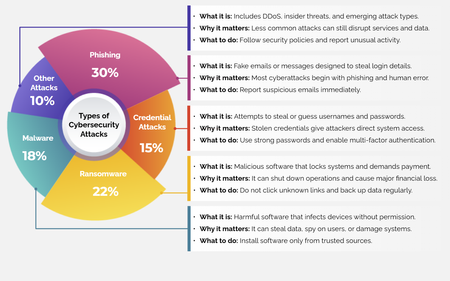
For this week’s challenge, we used snapshot graphics and a click-and-reveal interaction to help learners quickly recognize common cyber attacks—without overwhelming them. View the activity using the link below. https://www.swiftelearningservices.com/custom-elearning-snapshot-graphics-click-reveal-cyber-security-attacks/232Views2likes0CommentsMulti-Device E-Learning: What, Why, How?
Every day, more and more people rely on smartphones and tablets in their work and personal lives. Did you know that, on average, mobile users check their phones about 150 times a day? 1 Not only that, but 90 percent of full-time employees in the U.S. use mobile devices for work. 2 So it comes as no surprise that today’s learners expect their training content to be as portable as their devices. But does this mean you should abandon computer-based e-learning courses in favor of mobile ones? Not exactly. This article will help you understand the what, why, and how of multi-device e-learning. What Is Multi-Device E-Learning? When smartphones and tablets first started gaining popularity, e-learning designers wanted to create e-learning courses specially for these mobile devices. They called this e-learning spin-off “mobile learning” or “m-learning.” But after awhile, course developers realized that learners don’t need computer-only or mobile-only content. They switch from a smartphone to a tablet to a laptop and back again without blinking an eye. This reality about the way learners consume content is how multi-device learning—or online training that works on any device—was born! Why Should You Build Multi-Device E-Learning? Today’s learners don’t just want courses that work on smartphones, tablets, and computers. They expect it. They’re used to finding the information they need when they need it—whether they’re at home, at the office, or on the go. Creating multi-device e-learning is a great way to improve performance by expanding the reach of your training and empowering your learners to seek out the professional skills they’re lacking at the moment of need—just like they do in their personal lives. How Do You Create Multi-Device E-Learning? Lucky for you, modern authoring tools have evolved to the point where making multi-device e-learning is no more challenging than making computer-only e-learning. However, every app handles multi-device e-learning a little differently, so it’s important to do some research before committing. Apps like Rise 360 and Storyline 360, for example, allow you to keep building courses like you always have, taking care of cross-device compatibility for you in the background automagically. With Rise 360, you can create inherently responsive e-learning courses quickly and easily—no manual tweaking required! And with Storyline, you can author your slide-based course once, publish it, and it’ll automatically look great on any device. Be aware that some slide-based apps will require you to manually tweak each slide of your course to makes sure it works correctly on smaller devices—which can be a real time-suck. To help you evaluate the different multi-device authoring tools on the market, we created this comparison worksheet with the three main criteria you should consider. You may also want to check out this article for some additional, more general, things to think about when selecting e-learning software: Top 9 Considerations for Choosing the Right E-Learning Authoring Tool. Additional Resources After this introduction to multi-device e-learning, you may be feeling thirsty for more detailed information! If that’s the case, here are some other resources to help you take your knowledge to the next level: Articles Getting Started with Multi-Device E-Learning 4 Tips for Making Your E-Learning Course Content Mobile-Friendly What Is Responsive E-Learning and Why Does It Matter? Why Rise 360 Is a Kick-Butt Multi-Device Authoring Tool Comparing the Storyline 360 Responsive Player with Adobe Captivate’s Responsive Solution E-Book The Definitive Guide to Multi-Device E-Learning And remember to follow us on Twitter and come back to E-Learning Heroes regularly for more helpful advice on everything related to e-learning. If you have any questions, please share them in the comments.199Views0likes0Comments