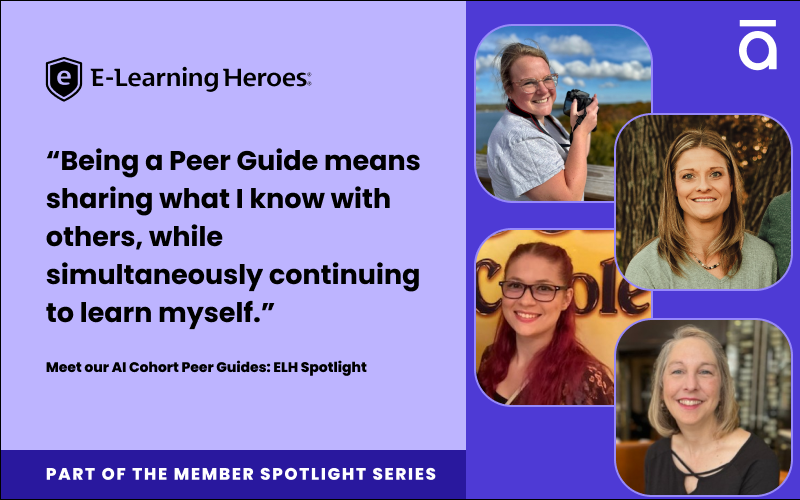
Many of you have seen buzz about our AI Assistant Certification Cohort , regardless if you have participated. Our second run of the program just wrapped up, and it’s safe to say that the biggest difference between these two sessions lies in the hands of four community members.
Our peer guides:
MelAngiulo SusanWhalen0822 lane_jacole & TaylorSakinsky-
What is a peer guide?
These are community leaders who help with community programs. Right now those programs are our AI Assistant Certification Cohort and Peer Pods. These initiatives are leveling up the way we learn in ELH by creating bite sized communities of practice. This increases peer to peer connection: they’re opportunities to learn not just with each other, but from each other. As these programs continue to grow we realized they needed one major improvement: peer leadership. That’s where these four community members come in!
Their journey to LD varies: from a recent M.S in Instructional Design (congrats Melissa!) to having left teaching middle school after 16 years (an incredible tenure, Jacole!). The path specifically to becoming a peer guide was more straightforward, as they all participated in the first AI cohort.
All four guides shared that filling this role was anything but a re-hash of their first experience. Rather, being a peer guide meant a front row seat to the variety, creativity, and possibilities that each participant brought to the assignment.
“We all had the same prompt, but it was fascinating to see how many different directions everyone took it in. There were some genuinely creative ideas and modifications that inspired me to try something new in my own work.” - Melissa“It's so fun to see everyone's take on the same task, and it shows just how truly unique we all are! The creativity was inspiring.” - Taylor
“I love the different color schemes, the images generated, and the creativity applied to the activity. It truly inspired me!” - Susan
“I saw some new ideas that I haven't seen before, and those submissions helped me grow as well!” - Jacole
The willingness to experiment with the assignment is just the surface of successful community based learning. Being open to resources, learning from others, sharing pain points (and of course bonding over pet pictures) are all central elements to maximizing the opportunity for personal growth in a learning community.
Taylor and Melissa emphasized the diversity of expertise in ELH, reminding us “lean on those around you” and that “we can all leverage and learn from one another.”
Jacole pointed out that “sometimes the best learning comes from the workarounds others have found and shared for their similar frustrations.” Susuan corroborated, sharing the reward of this is discovering “shared experiences, from our love of pets to the all-too-familiar challenge of getting AI to generate exactly the image we envision.”
Being intentional about openness to growth, to sharing, to learning with and from one another is a huge part of their success as peer guides. Another part is simply the joy of building up others.
When asked what being a peer guide meant to them there was a resounding consensus: they wanted to help and connect with the community.
“Stepping into the peer guide role gave me the opportunity to build meaningful connections with individuals across the global Articulate community.” -Susan
“I wanted to be a witness to the growth and trials of my peers, celebrate the wins no matter how big or small, and commiserate over any pain points.” - Jacole
“I thought it would be a great opportunity to help the next group of members navigate their experience.” - Taylor
“Being a Peer Guide means sharing what I know with others, while simultaneously continuing to learn myself.” - Melissa
And in the spirit of helping others by sharing what they know, each of our peer guides offered some advice:
- About using AI tools, make sure you check the final product.
- “As trained professionals, we have the expertise and responsibility to design effective courses—LLMs should be viewed as just another tool in our toolbox, not a replacement for our judgment.” -Susan
- What this looks like: integrating AI into your workflow means integrating a system of checks you might not have thought about before. The usual read-through for clarity, typos, and other common human errors should be joined by reviewing images, making sure quiz questions match the type of answers available, and keeping a library of prompts that are more effective than others.
- About ELH, explore the full extent of resources available
- “There are so many cool features and how-to videos that I wouldn't have known about if I didn't get an email about an "updated features walkthrough" or if I wasn't scrolling through the ELH resources.” -Melissa
- What this looks like: take advantage of our download library, ask for feedback on builds, and attend webinars whenever possible. Don’t hesitate to search for a keyword or interaction type- the well of knowledge here is deep.
- “Lean on those around you (and in the ELH community)! All of us come from varying backgrounds with different levels of experience, and none of us knows it all!” - Taylor
- What this looks like: reach out to your peers, pose questions about best practices, and specify if you think a certain lens will help you that you’re missing. Chances are high someone here has that perspective.
- About life outlook, stay in a growth mindset
- “There are always so many ways to grow when you are intentionally open to it.” - Jacole
- What this looks like: stay alert for opportunities to learn, to revisit things you once knew, and to share what you know now.
🌟Our peer guides are wonderful resources for advice, and we know there are many more in the community who just need the right chance to shine. If this is you, sound off in the comments with what you’d like to bring to the community! It can be an article, a build, or a community leadership position.
💬If you’re not ready for the spotlight, chime in below with what you believe is essential to learning in a community.