community
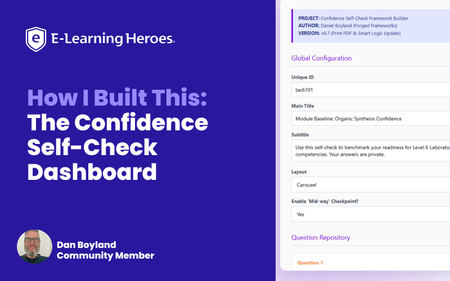
52 TopicsHow I Built This: The Confidence Self-Check Dashboard
What the Project Is The Confidence Self-Check Dashboard started with a challenge that many learning professionals will recognise: we're often very good at measuring learner perceptions at a single point in time, but much less effective at understanding the journey that got them there. Most confidence checks, smile sheets, and end-of-module surveys provide a snapshot. They tell us how a learner feels at the end of an experience, but they rarely show how much progress has been made between the starting point and the finish line. As learning designers, trainers, and educators, we're increasingly asked to demonstrate impact and effectiveness, yet many of our evaluation tools remain focused on isolated moments rather than measurable growth. The Confidence Self-Check Dashboard is an open-source framework designed to help visualise that growth. Learners can capture baseline, midpoint, and final confidence scores, creating a richer picture of progression across a programme, module, or learning journey. The system then visualises progress through checkpoints, historical tracking, and comparative reporting, helping learners and educators see not just where confidence sits today but also how it has evolved. What makes the project different is that the dashboard is only half of the solution. Built directly into the framework is a configurable Designer Mode that allows instructional designers, trainers, and subject matter experts to modify questions, scoring, weighting, feedback, and visual elements without touching the underlying code. Once configured, the framework can generate deployment-ready outputs for both standalone HTML environments and Storyline projects. For me, the project sits at the intersection of learning analytics, instructional design, and curiosity. It explores how we might move beyond static interactions and perception-based evaluation towards adaptable tools that not only support learning but help us better understand the impact of what we create. Why I Built This One recurring frustration I encounter as a learning designer is that many custom interactions end up as disposable solutions. They solve a problem for a specific programme, module, or client, but the moment somebody wants to adapt them, whether that's changing questions, adjusting scoring logic, updating feedback, or tailoring the experience for a different audience, the process often becomes disproportionately difficult. This isn't limited to Storyline. I've seen the same challenge across standalone HTML tools, JavaScript widgets, learning micro-applications, and community-shared frameworks. The learning community produces some incredible work, and I'm regularly inspired by the creativity on display. However, many of those solutions are understandably built to solve a specific challenge at a specific moment in time. Reusing them often means digging through code, unpicking logic, or rebuilding large chunks from scratch. At the same time, I was finding myself increasingly able to prototype ideas that previously would have stayed as scribbles in a notebook or half-finished thoughts in my head. That led me to a different question. Rather than repeatedly rebuilding interactions whenever requirements changed, could I create something that remained adaptable after development had finished? I became increasingly interested in building systems rather than outputs. Instead of creating another hardcoded interaction that would need future rebuilding, I wanted to explore whether the editing capabilities themselves could become part of the experience. The result was Designer Mode. Rather than expecting instructional designers, trainers, or subject matter experts to modify code, they could adjust questions, scoring, weightings, feedback, and configuration settings through a dedicated interface and generate deployment-ready outputs themselves. Ultimately, this project became an exploration of a broader idea: perhaps the most valuable thing we can build isn't the interaction itself, but the framework that allows other people to adapt it long after we've moved on. How I Built It The chronology of the project was actually quite different from what people might expect. It started with a community language-learning project where I was exploring how learners could benchmark their confidence over time using a simple Likert scale. At the time, I wasn't trying to build a framework. I was simply trying to create a better reflection point for learners. That evolved into a benchmarking dashboard, which I later adapted for quality management systems and professional development programmes. As the number of adaptations increased, I found myself repeatedly rebuilding or modifying the same interaction. The turning point came after sharing an earlier project with the Articulate community. Somebody asked a simple question (thanks to the E-Learning Heroes Community): "This is great, but how do I edit it myself?" That question stuck with me. The first version of Designer Mode was incredibly basic. It allowed users to configure the front and back of flip cards without touching the underlying code. Once that worked, I started asking questions: Could they change images? Could they update URLs? Could they alter scoring boundaries? Could they swap animations? Could they generate the code themselves? What started as a convenience feature gradually became the main project. At some point, I realised I wasn't really building interactions anymore. I was building frameworks that could generate interactions. The goal stopped being to build a better confidence tracker. The goal became building a system that could adapt itself. Once I made that mental shift, a lot of the design decisions suddenly became much clearer. My Development Workflow One thing I've learned is that my best ideas rarely arrive in a neat, structured format. They usually arrive as half-formed concepts, tangents, questions, and observations that need untangling before they become useful. Because of my dyslexia and dyscalculia, I often find it easier to explain concepts verbally than work directly with large blocks of code. Over time, I developed a workflow that helped translate those ideas into something more structured. ChatGPT often acted as a critical friend and sounding board. Gemini became my primary coding and debugging environment. Claude frequently challenged learner experience decisions, instructional design choices, and pedagogical assumptions. I also built a prompt generator that helped translate my often-discordant thought processes into something the various models could consistently understand and execute. Rather than generating code directly, it acted as a translation layer between ideas, constraints, learning requirements, accessibility considerations, technical limitations, and deployment requirements. One of the biggest lessons I learned was that prompting quality often mattered more than coding quality. I also learned very quickly that dirty context windows are real. The longer the conversations became, the more assumptions accumulated, and the more unpredictable the outputs could become. Managing context became almost as important as debugging. After what felt like the hundredth iteration, and probably wasn't far off, I finally realised I was solving the wrong problem: The challenge wasn't building a better interaction, it was making sure I didn't have to rebuild it again six months later. Exporting for Different Environments One of the design goals from quite early on was that I didn't want the framework tied exclusively to a single authoring tool. As a result, Designer Mode generates two separate deployment outputs. The first is a standalone HTML package that can be deployed independently and used outside of Storyline altogether. The second is a Storyline-compatible export. Rather than generating complete slides, the framework produces copy-and-paste-ready JavaScript that can be dropped directly into an Execute JavaScript trigger. The generated code sits behind a simple trigger, button, or slide event and handles the heavy lifting in the background. Supporting both outputs inevitably created additional testing and development effort, but it felt important that the framework remained flexible rather than becoming dependent on a single platform or workflow. Key Decisions & Trade-Offs One of the hardest parts of the project wasn't deciding what to build, it was deciding what not to build. There were plenty of moments where I could see an exciting next step. AI-generated learner feedback was one of them. Cloud storage was another. User accounts, enterprise integrations, reporting dashboards, and centralised administration all felt possible. But possible and sensible aren't always the same thing. AI-generated feedback sounds impressive until you remember that learners may act on that information. The last thing I wanted was a hallucinated recommendation confusing somebody or sending them down the wrong path. If that level of personalisation is going to happen, I think it belongs within a controlled organisational environment rather than inside an open-source learning widget. Cloud storage presented a similar challenge. Whilst it would unlock richer reporting and persistence, it also introduces authentication, security, GDPR considerations, APIs, hosting, maintenance, support requirements, and handover considerations. Very quickly, the project stops being a configurable learning tool and starts becoming a software platform. I had to keep reminding myself what problem I was actually trying to solve. The same challenge appeared within Designer Mode itself. Every new configuration option made the framework more powerful but also increased cognitive load. There is a point where flexibility becomes overwhelming. If somebody needs a developer sitting next to them to understand the configuration panel, I've probably failed. Sometimes the best design decision is leaving something out. 👉 Check out this build that exemplifies more of my design choices Why I Open-Sourced It The project is shared as open source because I genuinely believe we all stand on the shoulders of giants. That philosophy comes partly from learning design and partly from my blacksmithing hobby. Almost every forge project I've ever made has been inspired by somebody else's work, technique, or idea. Usually, somebody has already solved part of the problem before you arrive. The same is true in learning design: The more we share, the more we learn, the more we learn, the more we innovate. That's why the source framework, Designer Mode, and deployment outputs are all available for others to explore, adapt, and build upon. Not because it's finished, but because I hope somebody takes it somewhere I hadn't thought of yet. What I've Used It for Since Although the original use case focused on confidence benchmarking, the Designer Mode approach has quietly spread into a lot of my other projects. I've since added similar configuration layers to flip cards, quizzes, odd-one-out activities, swipe interactions, branching scenarios, media players, and other custom learning tools. Partly because it reduces build time, and partly because it reduces future maintenance. It also reduces the number of times I need to revisit the same problem. The framework can be adapted for: Skills audits Readiness assessments Professional development planning Reflective practice activities Learner self-assessment Progress check-ins What interests me most is that it turns what is often passive engagement into active reflection. Instead of simply consuming content, learners are asked to pause, think, and evaluate where they are right now. They feel included. Key Takeaways If there's one thing I'd encourage other instructional designers to take from this project, it's not that you need to become a programmer. You mustn't underestimate your ability to build. The tools available to us today mean that many of the barriers between an idea and a functioning prototype are lower than they've ever been. For me, the goal isn't to replace the work of learning design.It's to create more space for it. Less time wrestling with implementation. More time understanding learners. More time refining experiences. More time asking awkward questions. More time thinking. The biggest shift isn't that technology can generate code. The biggest shift is that instructional designers can now build tools, frameworks, and systems that previously required specialist development and teams. Use that opportunity wisely. Use it to remove the dross. Use it to reclaim time. And then spend that time doing the bits that humans are still brilliant at: creativity, empathy, reflection, judgement, and understanding what learners actually need. Ask Me Anything If you'd like to know more about the project, feel free to reach out or drop a comment below. I'm always happy to chat about generative AI in learning design, the successes, the pitfalls, and the occasional moments where everything goes wonderfully wrong. I'm also happy to talk about instructional design, learner engagement, accessibility, healthcare, accreditation, quality management systems, blacksmithing, or pretty much anything in between. Portfolio - Built with Claude Design and now hosted via GitHub Outside of learning design, you'll often find me metal-bashing in the forge, experimenting with new projects, or being supervised by my two feline quality inspectors, Tenacious D and Blackjack. Want to Share Your Build? Do you have a project you’d love to share with the community? We’re always looking for more How I Built This stories. Whether it’s a game, interaction, or unique design, we’d love to feature your process. Drop a note in the comments or reach out to the community team if you’re interested!824Views6likes13CommentsIntroducing ELH Rewards
What is ELH Rewards? ELH Rewards is a recognition and rewards program that celebrates the many ways members contribute to the E-Learning Heroes community. Whether you're answering questions, sharing examples, participating in challenges, or helping others learn, ELH Rewards is designed to highlight and reward the impact you're making in the E-Learning Heroes community. Scroll to the bottom of this page to register for ELH Rewards! Already registered? Head to the ELH Rewards group → How ELH Rewards Works 1 Participate in the Community Engage in ways that help others learn, solve problems, and grow their skills or knowledge. Think answering questions or offering thoughtful feedback, sharing examples or templates, participating in challenges, joining programs. 2 Earn Recognition and Rewards As you participate, your contributions are awarded points. The culmination of your points places you in a specific tier. Each tier offers specific recognition and rewards as a thank you for your engagement and contributions to the E-Learning Heroes community. 3 Grow With the Community ELH Rewards is designed to support long-term participation. As you continue contributing, you'll see your progress reflected through recognition and new opportunities to get involved. Our hope is that being involved in ELH Rewards provides you with opportunities for growth and development. Why Participate? ★ Recognition & Visibility Get noticed for the work you share, so others see your ideas, expertise, and contributions. ★ Meaningful Rewards Earn tangible perks and exclusive opportunities. Think raffle entries, priority event invites, etc. ★ Connect & Grow Build your skills and knowledge by engaging with resources, conversations, and programs that help you learn and improve. What Counts as Participation? Posting a new discussion thread Responding to existing discussion threads Participating in community programs Volunteering to be a peer guide Hosting a webinar Current Status ELH Rewards is just getting started! We’re actively learning from member activity and feedback, making adjustments along the way. Your input matters and we’ll keep you posted on changes and new features. Stay in the loop in the ELH Rewards group. Ready to be Part of ELH Rewards?1.2KViews2likes1Comment- 454Views2likes3Comments
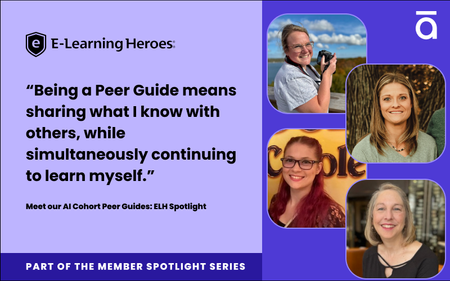
Community Insights: Peer Guide Spotlight
Many of you have seen buzz about our AI Assistant Certification Cohort , regardless if you have participated. Our second run of the program just wrapped up, and it’s safe to say that the biggest difference between these two sessions lies in the hands of four community members. Our peer guides: MelAngiulo SusanWhalen0822 lane_jacole & TaylorSakinsky- What is a peer guide? These are community leaders who help with community programs. Right now those programs are our AI Assistant Certification Cohort and Peer Pods. These initiatives are leveling up the way we learn in ELH by creating bite sized communities of practice. This increases peer to peer connection: they’re opportunities to learn not just with each other, but from each other. As these programs continue to grow we realized they needed one major improvement: peer leadership. That’s where these four community members come in! Their journey to LD varies: from a recent M.S in Instructional Design (congrats Melissa!) to having left teaching middle school after 16 years (an incredible tenure, Jacole!). The path specifically to becoming a peer guide was more straightforward, as they all participated in the first AI cohort. All four guides shared that filling this role was anything but a re-hash of their first experience. Rather, being a peer guide meant a front row seat to the variety, creativity, and possibilities that each participant brought to the assignment. “We all had the same prompt, but it was fascinating to see how many different directions everyone took it in. There were some genuinely creative ideas and modifications that inspired me to try something new in my own work.” - Melissa “It's so fun to see everyone's take on the same task, and it shows just how truly unique we all are! The creativity was inspiring.” - Taylor “I love the different color schemes, the images generated, and the creativity applied to the activity. It truly inspired me!” - Susan “I saw some new ideas that I haven't seen before, and those submissions helped me grow as well!” - Jacole The willingness to experiment with the assignment is just the surface of successful community based learning. Being open to resources, learning from others, sharing pain points (and of course bonding over pet pictures) are all central elements to maximizing the opportunity for personal growth in a learning community. Taylor and Melissa emphasized the diversity of expertise in ELH, reminding us “lean on those around you” and that “we can all leverage and learn from one another.” Jacole pointed out that “sometimes the best learning comes from the workarounds others have found and shared for their similar frustrations.” Susuan corroborated, sharing the reward of this is discovering “shared experiences, from our love of pets to the all-too-familiar challenge of getting AI to generate exactly the image we envision.” Being intentional about openness to growth, to sharing, to learning with and from one another is a huge part of their success as peer guides. Another part is simply the joy of building up others. When asked what being a peer guide meant to them there was a resounding consensus: they wanted to help and connect with the community. “Stepping into the peer guide role gave me the opportunity to build meaningful connections with individuals across the global Articulate community.” -Susan “I wanted to be a witness to the growth and trials of my peers, celebrate the wins no matter how big or small, and commiserate over any pain points.” - Jacole “I thought it would be a great opportunity to help the next group of members navigate their experience.” - Taylor “Being a Peer Guide means sharing what I know with others, while simultaneously continuing to learn myself.” - Melissa And in the spirit of helping others by sharing what they know, each of our peer guides offered some advice: About using AI tools, make sure you check the final product. “As trained professionals, we have the expertise and responsibility to design effective courses—LLMs should be viewed as just another tool in our toolbox, not a replacement for our judgment.” -Susan What this looks like: integrating AI into your workflow means integrating a system of checks you might not have thought about before. The usual read-through for clarity, typos, and other common human errors should be joined by reviewing images, making sure quiz questions match the type of answers available, and keeping a library of prompts that are more effective than others. About ELH, explore the full extent of resources available “There are so many cool features and how-to videos that I wouldn't have known about if I didn't get an email about an "updated features walkthrough" or if I wasn't scrolling through the ELH resources.” -Melissa What this looks like: take advantage of our download library, ask for feedback on builds, and attend webinars whenever possible. Don’t hesitate to search for a keyword or interaction type- the well of knowledge here is deep. “Lean on those around you (and in the ELH community)! All of us come from varying backgrounds with different levels of experience, and none of us knows it all!” - Taylor What this looks like: reach out to your peers, pose questions about best practices, and specify if you think a certain lens will help you that you’re missing. Chances are high someone here has that perspective. About life outlook, stay in a growth mindset “There are always so many ways to grow when you are intentionally open to it.” - Jacole What this looks like: stay alert for opportunities to learn, to revisit things you once knew, and to share what you know now. 🌟Our peer guides are wonderful resources for advice, and we know there are many more in the community who just need the right chance to shine. If this is you, sound off in the comments with what you’d like to bring to the community! It can be an article, a build, or a community leadership position. 💬If you’re not ready for the spotlight, chime in below with what you believe is essential to learning in a community.416Views2likes5CommentsSign Up for the E-Learning Heroes Newsletter
E-Learning Epiphanies is now E-Learning Heroes Weekly! Do you love all the helpful content here on E-Learning Heroes? If so, you should subscribe to our newsletter, E-Learning Heroes Weekly, to stay up-to-date on all the inspiring examples, insightful articles, and valuable tips shared in the community. You'll even get information about upcoming webinars, industry, and Articulate events, so you never miss out on an opportunity to grow your skills or connect with the Articulate team. Sound like something you’d like to see in your inbox on a weekly basis? Sign up here. We hope you’ll love it as much as we do!4.3KViews4likes1CommentMade by Members: Sneak a Peek at Speakers and Sessions for Articuland Orlando
Made by Members celebrates creativity, inspiration, and the incredible work shared right here in the E-Learning Heroes Community. This month, we’re turning the spotlight on a few of the faces who’ll take the stage at Articuland Orlando 2026! From design innovators to accessibility champions, these members have been sharing ideas, building connections, and inspiring others long before the event, and now, they’re bringing that same energy to the Articuland stage. 👉 Register Now! 🎤 Featured Speakers ✨Destery Hildenbrand — Instructional Designer, Green State Credit Union 🔗 View their projects 💬Session: Vibe Coding Scenario-Based Games in Rise “Most instructional designers assume building interactive learning games requires a developer—it doesn't. This session walks through a practical vibe coding workflow where you focus on learning design and interaction structure while AI generates the underlying code, then embeds it directly into Rise. You'll leave with working game templates, reusable AI prompts, and a repeatable process for building scenario-driven interactions—branching decisions, feedback-driven choices, and timed challenges—that reinforce real workplace behaviors without requiring a single line of handwritten code.” ✨Jean Marrapodi — Senior Instructional Designer, UMB Bank 🔗 View their projects 💬Session: Technical Training That Engages: Leveraging Character Stories and Interaction for Sticky Learning “How do you get Gen Z learners engaged with a legacy DOS-based mainframe system they've never seen before? This session shows how storytelling, quirky characters, and interactive design can transform dry technical content into something learners actually remember—using Storyline to bring it all together with a mix of static images, animations, stock photos, and AI-generated visuals. You'll leave with practical techniques for developing character personalities, building narrative around technical content, and adding interactions that get learners predicting and practicing—not just watching.” ✨Timothy Frost — Supervisor, IT Digital Learning, Orlando Health 🔗 View their projects 💬Session: Stop Showing. Start Doing. Building Practice-First Learning in Storyline “Most e-learning gives learners information—what it rarely gives them is experience. This session shows how to use Storyline to build interactive environments where learners do the work, make mistakes, and build real confidence before it counts—whether you're training on software, workflows, compliance, or onboarding. You'll leave with reusable templates, a framework for identifying where practice-based interactions belong in your own work, and a new benchmark for what effective training looks like when the goal is performance, not just completion.” ✨Karin Rex — Chief Geek, GeekyGirl LLC 🔗 View their projects 💬Session: Words Matter: The Language of Belonging “Inclusive writing isn't a courtesy—it's a core professional skill for anyone building content for a diverse workforce. This session combines a hands-on game that introduces common non-inclusive writing hazards—cultural insensitivity, mental health stigma, neurodiversity exclusion, and more—with a practical five-part framework for recognizing and correcting them. You'll leave with a repeatable method for auditing your own writing and a sharper eye for language that unintentionally excludes.” ✨Yvonne Urra-Bazain — Senior E-Learning Developer, Briljent, alawa 🔗 View their projects 💬Session: Streamlining in Storyline: Turn the Media Library into Your Control Center “Most Storyline users treat the Media Library like a catalog—but it's actually one of the most underused productivity tools in your project. This session shows you how to use it intentionally: organizing and auditing assets, eliminating duplication, optimizing file size, managing characters, and supporting accessibility workflows—including practical strategies for editing media externally and reintegrating it smoothly. You'll leave knowing how to make the Media Library do real work across every project you build.” 🌍 See more of the Articuland 2026 Lineup These are just a few of the inspiring voices you’ll hear this year. 👉 Explore the list of Articuland 2026 speakers*. *All speakers and subjects are subject to change.576Views3likes1Comment