Forum Discussion

FLaM∞ Made Visible — The Structure Beneath Learning
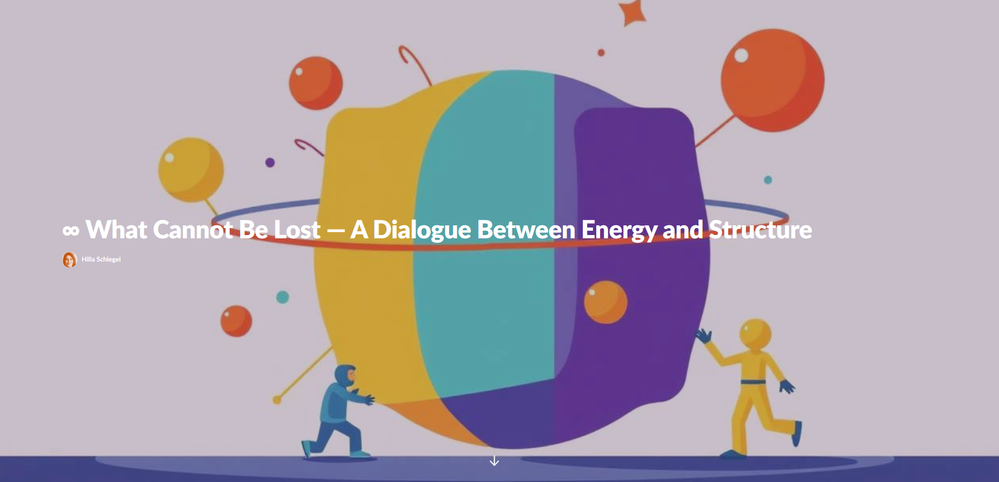
Recently, I had the pleasure of hosting a guest webinar for the Articulate Community, where I introduced FLaM∞.
FLaM∞ is not a method, but a universal structure underlying all learning experiences. To make it visible, the right language is essential — as demonstrated in my webinar through concepts like Subgoals, Functional Layers, and Layer Mapping, following the Double Diamond Method.
For a long time, I’ve explored how to describe learning experiences uniformly, studying many e-learning formats. This fundamental structure became clear to me especially while preparing my FrogGame webinar introduction.
Although it’s not documented in the webinar materials, I had already emphasized to DavidAnderson before the session how crucial I consider FLaM∞ — a clarity that also helped refine the FrogScenario.
I compare FLaM∞ to the law of conservation of energy — a universal principle discovered late because its concept had to be developed first; even Newton himself did not know the concept of energy as we understand it today — the language and the idea simply didn’t exist in his times.
FLaM∞ is a structure, a grammar, and a logic to develop and diagnose any learning experience and e-learning content. The concluding graphic in the demo (link below the text) summarizes this elegantly.
I recognize that FLaM∞ may still be unfamiliar to many. That’s why I share it not as a claim, but as a discovery — one that emerged from long-term observation, structural analysis, and cross-format comparison. Like energy, it needed the right language to become visible. I welcome dialogue and feedback, and I am currently working on documentation to make FLaM∞ accessible — not just as a tool, but as a grammar for designing and diagnosing learning experiences.
I apologize for the missing webinar introduction and description; perhaps DavidAndersonmight consider adding these, as I cannot edit the resource page.
In this demo, you can also explore the new Rise code block featuring an interactive mass-spring system, alongside a comparison between the great energy conservation law and FLaM∞ — a foundational framework for e-learning experiences.
I’m deeply proud of this work and excited to share it.
2 Replies
HillaSchlegel This is fascinating, thank you for sharing your insights and framework!
I’d love to hear how others interpret or apply this framework. Has anyone explored similar structural approaches to designing e-learning experiences?
- HillaSchlegelCommunity Member
Katie-Jordan Thanks, good question! I haven’t come across an identical structural approach that explicitly separates functional layers from tool features in this way.
FLaM∞ grew out of my own attempt to bring more structural clarity into real e-learning builds.I originally submitted a more detailed description of FLaM∞ for the webinar, which didn’t make it into the final framing. So I’m sharing it here for clarity and documentation.
The simplicity is intentional. Underneath it sits a structured decision logic, from defining subgoals, to clarifying cognitive intent, to mapping functional layers in a disciplined way.
I’m continuously refining the model through real builds, not just theory and that’s where it really proves (and improves) itself.

Related Content
- 1 year ago