interactivity
4 TopicsRisk Quest: Investigator Training
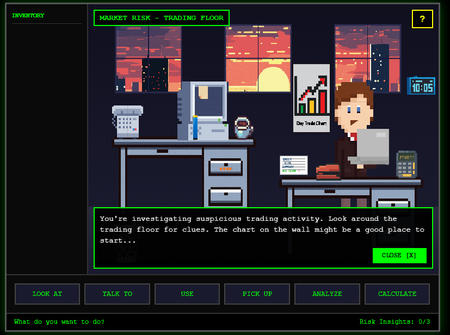
Code Block Experience Inspired by the old point-and-click adventure games, I wanted to build a simulation-style experience that lets learners have fun while actually practicing investigation skills. In this scenario, you step into the role of a newly assigned Risk Investigator trying to figure out why financial projections don’t match real-world returns. Projects like this usually don’t happen. Not because they aren’t valuable, but because they take time, money, and resources that most teams just don’t have. Fast builds are expected. Games are not. So instead of waiting for the perfect conditions, I used Rise Code Blocks, ChatGPT, stock images, and a lot of trial and error to build a playable proof of concept the team could realistically evaluate. The Risk Quest demo puts you directly in the investigation. You explore the environment, pick up and use objects, connect the dots, and report back what you’ve uncovered. If you’re not paying attention, you’ll miss things. That’s intentional. The project is broken into three parts: Risk Quest Demo Play the experience. Be the investigator. Figure out what’s going on. Risk Quest Evolution Walk through how the project evolved from v1 to the current POC. You can see what changed, what stuck, and what ideas didn’t survive contact with reality. Hidden Assets All of the graphics used in the experience and how they were stored and referenced directly in the Code Block as the look and feel evolved. And yes, this whole thing is heavily influenced by nostalgia. Did anyone else play these growing up? Zak McKracken and the Alien Mindbenders, Maniac Mansion, Sam and Max, Indiana Jones and the Fate of Atlantis, and my personal favorite, Monkey Island as Guybrush Threepwood. 😁 Take a look, share feedback, swap a memory or two, and enjoy.628Views11likes3CommentsCustom Tab Interaction (Code Block)
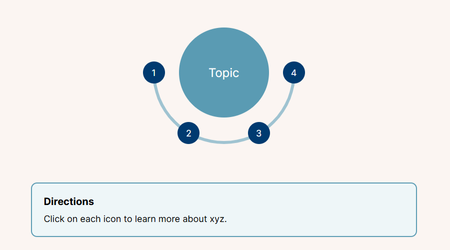
Link to Example For this Code Block Build-a-thon, I wanted to experiment with translating a custom tab interaction I originally built out in Storyline into a reusable code block for Rise. My goal was to create a version of the interaction that doesn't require Storyline experience so others can easily use it in their courses. I walk through my step-by-step process of prompting AI to show how I approached building and refining the interaction. A copy of the code is available at the end of the course.805Views5likes3CommentsCMY Mix Lab
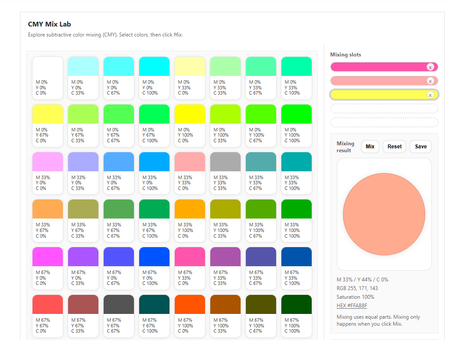
An experiment in pushing Articulate Rise beyond fixed variables and linear flows. What this is The CMY Mix Lab is an interactive experiment built in Articulate Rise to explore what happens when you are no longer limited to a fixed set of variables. Unlike standard Rise blocks, and even compared to Storyline, this approach allows for a virtually unlimited number of variables and states within a single interaction. For this challenge, I wanted to build something that cannot be created in Rise in any other way. The mixer relies on continuously changing values, combinations, and outcomes rather than predefined slides, layers, or triggers. Everything happens inside one custom block, driven by logic. How it was made Full transparency: I’m not a programmer. This project was very much vibe coded. I built it by experimenting, tweaking values, breaking things, and fixing them again with the help of AI and a lot of curiosity. Working this way felt very different from building in Storyline or standard Rise blocks. Instead of defining all states upfront, the interaction reacts to whatever values the learner creates in the moment. That shift in thinking was a big part of the experiment. The challenge One of the biggest challenges has been (and still is) accessibility. Mouse interaction works well, but I do not have a stable, fully keyboard-accessible version to show you yet. Improving this is something I am actively working on and continuing to refine. This challenge is also part of what makes the project interesting to me. It clearly shows both what Rise can already do and where its current limits are, especially when you start working with many dynamic variables. Why this build This build is not about delivering a perfect or finished solution. It is about exploring possibilities, learning by doing, and testing how far you can push Rise without relying on Storyline or predefined interaction patterns. If this experiment inspires other Rise users to think differently about variables, logic, or custom code, then it has done exactly what I hoped it would do. Vote If you like this experiment or find the idea behind it interesting, I’d really appreciate your vote. https://share.articulate.com/aWvCo417oehOA2FTwbHLA Oh... one last thing! Try mixing with "white". You'll be surprised. :D145Views3likes0CommentsRIVE animations in Storyline
I was curious if anyone has used RIVE for interactive elements in Storyline. I know they can be imbedded in the JavaScript, but I was wondering if you could use the listeners for interactivity within a Storyline project. Any guidance would be appreciated. I'm not sure if I'm barking up the wrong tree or not.233Views1like0Comments