rise 360
3 TopicsMeet Your Instructor - Which One Is the Lie?
I built this quick “Meet Your Instructor” interaction for the latest eLearning Heroes challenge. The interaction is a simple truth-or-lie icebreaker where learners review three statements about the instructor and decide which one is false. I designed it with a heavy equipment/construction theme and included custom visuals, themed buttons, correct/incorrect feedback screens, and a short video introduction and conclusion featuring me as the instructor. What I like about this concept is that it could work both virtually and in person. In an eLearning course, learners can click through and make their own choice. In a live class, a facilitator could use the same interaction as a quick group icebreaker before moving into the session. It’s a small activity, but it adds some personality, gives learners a reason to engage right away, and helps make the instructor feel a little more human before the course begins.15Views0likes0CommentsBack In My Day
Hello! Icebreaker games get a bad rap in corporate training. But I think Articulate's AI Avatar feature can breathe new life into this format. For this Futurama-inspired demo, I created a series of videos using the 'Upload Character' option in the Rise AI Avatar tool. Then I downloaded these videos and placed them in a 'Pick One' freeform question slide in Storyline. Your answer determines how my avatar responds. Try it out here: https://bit.ly/elhc553 55Views1like1Comment
I Asked AI to Help Me Build Team Games. I Didn't Stop at One.
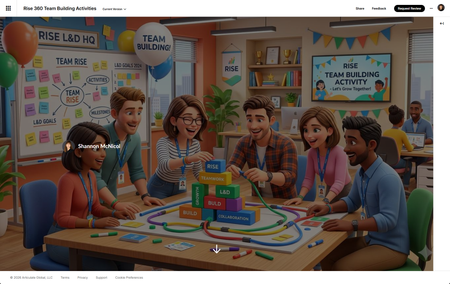
Let me set the scene. I've got a team building meeting coming up. I wanted something engaging — not another "share two truths and a lie" moment that makes everyone stare at the ceiling. I wanted something that actually gets people talking, laughing, maybe even a little competitive. You want a game. 🎮 But I also had approximately zero hours to build one from scratch. Sound familiar? Here's what I did instead: I opened a conversation with AI, described what I was going for, and started building. And somewhere between "let's make it facilitator-led" and "can you add confetti when someone scores a point" I didn't end up with one game. I ended up with five. The Process Was the Whole Point I didn't sit down with a grand master plan to build a game library. I started with a simple goal: create something fun for a L&D team building session that didn't require everyone to download an app, log into a platform, or remember a join code. The constraint? It needed to live in Rise 360 as a Code Block self-contained, no dependencies, ready to run on one shared screen. What I didn't expect was how fast 🏎️ the ideation loop would move. Describe a concept, see it rendered, react to it, refine it. Across a few sessions, that loop produced five fully playable games: L&D Jeopardy: Five categories of industry-specific clues that hit a little too close to home (SME Confessions, anyone?) AI Confessional: A L&D edition where the real answers might surprise you Prompt Lab: A game that actually reinforces AI prompting skills while everyone thinks they're just playing L&D Quest: Virtual Trivia Pursuit: Because our field deserves its own trivia championship The Case of the Vanishing Keynote: A mystery game so relatable it hurts Five games. Multiple sessions. No dev team. No budget line item. What Made It Work A few things I learned along the way that made the process actually fun instead of frustrating: Start with the vibe, not the mechanics. Before I said a word about HTML or JavaScript, I described the energy I wanted: laugh-out-loud, low stakes, facilitator-led, one screen for 20 people. That framing shaped every design decision that followed. React out loud. The fastest iterations happened when I said exactly what I saw — "the modal is off to the left," "the text isn't readable," "this needs more wow factor." Specific feedback beats vague dissatisfaction every time. Let it surprise you. I came in asking for Would You Rather. I left with Jeopardy complete with a starfield background, confetti cannons, animated score bumps, and a facilitator answer key. The AI brought ideas I wouldn't have thought to ask for — and some of them were the best parts. The Real Takeaway for L&D We talk a lot about engagement in learning design. We spend weeks building branching scenarios and interactive modules trying to manufacture the thing that games create naturally: people want to play. What this experiment reminded me is that the barrier to building game-based learning experiences is lower than it's ever been — not because the craft got easier, but because the tools got smarter. You still need to know your audience. You still need to write questions that land. You still need to make judgment calls about what's too complex and what's just right. But the part where you stare at a blank HTML file at 11pm wondering how to center a div? That part you can skip now. Try It Yourself If you've got a team meeting coming up, a training session that needs a warm-up, or just a burning desire to ask your colleagues whether they'd rather deal with a hands-off SME or a micromanaging one — build the game. Describe the vibe. Pick a format. React to what you see. Iterate. You might sit down to build one game and walk away with five. Built in Rise 360 using Code Block. AI-assisted development across multiple sessions. No divs were harmed in the making of these games. 🐵 Rise 360: Team Building Activities42Views0likes0Comments