svg
8 TopicsRace Back To Base
Hello! Can you make it back to base before the sandstorm hits? Play now. The thing I really love about working with vectors is how scalable they are. Even the tiniest details remain crystal clear when you scale them up. I built this demo using elements from a single vector pack created by Macrovector on Freepik. To create the illusion of movement, I used PowerPoint to recolour the wheels on the Mars Rover vehicle, and isolated parts of the tyre track. I then made a GIF using these shapes. And then placed the GIF over the modified SVG image in Storyline. This allowed me to turn the motion on/off using state changes. Pretty much everything that moves in this demo is a GIF, tucked away in a state change until it's needed. Having access to high-quality, easy-to-use graphics allowed me to focus on the instructional elements and the scoring mechanic. The 'wronger' your answer, the quicker your oxygen will deplete. Even if you reach the third question, if your oxygen hits zero, you will have to start again. This is controlled by JavaScript, which adjusts the value of the variable by a set amount when triggered. var player = GetPlayer(); var penalty = 35; // Change to 45 or 55 depending on the button var battery = player.GetVar("Battery"); var elapsed = 0; var interval = 100; var steps = 10000 / interval; var amountPerStep = penalty / steps; var timer = setInterval(function() { elapsed++; battery = Math.max(0, battery - amountPerStep); if (battery === 0) { player.SetVar("Battery", 0); clearInterval(timer); } else if (elapsed >= steps) { player.SetVar("Battery", Math.round(battery)); clearInterval(timer); } else { player.SetVar("Battery", Math.round(battery)); } }, interval); The eagle-eyed among you will have also noticed that when this demo runs on a desktop, the closed captions that accompany the narration have been repositioned and have a slight 'glitch' effect as they appear. This is also achieved with JavaScript. Despite the recent improvements to the closed caption feature in Storyline, sometimes I prefer to manually override the position of the captions to better suit my layout. This code only reliably works in desktop view, though. const mobileView = window.innerWidth < 768 || window.innerHeight < 500; var storyW = 1280; var storyH = 720; var boxLeft = 850; var boxTop = 430; var boxWidth = 350; var boxHeight = 200; var captionFontSize = 20; function positionCaptions() { if (mobileView === true) { console.log("Mobile view detected - caption positioning skipped."); return; } var leftPct = (boxLeft / storyW * 100).toFixed(2) + "%"; var topPct = (boxTop / storyH * 100).toFixed(2) + "%"; var widthPct = (boxWidth / storyW * 100).toFixed(2) + "%"; const css = ` .caption-container { position: absolute !important; transform: none !important; } .caption { position: absolute !important; left: ${leftPct} !important; top: ${topPct} !important; width: ${widthPct} !important; font-size: ${captionFontSize}pt !important; transform: none !important; z-index: 1000 !important; } @keyframes glitchstutter { 0% { opacity: 0; transform: translate(-10px, 4px) skewX(-8deg); filter: blur(6px); } 8% { opacity: 0.8; transform: translate( 10px, -4px) skewX( 9deg); filter: blur(3px); } 12% { opacity: 0; transform: translate(-8px, 2px) skewX(-6deg); filter: blur(7px); } 18% { opacity: 0.9; transform: translate( 8px, 3px) skewX( 6deg); filter: blur(1px); } 22% { opacity: 0.1; transform: translate(-12px, -2px) skewX(-10deg); filter: blur(5px); } 28% { opacity: 1; transform: translate( 6px, 0px) skewX( 4deg); filter: blur(1px); } 35% { opacity: 0.3; transform: translate(-6px, 4px) skewX(-6deg); filter: blur(3px); } 42% { opacity: 1; transform: translate( 4px, -2px) skewX( 3deg); filter: blur(1px); } 50% { opacity: 0.6; transform: translate(-3px, 1px) skewX(-2deg); filter: blur(1px); } 60% { opacity: 1; transform: translate( 2px, 0px) skewX( 1deg); filter: blur(0px); } 75% { opacity: 0.95; transform: translate(-1px, 0px) skewX( 0deg); filter: blur(0px); } 100% { opacity: 1; transform: translate( 0px, 0px) skewX( 0deg); filter: blur(0px); } } .caption-glitch { animation: glitchstutter 0.6s ease-out forwards !important; } `; let style = document.getElementById('custom-caption-style'); if (!style) { style = document.createElement('style'); style.id = 'custom-caption-style'; document.head.appendChild(style); } style.textContent = css; var capEl = document.querySelector('.caption'); if (capEl) { var observer = new MutationObserver(function(mutations) { mutations.forEach(function(mutation) { capEl.classList.remove('caption-glitch'); void capEl.offsetWidth; capEl.classList.add('caption-glitch'); }); }); observer.observe(capEl, { childList: true, subtree: true, characterData: true }); capEl.classList.add('caption-glitch'); } console.log(`Captions positioned at left:${leftPct} top:${topPct} font:${captionFontSize}pt`); } document.addEventListener('DOMContentLoaded', positionCaptions); positionCaptions(); I had a lot of fun making this. It still surprises how much mileage you can get from a small number of visual assets. If you have any more questions about this demo, please ask.
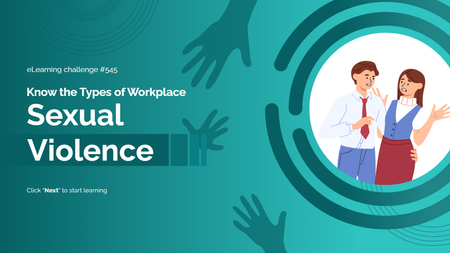
Build awareness. Promote safety. Empower action.
An engaging eLearning module designed using vector graphics and microlearning to help learners recognize workplace sexual violence and respond appropriately. Check it out: https://www.brilliantteams.com.au/vector-graphics-elearning-workplace-sexual-violence-training/Childhood Wonder: A Journey to Wellness
Hi everyone! I am Tiffoni, a health educator, licensed massage therapist, and instructional designer based in Dallas, Texas. My background sits at the intersection of wellness, adult learning, and community and I am currently building my ID portfolio while transitioning fully into the L&D space. This is my first Rise challenge submission. I worked with a photo of kids in Canva, separating the individual children from the original image and using them across slides to create a cohesive visual thread throughout the build. The result is a short micro-learning called Childhood Wonder: A Journey to Wellness. I am excited to keep experimenting and I have my eye on PowerPoint animations and adding more movement to future builds. Looking forward to learning from this community and growing alongside everyone here. Here is my first ever: Childhood Wonder Connect with me on LinkedInEffective Email Writing Skills
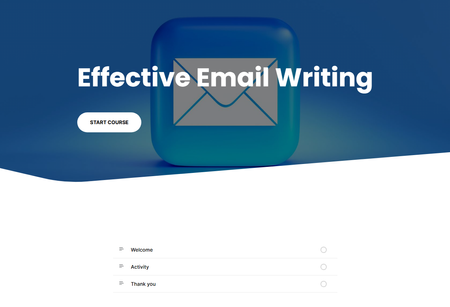
We focused on creating a simple and engaging learning experience using vector graphics and microlearning design. The goal was to make workplace communication training: Easy to understand Visually appealing Practical to apply Built in Articulate Rise 360 with simple interactions. View the sample: Email Writing Skills Training | Custom eLearning CourseVector Graphics for Onboarding
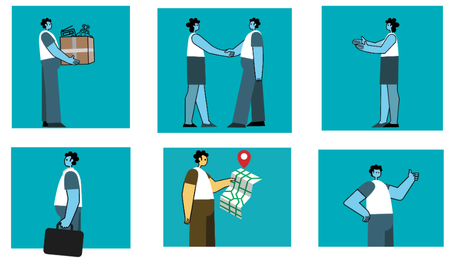
I created a custom library of vector-based characters to support an onboarding course, ensuring a consistent visual style aligned with the overall learning experience. Using Adobe Illustrator, I designed scalable assets that could be easily adapted across different modules and scenarios. To enhance engagement, I then imported these assets into Adobe Animate, where I developed simple, purposeful animations that added motion and personality without distracting from the instructional content. This approach allowed me to maintain visual consistency while introducing dynamic elements that helped bring the onboarding experience to life. LinkSVGs not loading in Rise (again!)
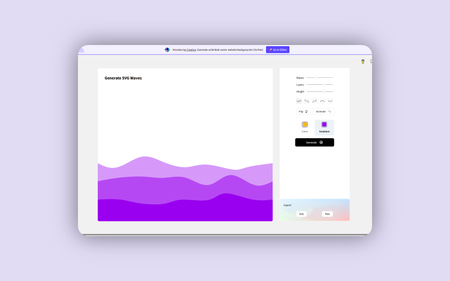
Hi - I've already put in a Case about this but not had an answer yet. A few months back SVGs stopped loading properly after an update and it's an issue again. An urgent one. If someone would look into this a.s.a.p. it'd be great. Thanks.Solved566Views1like4Comments