e-learning essentials
64 TopicsAudio-Button functions and states within selfbuild WBT menue and options
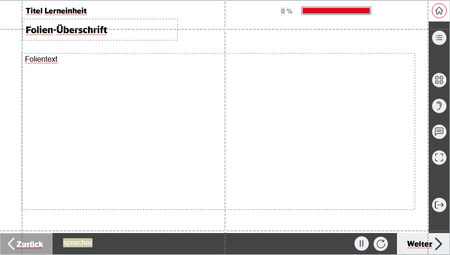
Hi everyone, currently I am working on a selfbuild WBT menue with own options on buttons (like refresh, fullscreen, turn on/off subtitles, etc.). This also includes a button for un/muting audio. (Screenshot "Menue 1") Until now I tried a lot; made my way through own ideas, tutorials in various forum posts or videos, asked colleagues, tried prompts in Copilot and so on. The thing is, I always get stuck evertime at the same point. Therefore, I am reaching out to you in hope that you can help me out. My setup is the following - first slide in master slide view: I have a button that consists of these elements grouped together: a circular “Ellipse” element, and above it a vector graphic of an ear. This vector graphic has the normal state (regular ear Icon) and the state selected (ear Icon crossed out). (Screenshot Icon states) The Ellipse has also a second state for hovering with a slight shadow around the circle. Then, to make things even a little bit more complicated, when the user can either click this button directly from the side menue. But if they navigate to the "Menue"-Button, the side menue will expand, laid out on another layer (Screenshot "Menue 2 Expanded"). Next to each button is a section reading the function of the button and thanks to a hotspot over each section, it is also clickable. So the button must be functioning and changing it's states in both ways: regular menue and expanded menue - and from the expanded menue as well. Goal; what should be the effects by clicking the Audio button? As soon as the user clicks on the button group, the audio on the slide should be muted and the state of the vector graphic should change: an ear crossed out. When the user clicks this button again, the audio should be unmuted, and the vector graphic should return to its original state (the normal ear). So, the audio should not be stopped and resumed: The audio should be "playing" without sound in the background with continuous timeline. A slide can also contain multiple consecutive audio files that play one after the other. The audio button un/mutes all of them when the user clicks the button. And when the user moves to the next slide, the WBT should remember that the selected function (audio is turned off/on) and show the ear icon accordingly (as crossed out/normal). Point 3 and 4 shall also apply for the audios of videos: So the video-part is still going on while the audio can be muted/unmuted. --> To make it trickier: This should also work for the case when there are audios and videos on one slide. Hay anyone an idea how to solve this riddle and incorporate all the required speficiations? I would be beyond grateful. Thanks in advance Best regards23Views0likes2CommentsHow to set up spaced learning for e-learning
Hi there! I've read a lot about spaced learning, and I'm all in - but I'm at a loss on how to actually do it. I typically use Rise with some Storyline blocks embedded. I'm hoping to make multiple scenarios and space them out, but I don't know how to actually do this. I'm thinking the learner would be able to do a max of 2-3 per day, then it would be "locked" for 24 hours until they can do more. I don't know how that would be feasible, so I'm open to creating multiple microlearnings where they automatically get assigned the next one 24 hours after completing the previous one. Is this possible with Storyline? Or is this something that needs to be set up using the LMS? (We use Absorb). Thank you!40Views0likes2CommentsRedesigning Under Constraints: Condensing 8 Hours of Training into a 1-Hour eLearning Module
In most projects, SMEs provide slides, facilitator guides, or at least some documentation. In this case, I received none. The request was to convert a full-day (7–8 hour) onboarding workshop into a 1-hour e-learning course. Instead of materials, I was invited to attend the live session as if I were a new hire. The onboarding itself was highly activity-based (discussions, reflections, group exercises...). As a training workshop, it worked well, but that's exactly what made the conversion harder. The real challenge was this: How do you compress a full day of experiential learning into one interactive hour without simply digitizing the activities? That alone would have been enough to deal with. But then another constraint surfaced. The original workshop had been designed by an external consulting firm. Leadership later raised concerns about copyright and ownership. I was instructed not to replicate or closely resemble any of the original activities, even the ones that had consistently received the best feedback. That meant redesigning everything from first principles. How I decided what to keep from the 8-hour workshop Rather than starting with the activities themselves, I focused on understanding what the workshop was really trying to achieve. Observing the learning intent behind each activity While attending the workshop, I paid close attention to several things: * What the company expected learners to gain from each activity * What learning goals those activities were meant to support * How participants reacted during the session and what feedback they shared After the workshop, I asked the HR what they had observed from employees who previously completed the onboarding? Which behaviors seemed to reflect the intended outcomes, and where they still noticed gaps? One question I specifically asked was: What behaviors or thinking patterns do you expect a new hire to demonstrate after this training? Once I understood what the training was really trying to do, it became much easier to decide what to keep and what to cut. Have you ever had to redesign training under similar constraints? I'd love to hear how you handled it. And if there's interest in the design side of this project, drop a comment. I'm happy to share more.197Views3likes6CommentsAI Talking Heads: Uncanny Valley Test
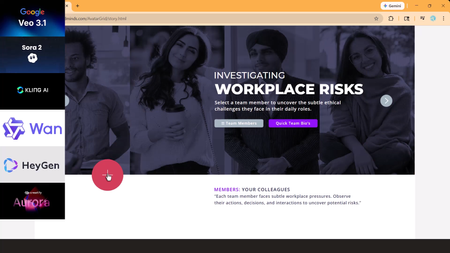
AI talking heads are everywhere, but most still fall straight into the Uncanny Valley. When lip-sync drifts or facial movements glitch, the learner stops focusing on the scenario and starts focusing on the AI mistake. I tested Veo 3.1, Kling 3.0, Creatify Aurora, Seedance 1.5, and HeyGen using the same image, script, and workplace scenario. One model clearly stood out as production-ready for realistic eLearning conversations. Watch the tutorial: https://www.youtube.com/watch?v=zroW6I7CGO0&t=317s Try the Storyline live demo: https://www.redesignedminds.com/AvatarGrid/story.html148Views0likes2CommentsTurn a PPT Into a Rise 360 SCORM
Hello! I am new to Articulate and I am looking for something very specific. At my job, we already have a lot of great teaching material in PowerPoint. Now, we are trying to converting the PPT-content into a SCORM-file each. It worked fine with Storyline, but it is shown through the player. I am actually looking for the Articulate Rise 360 feel, having one page beneath the last. Is there any way to change the setting and achieve what I am looking for? Thank you so much! Love, KathiSolved235Views0likes5CommentsPreventing Learners from Forcing Completion/Score via Browser Developer Tools in Storyline 360
Hello Community, I’m an eLearning developer working with Articulate Storyline 360 and SCORM-based LMS tracking. Recently, we discovered that a learner was able to manipulate browser developer tools to artificially mark a course as completed/passed with a high score—without actually attempting the quiz or interacting with the content. I understand that SCORM communication happens client-side, so absolute prevention may not be possible. However, I’d like to learn from the community: What best-practice approaches do you recommend to harden Storyline courses against this type of manipulation? Are there recommended design patterns for gating completion so that it is only issued after legitimate quiz completion? Have you used centralized or conditional commit logic (for example, allowing LMS communication only after passing the final assessment)? Any experience with LMS-side configurations that significantly reduce this risk? Are there known strategies for detecting suspicious behavior (e.g., unrealistically fast completion)? My goal is to reduce risk, raise the technical barrier, and follow industry best practices—even if 100% prevention isn’t feasible. Thanks in advance for any guidance or examples you’re willing to share.173Views0likes2CommentsCourse Design Best Practices
Hello everyone...a few months ago, our Senior eLearning Instructional Designer retired and I've inherited a catalog of eLearning courses that were authored in Storyline 2. I'm working on updating courses as needed and turning my attention to better processes and best practices for course design. One of the standards I'm examining is course navigation and baseline expectations for any given course with regard to seat time, whether it has audio, etc. Because the courses I'm updating and developing will be authored in the new versions of Storyline and Rise, there is also a learning curve for the organization on using these new player interfaces. I've seen a number of creative ways this has been done, but wanted to ask if there were any recommendations for things that have worked well for you. For things like orienting the learner to the player controls, fullscreen options, etc. do you recommend creating a Lightbox overlay for Storyline courses at the beginning? What about Rise courses? Do you include a block at the beginning, during the introduction that shows learners how to use the player, etc.? I appreciate any creative inspiration and recommendations! Added screenshots as examples. My apologies for not knowing the author of the first example. I grabbed a quick screenshot when I saw this in one of the community downloads as it was very close to what I'm wanting to do. The second is an example (from a recent video course I just finished) of similar information I'd like to include in eLearning courses.Solved322Views0likes3CommentsDo you create training for Sales Enablement or Customer Service teams? Join our Template Creation Guild pilot program!
💁 Are you a trainer in either the Sales Enablement or Customer Service Training spaces? 🤝 Do you love co-creating content and networking with others in your training niche? ✍️ Do you want to build authority and credibility in your training niche with an Articulate by-line, all while helping others in your space? We’re launching a new community program just for you! Introducing: Template Creation Guilds 🎉 These four-week co-working programs will bring together 15-25 creators from specific training niches to collaborate on creating a “core template hub” for that niche. Gain connections and skills with peers in your niche while working together to produce valuable additions to your portfolio, supported by Articulate’s team. Interested in learning more? We put together an article here with all the details about: Program schedule Time commitment Who’s a fit How to join 💬 Your turn: what was the last training you created? If you work in the Customer Service Training or Sales Enablement spaces, what was the last training you created for this niche? Was it new agent onboarding, a quarterly product launch overview, a QA assessment training, or something completely different? Let us know in the comments.396Views6likes1Comment