ai assistant
457 TopicsAI accents changing - Rise 360
I have seen that there have been other discussions about the accents of the AI Text to Voice changing. My colleague and I have both had similar experiences. I have been using the Addison 2.0 Australian Audiobook & Podcast voice in the majority of my courses, and had not had an issue with it until a week or two ago. The accent changed from Australian to New Zealand. Before I checked the discussions here, I tried to see if the accent would change if I just kept clicking the Generate Speech button - and it made very little change. I then checked the discussion board, and tried the suggested fixes, first entering an Aussie term at the beginning of the audio "G'Day" - which did make the audio revert to the Australian accent, but as soon as I deleted G'day, as it was not appropriate for my course, it reverted to the New Zealand accent. I then tried to change this to the Multilingual v2 and the voice was even worse. After no luck with the accent for this block, I went to enter the next audio block further down in the course. The voice was perfect, and all of the other audio blocks in this course and others have been fine. Today, I returned to the course, to see if the accent would change if I tried to re-generate the audio. No luck. Due to not having the issue in the rest of the course, I tried to create a new audio block in the same position. Accent was still the same. I tried to create a new audio block under the following text block and still no luck. In the end, I added a new audio block at the end of the lesson. Addison has two versions, so I tried to generate the audio with the Addison - Australian Narration and Conversational, and this generated the Audio with an American accent. I then changed it back to Addison 2.0 - and finally have the Australian accent. My colleague has also had issues with the following Australian voices having American accents: Emily, Jess and Clara. When she has changed the settings to the Multilingual V2, the volume of the audio decreases. While we are loving the AI tools, this issue when it is occurring is taking up way too much time to investigate and where possible have it work as it should. Leaving it there, or removing the audio entirely will impact the learner expereince. Is there any planned rectification works for these issues?264Views2likes12CommentsAI Avatar Improvements
A few suggestions regarding the AI avatars that I have not seen totally written out elsewhere: The Articulate voices (labeled as Owned by Articulate, Aaron - Wes) absolutely need to be listed as options when using the Generate AI Audio feature. Sometimes I need a talking head, sometimes I just need a voiceover - but I almost ALWAYS need the voices to be the same. I have a work around for this, but it is an annoying process and creates a file that is not easily editable in the future. When cropping or resizing an AI Avatar the resulting video appears distorted in Storyline, but displays correctly when previewed or published. Not a huge deal, but slightly annoying - I submitted a bug report on this. It would be great if I could attach a voice to an Avatar that is the default voice whenever I choose that Avatar. It would also be great if I could generate the "script" for the AI Avatar and had the option to Save without actually generating the video (bonus if I could generate just the voiceover, or not at all) - it could just have a placeholder load instead. This would be helpful when I have a script/storyboard that is mostly complete but I need to get further feedback at a later date. I don't like the idea of generating a video and then having to regenerate later when something changes - I try to be conscious of both my time and the resources required to make these videos. And of course, it would be great to have more granular control of the Avatar and voiceover (adding emphasis, directing the Avatar to point in specific places and such) but those are general improvements that most AI is not fully capable of at this point.55Views0likes2CommentsArticulate Rise AI Tutor Defaults to ON - Concerns
Hi everyone, we are very concerned that the AI Tutor publishing feature is defaulted to ON. For our enterprise license, this is very concerning as we have no way to manage the use other than to advise our seats to not use it unless approved by their legal team. We have no way to track if groups are using it when they are not permitted, we have no way to turn it off administratively or to control who is using it. We were able to go through a process of approval for the internal AI features that are visible and available to our developers, but this is actually an end-user-facing AI function - which is outside of the scope of our original approval. This opens us to liability issues and frankly puts into question if we have to drop the use of AI entirely just to manage this vulnerability. How are you managing your developers utilizing the AI Tutor?Solved113Views1like5CommentsMajor AI Assistant Workflow Friction in Rise 360: Impact on Recent Updates
Hi E-Learning Heroes Community & Articulate Team, I am sharing feedback regarding the recent updates to the AI Assistant features in Rise 360. Even as a certified user, these recent changes to the interface and functionality have introduced major friction into my authoring workflow and are severely slowing down production: Top AI Menu Toolbar Restrictions: The main AI toolbar button at the top is now only Update text across your course or for specific lessons or blocks. Previously, this button opened a comprehensive drop-down list featuring all available AI actions in one central location. Now, that list is gone, and those options have been scattered throughout different areas of Rise. Instead of having a single, efficient menu, I now have to hunt through the entire interface just to find tools that used to be readily accessible in one place. Block Background Image Swapping Glitches: Swapping out the default mountain background visual on blocks has become frustratingly unreliable. It often takes multiple attempts, rather than a single attempt like prior, to replace the generic mountain photo with a custom image when setting up background visuals for block components. Reduction in Generated Image Variations: The AI image generation tool now yields only a single image option per attempt, down from the four distinct variations we used to receive. Storyline still provides four generated image options to choose from, but Rise 360 now yields only a single image option per attempt. This reduction requires repeatedly generating images from scratch, making the search for appropriate visuals far more time-consuming. Getting four options previously allowed us to quickly compare compositions and select the best fit. Loss of Image Prompt History: The system no longer saves, displays, or retains the AI prompt used to generate an image. Previously, we could easily open an existing generated image, view the exact prompt, and copy/paste it to adapt for subsequent images. Articulate needs to add prompt history retention to Rise and Storyline for images so we can iterate on past prompts and keep generated images aligned with the same brand/theme family across a course. These changes are directly impacting authoring speed, visual brand consistency, and daily productivity. Has anyone else encountered these friction points or found effective workarounds? I strongly urge the product team to consider restoring prompt history retention, four-option image generation, and the centralized drop-down menu for AI toolbar controls.433Views5likes6CommentsPrompt or Template to reuse in Rise
Hi there, I have about 90 courses to prepare. They will be on the same topics/same structure but for 90 different countries. I will use uniform word files that will contain the same structure and topics. The idea is to use the AI Assistant for the creation of the courses. Is there a way to reuse the same prompt in Rise so I get the same result? Can we save a previously used prompts or use the previously created course as template? Thank you B92Views0likes8Comments“When Rise AI Audio Has a Mind of Its Own…” 😄
I ran into a strange issue while creating AI audio in a Rise accordion. I couldn’t get any of the voices to pronounce all the words correctly. For example, vehicle was pronounced “Vladimir” in one voice and “vaccine” in another. There was no consistency from voice to voice—and, even stranger, Rise was adding words to my script that weren’t there. 🤔 I was getting ready to submit a support case when I wondered if the problem might not be with the AI voice itself, but with the accordion block. I created a standalone Audio block using the same script. It worked—all but one word! Since I had copied and pasted the text, I deleted the “offending” word, typed it back in manually, and...it worked! 🎉 Now I had another problem: How do I get this working in the accordion? You can’t export and import the AI audio, so I tried copying and pasting the script from the standalone Audio block back into the accordion. And for whatever reason...everything worked! Who am I to question it? It worked! 😂 I don’t know if this trick will work for everyone or in every situation, but if you run into something similar, it might be worth a try. I’m ending my Friday on a high note! Happy Friday! 🎉 Penny35Views0likes1CommentWhy Include AI in Articulate 360 Subscription?
Hello! After attending Articuland 2026, I am very enthusiastic about presenting evidence to convince my organization to purchase the AI component add-on to our Articulate 360 subscription. I've gathered several points on my own, but I wanted to check in if there's a one-pager or document (that's already created by Articulate) that I could present to our leadership. Thanks!Solved80Views0likes2CommentsJapanese AI Text-to Speech Quality
Has anyone had success using a particular voice for the AI Text-to-Speech for Japanese? I have tried several and continue to get feedback that the text-to-speech quality is very poor, and some voices randomly mix Japanese, Chinese, and Korean accents even within a single paragraph. All of the translated audio text has been thoroughly reviewed and is accurate. Here are the latest voices I have tried and the general feedback received: Alva: Good (the voice used in the course) Akira: Poor Hajime: Poor Gojo: Acceptable Ken: Good (possible alternative, but does not address the root cause) Masa: Acceptable In the Advanced settings, I have Multilingual v2 selected for each one. Note that even for the voices marked good or acceptable, the reviewer still indicates that the quality is not at a level that they feel can be used. They believe the root cause is that the program invoking text-to-speech does not consistently retain the selected voice option and that it incorrectly auto-detects the language and switches voice options even within a single sentence. I am not sure how to respond to that. I would appreciate any insights anyone else has about this topic!529Views0likes6Comments(Kind of urgent) How do I make an icon animate across a map in multiple slides?
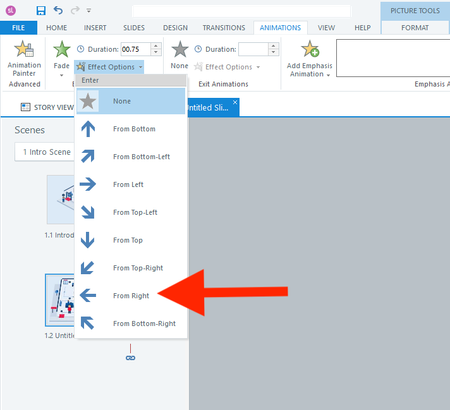
Hi everyone, I actually have two questions. I will start with the easier one first. Question 1 In a fade-in from the right animation, is there a way to adjust how far to the right the object starts? I don't want it to animate from off the right side of the slide. I only want it to start a few pixels to the right. Question 2 How do I animate the red shirt character below across 13 slides? I want it to follow each button from 1 to 13. I realize I should use the Motion Path. But what's the smartest way to use the motion path across slides? I have always found the motion path to be challenging. Thank you all for your help! :)67Views0likes3Comments