ai assistant
570 TopicsAI accents changing - Rise 360
I have seen that there have been other discussions about the accents of the AI Text to Voice changing. My colleague and I have both had similar experiences. I have been using the Addison 2.0 Australian Audiobook & Podcast voice in the majority of my courses, and had not had an issue with it until a week or two ago. The accent changed from Australian to New Zealand. Before I checked the discussions here, I tried to see if the accent would change if I just kept clicking the Generate Speech button - and it made very little change. I then checked the discussion board, and tried the suggested fixes, first entering an Aussie term at the beginning of the audio "G'Day" - which did make the audio revert to the Australian accent, but as soon as I deleted G'day, as it was not appropriate for my course, it reverted to the New Zealand accent. I then tried to change this to the Multilingual v2 and the voice was even worse. After no luck with the accent for this block, I went to enter the next audio block further down in the course. The voice was perfect, and all of the other audio blocks in this course and others have been fine. Today, I returned to the course, to see if the accent would change if I tried to re-generate the audio. No luck. Due to not having the issue in the rest of the course, I tried to create a new audio block in the same position. Accent was still the same. I tried to create a new audio block under the following text block and still no luck. In the end, I added a new audio block at the end of the lesson. Addison has two versions, so I tried to generate the audio with the Addison - Australian Narration and Conversational, and this generated the Audio with an American accent. I then changed it back to Addison 2.0 - and finally have the Australian accent. My colleague has also had issues with the following Australian voices having American accents: Emily, Jess and Clara. When she has changed the settings to the Multilingual V2, the volume of the audio decreases. While we are loving the AI tools, this issue when it is occurring is taking up way too much time to investigate and where possible have it work as it should. Leaving it there, or removing the audio entirely will impact the learner expereince. Is there any planned rectification works for these issues?264Views2likes12CommentsNotify Users When Credits are Used
We have a large number of Rise users who don't all pay attention to announcements. Several have used thousands of credits "playing" with AI Avatars because they did not know that there were credits being deducted from a general bucket of credits for everyone to use. There should be a notification each time a user is about to complete any action that will use credits to alert them that credits are being used and telling them exactly how many credits they are using. This doesn't seem like something that should need to be requested.19Views1like1CommentAI Avatar Improvements
A few suggestions regarding the AI avatars that I have not seen totally written out elsewhere: The Articulate voices (labeled as Owned by Articulate, Aaron - Wes) absolutely need to be listed as options when using the Generate AI Audio feature. Sometimes I need a talking head, sometimes I just need a voiceover - but I almost ALWAYS need the voices to be the same. I have a work around for this, but it is an annoying process and creates a file that is not easily editable in the future. When cropping or resizing an AI Avatar the resulting video appears distorted in Storyline, but displays correctly when previewed or published. Not a huge deal, but slightly annoying - I submitted a bug report on this. It would be great if I could attach a voice to an Avatar that is the default voice whenever I choose that Avatar. It would also be great if I could generate the "script" for the AI Avatar and had the option to Save without actually generating the video (bonus if I could generate just the voiceover, or not at all) - it could just have a placeholder load instead. This would be helpful when I have a script/storyboard that is mostly complete but I need to get further feedback at a later date. I don't like the idea of generating a video and then having to regenerate later when something changes - I try to be conscious of both my time and the resources required to make these videos. And of course, it would be great to have more granular control of the Avatar and voiceover (adding emphasis, directing the Avatar to point in specific places and such) but those are general improvements that most AI is not fully capable of at this point.55Views0likes2CommentsArticulate Rise AI Tutor Defaults to ON - Concerns
Hi everyone, we are very concerned that the AI Tutor publishing feature is defaulted to ON. For our enterprise license, this is very concerning as we have no way to manage the use other than to advise our seats to not use it unless approved by their legal team. We have no way to track if groups are using it when they are not permitted, we have no way to turn it off administratively or to control who is using it. We were able to go through a process of approval for the internal AI features that are visible and available to our developers, but this is actually an end-user-facing AI function - which is outside of the scope of our original approval. This opens us to liability issues and frankly puts into question if we have to drop the use of AI entirely just to manage this vulnerability. How are you managing your developers utilizing the AI Tutor?Solved112Views1like5CommentsMajor AI Assistant Workflow Friction in Rise 360: Impact on Recent Updates
Hi E-Learning Heroes Community & Articulate Team, I am sharing feedback regarding the recent updates to the AI Assistant features in Rise 360. Even as a certified user, these recent changes to the interface and functionality have introduced major friction into my authoring workflow and are severely slowing down production: Top AI Menu Toolbar Restrictions: The main AI toolbar button at the top is now only Update text across your course or for specific lessons or blocks. Previously, this button opened a comprehensive drop-down list featuring all available AI actions in one central location. Now, that list is gone, and those options have been scattered throughout different areas of Rise. Instead of having a single, efficient menu, I now have to hunt through the entire interface just to find tools that used to be readily accessible in one place. Block Background Image Swapping Glitches: Swapping out the default mountain background visual on blocks has become frustratingly unreliable. It often takes multiple attempts, rather than a single attempt like prior, to replace the generic mountain photo with a custom image when setting up background visuals for block components. Reduction in Generated Image Variations: The AI image generation tool now yields only a single image option per attempt, down from the four distinct variations we used to receive. Storyline still provides four generated image options to choose from, but Rise 360 now yields only a single image option per attempt. This reduction requires repeatedly generating images from scratch, making the search for appropriate visuals far more time-consuming. Getting four options previously allowed us to quickly compare compositions and select the best fit. Loss of Image Prompt History: The system no longer saves, displays, or retains the AI prompt used to generate an image. Previously, we could easily open an existing generated image, view the exact prompt, and copy/paste it to adapt for subsequent images. Articulate needs to add prompt history retention to Rise and Storyline for images so we can iterate on past prompts and keep generated images aligned with the same brand/theme family across a course. These changes are directly impacting authoring speed, visual brand consistency, and daily productivity. Has anyone else encountered these friction points or found effective workarounds? I strongly urge the product team to consider restoring prompt history retention, four-option image generation, and the centralized drop-down menu for AI toolbar controls.433Views5likes6CommentsMeet Your New Co-Presenter: What I Learned Building with AI Avatars in Rise 360
If you've been following along on E-Learning Heroes lately, you've probably noticed AI Avatars starting to pop up in people's Rise 360 projects. I decided to take it for a real spin — not just a quick test, but an actual microlearning build — and I want to share what I found. The good, the genuinely useful, and the "wish I'd known that before I hit publish." The result is a five-slide microlearning called Meet Your New Co-Presenter, built entirely in Rise 360 with AI Avatars as the hook. Here's what I learned along the way. What AI Avatars actually does In case you haven't tried it yet: AI Avatars is a native Rise 360 feature that generates a lifelike on-screen presenter from a written script. You type what you want the avatar to say, choose a presenter style, and Rise generates a speaking video — no camera, no studio, no scheduling a subject matter expert who keeps canceling on you. It lives inside Rise as a Media Block, which means it drops cleanly into your lesson flow just like any other media element. The generated video includes Rise's native player controls automatically, so learners can pause, rewind, and replay without any extra setup on your end. For certain use cases — quick scenario illustrations, course introductions, process overviews — it's a genuinely useful addition to the toolkit. And the speed of it is real. From script to generated avatar, you're talking minutes, not days. What worked well The hook moment is powerful. There's something genuinely compelling about opening a course with a speaking presenter that you built from a single paragraph of text. For the first slide of this microlearning, I used an AI Avatar to deliver the hook line — "What if your next training course already had a presenter?" — and then immediately showed learners the exact script that produced it. The meta moment landed exactly the way I hoped. Script-first thinking is actually good instructional design practice. Because the avatar reads exactly what you write, you're forced to write the way people talk, not the way people write slide decks. Short sentences. Active voice. A conversational rhythm. Those are things we should be doing anyway — AI Avatars just enforces it. Iteration is fast. Don't like how something sounds? Rewrite a sentence, regenerate, and you've got a new version in a couple of minutes. No reshoots. No re-recording. No waiting on anyone. That speed genuinely changes how you think about revision. Avatar selection is a real design decision — and a good one. The range of avatar styles available gives you enough variety to be intentional about representation. Choosing a presenter who reflects your learner audience is a small decision with real impact on engagement and trust. You can build a custom avatar — and it's easier than you think Here's the part that genuinely surprised me, and that I think more IDs need to know about: you're not limited to the preset avatar options. You can create a custom AI Avatar using a plain-language prompt describing exactly who you want your presenter to be. For this microlearning, I created a custom avatar from scratch using this prompt: A professional woman in her 50s with long, straight auburn-brown hair and bangs. She has light skin, green-hazel eyes, and a warm, confident smile. She is wearing a black blazer over a black turtleneck. She is standing in a modern professional office environment with soft, neutral lighting. Her expression is approachable and knowledgeable — like a trusted subject matter expert presenting to colleagues. She faces the camera directly with a poised, engaging demeanor. That's it. One paragraph. And what came back was a polished, realistic-looking presenter that felt like she belonged in the course — not a generic stock character, but someone with a specific look, a specific energy, and a specific professional context. Think about what that means for your work. If you're building for a specific industry, you can describe a presenter who looks like they actually work in that field. If you have brand guidelines around representation, you can build a presenter who reflects them precisely. If your learner audience is specific — frontline healthcare workers, financial advisors, retail managers — you can describe a presenter who looks like a trusted colleague rather than a generic talking head. A few tips for writing custom avatar prompts that get good results: Be specific about appearance. Hair color and style, eye color, approximate age, skin tone — the more detail you give, the more consistent and intentional the result. Vague prompts produce vague avatars. Describe the setting, not just the person. The background matters more than you'd think. "Modern professional office with soft neutral lighting" reads completely differently than "bright open-plan workspace" or "clinical white background." The environment signals context to your learner before the avatar says a single word. Name the energy, not just the look. Phrases like "approachable and knowledgeable," "warm but authoritative," or "confident and direct" genuinely influence how the avatar presents. Think of it like writing a casting note for an actor. Iterate the prompt, not just the script. If the first result isn't quite right, adjust the prompt description and regenerate. Small tweaks — changing "business casual" to "blazer and turtleneck," for example — can shift the result meaningfully. The custom avatar prompt is, in my view, one of the most underrated parts of this feature. The ability to describe your ideal presenter and actually get them — without a casting call, a shoot day, or a post-production budget — is genuinely remarkable. Use it intentionally. What to know before you dive in Here's where I want to be honest with you, because the E-Learning Heroes community deserves the real version, not the marketing version. You cannot edit the generated video. This is the big one. Once Rise generates your avatar video, what you get is what you get. There's no trim tool. No way to cut a section. No way to splice takes together. I ran into this firsthand: for some reason, my avatar was still visibly moving — still talking — at the very end of the clip, even after the script had ended. It looked awkward. And there was nothing I could do about it. No way to cut those last few seconds. I actually left that version in the microlearning intentionally so you can see exactly what I mean — go ahead and watch through to the end of the first slide and you'll catch it. The only fix was to rewrite the script, add a cleaner closing line, and regenerate the whole thing and hope the new version ended more gracefully. If you're used to working with tools like Camtasia or even a basic video editor where you can trim a clip to the frame, this limitation will feel significant. Plan your scripts carefully on the front end — because you can't fix it on the back end. You cannot export the avatar video out of Rise. The generated video lives inside Rise and that's where it stays. You can't download it, bring it into another tool for editing, or repurpose it elsewhere. If you were hoping to grab the file and use it in a Storyline project or a standalone MP4, that's not currently possible. The Media Block is the only home for AI Avatars. This has layout implications. Because AI Avatars only lives in a Rise Media Block, you don't have the layout flexibility to, say, place the avatar side by side with text content in the same block. I originally designed this microlearning with a two-column layout — avatar on the left, script context on the right — but had to rethink it when I realized the Media Block doesn't support that kind of custom positioning. I ended up stacking the avatar above the Code Block content, which actually worked fine once I reframed it: the avatar speaks first, then learners look down and see the script that produced it. Flexibility is limited overall. Beyond the editing and export limitations, you're working within whatever Rise generates. You can influence the output through your script, but you can't control pacing, emphasis, pause timing, or the avatar's gestural behavior in any granular way. What you see is what the AI decided to do with your text. How I worked around the limitations A few things that helped: Write for endings. Since you can't trim, your last line matters a lot. Write a clean, definitive closing sentence that gives the avatar a natural stopping point. Something like "Let's take a look at how it works" worked better for me than an open-ended line that trailed off. Keep scripts short and focused. The shorter the script, the easier it is to regenerate if something doesn't land right. I kept every avatar script in this microlearning to 20–30 seconds. Fast iteration is only an advantage if you're not regenerating a two-minute monologue every time. Use the avatar strategically, not on every slide. I originally planned to include an AI Avatar on each of the five slides. After working through the layout constraints and the Media Block limitation, I scaled back to just the first slide. That was actually the right call — one strong hook moment is more impactful than a talking head on every screen, and it kept the rest of the microlearning moving at a good pace. Lean into Code Blocks for layout control. Since the avatar lives in a Media Block and I needed more visual control over the surrounding content, I built each slide's content layout as a custom Code Block. This gave me full control over typography, spacing, animations, and interactivity — things Rise's native blocks don't always offer. If you're comfortable with HTML, CSS, and JavaScript, Code Blocks are where you can push Rise further than it's designed to go. The bottom line AI Avatars is a genuinely useful feature — with real constraints. It's fast, it's accessible, and it removes a meaningful barrier for IDs who want a human presence in their courses but don't have the budget, equipment, or scheduling flexibility for recorded video. But go in clear-eyed. You're trading editorial control for speed and convenience. If your workflow depends on being able to trim, cut, export, or precisely control the output, you'll run into walls. If you can write a tight script, embrace iteration, and design around the tool's constraints rather than against them — you'll find a lot to like. I'd love to hear how others are using AI Avatars in their own projects — especially if you've found creative workarounds I haven't thought of yet. Drop your thoughts in the comments below. Meet Your New Co-Presenter1.2KViews6likes3CommentsInteractive Video: Start from blank option or Rise block option
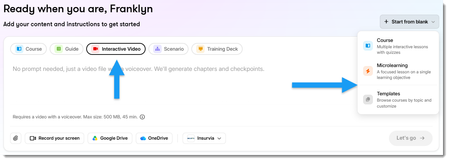
Loving the new AI features! In particular I love the ability to upload a video and have checkpoints and knowledge checks baked in with AI-assistance! Something that I would like to see would be the option to "Start from blank" on the Interactive Videos, or have the ability for them to be interactive blocks in Rise. I don't always find myself needing to let the AI do that for me. Sometimes, I'd like the ability to decide when and what those checkpoints should be without assistance. For example, when we have a short-length video that we don't necessarily want to spend 3,000 of the AI credits on when we already know when and what types of interactions we'd like to add. ~ Frankie52Views0likes3CommentsPrompt or Template to reuse in Rise
Hi there, I have about 90 courses to prepare. They will be on the same topics/same structure but for 90 different countries. I will use uniform word files that will contain the same structure and topics. The idea is to use the AI Assistant for the creation of the courses. Is there a way to reuse the same prompt in Rise so I get the same result? Can we save a previously used prompts or use the previously created course as template? Thank you B92Views0likes8Comments“When Rise AI Audio Has a Mind of Its Own…” 😄
I ran into a strange issue while creating AI audio in a Rise accordion. I couldn’t get any of the voices to pronounce all the words correctly. For example, vehicle was pronounced “Vladimir” in one voice and “vaccine” in another. There was no consistency from voice to voice—and, even stranger, Rise was adding words to my script that weren’t there. 🤔 I was getting ready to submit a support case when I wondered if the problem might not be with the AI voice itself, but with the accordion block. I created a standalone Audio block using the same script. It worked—all but one word! Since I had copied and pasted the text, I deleted the “offending” word, typed it back in manually, and...it worked! 🎉 Now I had another problem: How do I get this working in the accordion? You can’t export and import the AI audio, so I tried copying and pasting the script from the standalone Audio block back into the accordion. And for whatever reason...everything worked! Who am I to question it? It worked! 😂 I don’t know if this trick will work for everyone or in every situation, but if you run into something similar, it might be worth a try. I’m ending my Friday on a high note! Happy Friday! 🎉 Penny35Views0likes1Comment