community
52 TopicsWelcome to the New E-Learning Heroes
We’re super excited to introduce you to the all-new E-Learning Heroes community platform. Whether you’ve been a community member for years or you’re just looking to join us, there are plenty of new and improved features to love. For example, now you can earn badges for your contributions, connect with other members about specific topics in dedicated groups, and find answers to your questions more easily. Check out the video below for a walkthrough of our favorite new features, and let us know what you’re most excited about in the comments! Subscribe to our newsletter to get the latest e-learning inspiration and insights directly in your inbox. You can also find us on LinkedIn and X (formerly Twitter). And if you have questions, please share them in the comments.35KViews14likes45CommentsHow I Built This: I Developed an Award-Winning Ethics Course
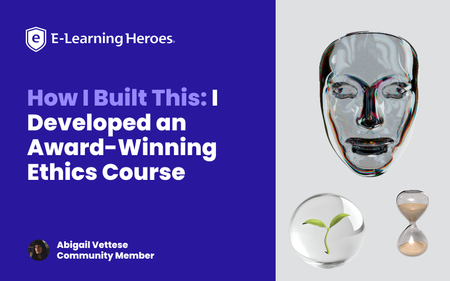
Why I Built This: When I first learned about branching scenarios, something clicked for me that I hadn’t seen other eLearning developers execute: visually compelling, philosophically rich thought experiments. I studied Moral Philosophy in my undergrad and became obsessed with ethical dilemmas. Naturally, I decided to build an ethics course about technology. Think The Trolley Problem, only I wanted to pose questions about the growing reliance on AI and its implications by employing Instructional Design strategies. An opportunity came up through my Master’s program to attend DevLearn and compete in DemoFest, so it was time to start building my concept. I designed and developed a course in Storyline called The Agency Algorithm that confronts learners with issues regarding three main topics: algorithmic warfare (The Armory), AI assisted resource allocation (The Triage Garden), and surveillance (The Mask Archive). The Experience & Design Intent: A quick walkthrough of the multi-room experience. The Agency Algorithm is a multi-room interactive learning experience that blends instructional design, game-like mechanics, and philosophical inquiry. It immerses learners in ethically complex scenarios by leveraging branching logic, and integrating experiential aesthetics with conceptual depth. My primary goal with this project was to encourage critical reflection on the role of technology on human agency and autonomous choice. The concept itself was pretty clear to me, but I wanted to push the limits of Storyline visually, so I acquired a number of 3D assets from Adobe Stock, some of which I further modified in Adobe Dimension. I wanted the visuals to anchor the learner in a unique environment that did not feel reminiscent of traditional eLearning, and rather create space to explore and feel like a participant in something unfolding. There aren’t often black and white answers to ethical questions, and branching scenarios are an excellent way to illustrate this while offering learners a safe place to experiment and think through various outcomes based on their decision making. Visual Worldbuilding/Making It Not Feel Like eLearning: Initially, I intended to hand draw assets myself to really hone in on the human vs AI dynamic, but quickly realized the time I’d have to accomplish this was dwindling. While I drafted a few loose concepts in my journal, I ultimately decided to stick with digital assets. While I landed on 3D assets largely due to time constraints, the outcome is reminiscent of an old experimental video game or some sort of immersive idea gallery. As an artist, I often approach my work from a minimalist lens so this project was a fun way to really add some artistry that corporate training often doesn’t have room for. Variables, Multi-state objects, Cue points, and other mechanics: I relied heavily on multi-state objects to create hover states, “tip” cards, text labels, and more, for example in the circuits with definition reveals. I enjoyed building the “loading” effect in the Mask Archive, although it was a bit clunky and took a lot of trial and error! I learned a lot along the way and used a cue point on an orb with a glow effect beneath the mask and used triggers to cause the effect to work. The course overall has a few hundred triggers (slide, object, and variable triggers) and somewhere around 40 variables (mostly T/F variables). What I learned: I think it is important that we don’t hand-hold learners through every learning experience. I want users to think through complex challenges and autonomously choose and feel like a true agent in the process of acquiring knowledge. A lot of eLearning makes it too easy for the learner and we lose engagement when we undermine the intelligence of our audience. I learned SO much about how to leverage Storyline in new ways. I am still a relatively new user to the tool, so this project allowed me to freely explore and be guided by curiosity. Link to my portfolio: https://www.abigailvettese.com/1.5KViews12likes7CommentsCommunity Insights: What Judy Nollet’s L&D Journey Can Teach You About Growing Your Own Career
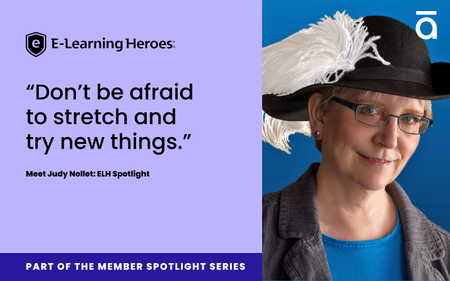
In this Member Spotlight, you’ll find insights and takeaways from her decades in learning and development (L&D), including ways you can put them into practice as you shape your own path.1.1KViews9likes6CommentsCommunity Insights: What You Can Learn from David Tait’s Career Pivot
One of the best things about creative careers is how flexible they are—you can take them in so many directions. For DavidTait, that flexibility led from graphic design to learning design, and eventually to co-founding 4pt, a learning design studio. 4pt has been creating meaningful learning experiences for more than 16 years. In this Member Spotlight, you'll discover how adaptability, curiosity, and community shaped David's journey, and how to apply these lessons to your own career path. From Design to Learning “Before starting my career in e-learning, I was a student focused on design,” David says. “I spent four years studying design. Two in graphic design and two in newspaper, magazine, and infographic design. That background gave me a strong foundation in visual communication, which has been incredibly useful in my learning and development (L&D) work.” While still in college, he took on a freelance project as a graphical user interface designer for the Northern College Network. “It was my first real step into the world of digital learning design,” he recalls. “It helped me see how I could apply my design skills in a completely different context.” Soon after, a former lecturer offered him a role at an e-learning startup creating online CPD courses for healthcare professionals. “Working in a startup meant wearing many hats,” David says. “That experience really shaped my path and helped me see how my design skills could grow into a career in learning.” 💡Tip: Apply your existing creative skills to a small digital learning project (freelance, volunteer, or self-initiated). Hands-on experience helps bridge design and instructional work faster than theory alone. Turning Change into Opportunity A few years later, the company was acquired, and layoffs followed. “Rather than seeing it as a setback, my studio manager and I took it as an opportunity,” David says. “When we started 4pt, all of those responsibilities suddenly became our job. Being able to adapt to new challenges was essential, and it’s a big reason why we’ve been able to thrive.” 💡Tip: When your path shifts unexpectedly, use it to test new skills or partnerships. Career detours often reveal strengths you wouldn’t discover in a stable role. Finding Flexibility with Storyline “One project in 2013 really shaped our company,” David says. “A client asked us to build a course in Storyline 1. We’d never used it before, but rather than turn the work away, we invested in licenses and learned as we went.” “Before long, Storyline became the tool most of our clients wanted to use,” he explains. “Storyline gave us the ability to solve problems ourselves, experiment more freely, and move much faster. That agility has stayed with us ever since—it’s a core part of how we approach learning design.” 💡Tip: Don’t wait to feel like an expert. Pick a project, open the tool, and build. Use the community forums and shared files when you hit roadblocks. The Power of Community “I’ve lost count of how many times I’ve hit a dead end in Storyline and found the solution on the forums,” David says. “That support has saved me countless hours and kept projects moving. The community around Articulate is unlike anything else.” Over time, helping others became just as rewarding. “Being part of E-Learning Heroes isn’t just about getting help,” he adds. “It’s about giving back. I try to pay it forward when I can, and that sense of community has been such a valuable part of my journey.” 💡Tip: When you find an answer in ELH, take a minute to thank the poster—or add your own version of the solution. Small interactions build visibility and confidence. Lessons from the Journey “Figure out where your limitations are, and then build a trusted network of professionals who can help you overcome them,” David says. “Continuous learning is important, but you don’t have to master everything yourself.” He also believes in stepping outside your comfort zone: “Sometimes doing that sooner opens doors you didn’t even realize were there.” “I try to focus on projects where I can see real value and impact—and to work with people I genuinely like and respect. That combination has made the journey far more meaningful.” 💡Tip: Find one collaborator who complements your skills—a developer, writer, or media pro—and trade knowledge. Collaboration accelerates growth and keeps learning fun. Looking Ahead These days, David is focused on advancing localization in his projects and exploring how AI fits into e-learning. “We’re evaluating Storyline’s new localization features ahead of a major project,” David says. “I’m excited to see how these tools evolve and how we can integrate them to deliver even better multilingual learning experiences.” He’s also reading Co-Intelligence: Living and Working with AI by Ethan Mollick. “It’s not written specifically for L&D, but it’s helped me think more critically about how AI can be used thoughtfully and effectively.” 💡Tip: Keep one “outside-the-industry” book on your reading list. Fresh perspectives often spark the most creative ideas. 💬 Your Turn David’s story is a reminder that creativity, curiosity, and community can take your career in directions you never planned, but might love most. What’s one skill—or moment—that’s shaped your own learning design journey? Share it in the comments below!1.9KViews7likes16CommentsHow I Built This: The Confidence Self-Check Dashboard
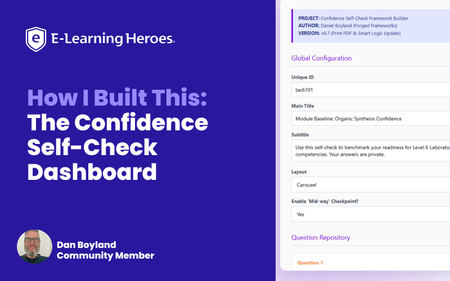
What the Project Is The Confidence Self-Check Dashboard started with a challenge that many learning professionals will recognise: we're often very good at measuring learner perceptions at a single point in time, but much less effective at understanding the journey that got them there. Most confidence checks, smile sheets, and end-of-module surveys provide a snapshot. They tell us how a learner feels at the end of an experience, but they rarely show how much progress has been made between the starting point and the finish line. As learning designers, trainers, and educators, we're increasingly asked to demonstrate impact and effectiveness, yet many of our evaluation tools remain focused on isolated moments rather than measurable growth. The Confidence Self-Check Dashboard is an open-source framework designed to help visualise that growth. Learners can capture baseline, midpoint, and final confidence scores, creating a richer picture of progression across a programme, module, or learning journey. The system then visualises progress through checkpoints, historical tracking, and comparative reporting, helping learners and educators see not just where confidence sits today but also how it has evolved. What makes the project different is that the dashboard is only half of the solution. Built directly into the framework is a configurable Designer Mode that allows instructional designers, trainers, and subject matter experts to modify questions, scoring, weighting, feedback, and visual elements without touching the underlying code. Once configured, the framework can generate deployment-ready outputs for both standalone HTML environments and Storyline projects. For me, the project sits at the intersection of learning analytics, instructional design, and curiosity. It explores how we might move beyond static interactions and perception-based evaluation towards adaptable tools that not only support learning but help us better understand the impact of what we create. Why I Built This One recurring frustration I encounter as a learning designer is that many custom interactions end up as disposable solutions. They solve a problem for a specific programme, module, or client, but the moment somebody wants to adapt them, whether that's changing questions, adjusting scoring logic, updating feedback, or tailoring the experience for a different audience, the process often becomes disproportionately difficult. This isn't limited to Storyline. I've seen the same challenge across standalone HTML tools, JavaScript widgets, learning micro-applications, and community-shared frameworks. The learning community produces some incredible work, and I'm regularly inspired by the creativity on display. However, many of those solutions are understandably built to solve a specific challenge at a specific moment in time. Reusing them often means digging through code, unpicking logic, or rebuilding large chunks from scratch. At the same time, I was finding myself increasingly able to prototype ideas that previously would have stayed as scribbles in a notebook or half-finished thoughts in my head. That led me to a different question. Rather than repeatedly rebuilding interactions whenever requirements changed, could I create something that remained adaptable after development had finished? I became increasingly interested in building systems rather than outputs. Instead of creating another hardcoded interaction that would need future rebuilding, I wanted to explore whether the editing capabilities themselves could become part of the experience. The result was Designer Mode. Rather than expecting instructional designers, trainers, or subject matter experts to modify code, they could adjust questions, scoring, weightings, feedback, and configuration settings through a dedicated interface and generate deployment-ready outputs themselves. Ultimately, this project became an exploration of a broader idea: perhaps the most valuable thing we can build isn't the interaction itself, but the framework that allows other people to adapt it long after we've moved on. How I Built It The chronology of the project was actually quite different from what people might expect. It started with a community language-learning project where I was exploring how learners could benchmark their confidence over time using a simple Likert scale. At the time, I wasn't trying to build a framework. I was simply trying to create a better reflection point for learners. That evolved into a benchmarking dashboard, which I later adapted for quality management systems and professional development programmes. As the number of adaptations increased, I found myself repeatedly rebuilding or modifying the same interaction. The turning point came after sharing an earlier project with the Articulate community. Somebody asked a simple question (thanks to the E-Learning Heroes Community): "This is great, but how do I edit it myself?" That question stuck with me. The first version of Designer Mode was incredibly basic. It allowed users to configure the front and back of flip cards without touching the underlying code. Once that worked, I started asking questions: Could they change images? Could they update URLs? Could they alter scoring boundaries? Could they swap animations? Could they generate the code themselves? What started as a convenience feature gradually became the main project. At some point, I realised I wasn't really building interactions anymore. I was building frameworks that could generate interactions. The goal stopped being to build a better confidence tracker. The goal became building a system that could adapt itself. Once I made that mental shift, a lot of the design decisions suddenly became much clearer. My Development Workflow One thing I've learned is that my best ideas rarely arrive in a neat, structured format. They usually arrive as half-formed concepts, tangents, questions, and observations that need untangling before they become useful. Because of my dyslexia and dyscalculia, I often find it easier to explain concepts verbally than work directly with large blocks of code. Over time, I developed a workflow that helped translate those ideas into something more structured. ChatGPT often acted as a critical friend and sounding board. Gemini became my primary coding and debugging environment. Claude frequently challenged learner experience decisions, instructional design choices, and pedagogical assumptions. I also built a prompt generator that helped translate my often-discordant thought processes into something the various models could consistently understand and execute. Rather than generating code directly, it acted as a translation layer between ideas, constraints, learning requirements, accessibility considerations, technical limitations, and deployment requirements. One of the biggest lessons I learned was that prompting quality often mattered more than coding quality. I also learned very quickly that dirty context windows are real. The longer the conversations became, the more assumptions accumulated, and the more unpredictable the outputs could become. Managing context became almost as important as debugging. After what felt like the hundredth iteration, and probably wasn't far off, I finally realised I was solving the wrong problem: The challenge wasn't building a better interaction, it was making sure I didn't have to rebuild it again six months later. Exporting for Different Environments One of the design goals from quite early on was that I didn't want the framework tied exclusively to a single authoring tool. As a result, Designer Mode generates two separate deployment outputs. The first is a standalone HTML package that can be deployed independently and used outside of Storyline altogether. The second is a Storyline-compatible export. Rather than generating complete slides, the framework produces copy-and-paste-ready JavaScript that can be dropped directly into an Execute JavaScript trigger. The generated code sits behind a simple trigger, button, or slide event and handles the heavy lifting in the background. Supporting both outputs inevitably created additional testing and development effort, but it felt important that the framework remained flexible rather than becoming dependent on a single platform or workflow. Key Decisions & Trade-Offs One of the hardest parts of the project wasn't deciding what to build, it was deciding what not to build. There were plenty of moments where I could see an exciting next step. AI-generated learner feedback was one of them. Cloud storage was another. User accounts, enterprise integrations, reporting dashboards, and centralised administration all felt possible. But possible and sensible aren't always the same thing. AI-generated feedback sounds impressive until you remember that learners may act on that information. The last thing I wanted was a hallucinated recommendation confusing somebody or sending them down the wrong path. If that level of personalisation is going to happen, I think it belongs within a controlled organisational environment rather than inside an open-source learning widget. Cloud storage presented a similar challenge. Whilst it would unlock richer reporting and persistence, it also introduces authentication, security, GDPR considerations, APIs, hosting, maintenance, support requirements, and handover considerations. Very quickly, the project stops being a configurable learning tool and starts becoming a software platform. I had to keep reminding myself what problem I was actually trying to solve. The same challenge appeared within Designer Mode itself. Every new configuration option made the framework more powerful but also increased cognitive load. There is a point where flexibility becomes overwhelming. If somebody needs a developer sitting next to them to understand the configuration panel, I've probably failed. Sometimes the best design decision is leaving something out. 👉 Check out this build that exemplifies more of my design choices Why I Open-Sourced It The project is shared as open source because I genuinely believe we all stand on the shoulders of giants. That philosophy comes partly from learning design and partly from my blacksmithing hobby. Almost every forge project I've ever made has been inspired by somebody else's work, technique, or idea. Usually, somebody has already solved part of the problem before you arrive. The same is true in learning design: The more we share, the more we learn, the more we learn, the more we innovate. That's why the source framework, Designer Mode, and deployment outputs are all available for others to explore, adapt, and build upon. Not because it's finished, but because I hope somebody takes it somewhere I hadn't thought of yet. What I've Used It for Since Although the original use case focused on confidence benchmarking, the Designer Mode approach has quietly spread into a lot of my other projects. I've since added similar configuration layers to flip cards, quizzes, odd-one-out activities, swipe interactions, branching scenarios, media players, and other custom learning tools. Partly because it reduces build time, and partly because it reduces future maintenance. It also reduces the number of times I need to revisit the same problem. The framework can be adapted for: Skills audits Readiness assessments Professional development planning Reflective practice activities Learner self-assessment Progress check-ins What interests me most is that it turns what is often passive engagement into active reflection. Instead of simply consuming content, learners are asked to pause, think, and evaluate where they are right now. They feel included. Key Takeaways If there's one thing I'd encourage other instructional designers to take from this project, it's not that you need to become a programmer. You mustn't underestimate your ability to build. The tools available to us today mean that many of the barriers between an idea and a functioning prototype are lower than they've ever been. For me, the goal isn't to replace the work of learning design.It's to create more space for it. Less time wrestling with implementation. More time understanding learners. More time refining experiences. More time asking awkward questions. More time thinking. The biggest shift isn't that technology can generate code. The biggest shift is that instructional designers can now build tools, frameworks, and systems that previously required specialist development and teams. Use that opportunity wisely. Use it to remove the dross. Use it to reclaim time. And then spend that time doing the bits that humans are still brilliant at: creativity, empathy, reflection, judgement, and understanding what learners actually need. Ask Me Anything If you'd like to know more about the project, feel free to reach out or drop a comment below. I'm always happy to chat about generative AI in learning design, the successes, the pitfalls, and the occasional moments where everything goes wonderfully wrong. I'm also happy to talk about instructional design, learner engagement, accessibility, healthcare, accreditation, quality management systems, blacksmithing, or pretty much anything in between. Portfolio - Built with Claude Design and now hosted via GitHub Outside of learning design, you'll often find me metal-bashing in the forge, experimenting with new projects, or being supervised by my two feline quality inspectors, Tenacious D and Blackjack. Want to Share Your Build? Do you have a project you’d love to share with the community? We’re always looking for more How I Built This stories. Whether it’s a game, interaction, or unique design, we’d love to feature your process. Drop a note in the comments or reach out to the community team if you’re interested!825Views6likes13CommentsMade by Members: Code Block Build-a-thon Highlights
The Code Block Build-a-thon wrapped last month with three winners, 60+ submissions, and so much creativity! This month, we’re exploring the highlights from the event: creative submissions, topic trends, and what you can learn from the build-a-thon, even if you didn’t participate 🎨 Creative Submissions These submissions were not only fun and functional, but novel uses of the code block focused on game-type interactions. 👑Paint by Num-Birds by ArthaLearning03 This winning submission is a fresh take on a classic pastime, helping novice bird watchers over a large hurdle in the hobby. Wizard Maze Game by KayleneWance Have you wished that pac-man was a little more magical? This submission will be right up your alley as a mix between familiar gameplay and unique graphics. CMY Mixer by ISa Color theory is one of those skills that can take a lifetime to master, but this mixer lets you practice with hexcode and percentage mixing support. 💭 Play is a great way to improve engagement and recall—what type of game could you include in your next course? 📈 Trending Content There were a few noticeable trends in submissions: those that taught, encouraged thought, or sought to help with professional development. Australian Sign Language by ShwetaArun Visual and kinesthetic learners will appreciate this lesson that not only runs you through the Australian Sign Language Alphabet, but teaches you how to sign your name. Using Time with Intention by AnnaRabasso This thoughtful lesson takes you through practical time awareness in a kind and beautiful exercise. 👑 Meet your Learner Persona - by ClaudiaNadol891 Our first place winner shines as both a code block example and professional development session. 💭 What trends are you seeing in the Instructional Design space? Which do you enjoy the most? 🥡Takeaways These submissions were thoughtfully made as templates and tools for the community so that you can start experimenting with them right away. Custom Tab Interaction by JenChang You can plug-and-play with this interaction, and use it for a wide variety of learner interactions. 👑Accessibility Checker by SheriLee A winning submission through and through, this accessibility checker can levelset your accessibility related decision making in just a few interactions. Custom Interactive Product Match by VirginieBergon If you’re looking for a variation of a matching knowledge check with learner feedback, this code block is for you. 💭Templates and checker-type tools can be incorporated into your work today. What are some other tips or tricks you’ll be able to implement? Experiment with games for learners, get inspired by trending topics, or try one of these templates in your work and let us know how it goes. You can also share any new code block examples for others to see and learn from, too. Thank you to everyone who participated in our first ever build-a-thon! 🗨️Let us know Which submission was your favorite? Were there any that surprised you? 🏅 Want to Be Featured Next? We’re always looking to highlight inspiring examples from the community, and your work could be next! Here's what we look for in a standout submission: A downloadable .story file or link to your Rise course so others can explore, adapt, and learn from your build. A clear explanation of what you built, how it works, and what makes it unique. Behind-the-scenes insight into your process, techniques, tools, or challenges you tackled. Purposeful design, whether it’s solving a problem, teaching a concept, or experimenting with a new approach. Bonus: Share your ideas for how your design is widely applicable beyond the specific example.610Views4likes1Comment