e-learning challenge
79 TopicsFeelings Pulse
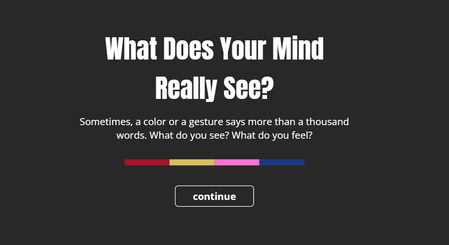
This is an interactive experiment using poll-style questions within a video. It’s designed to describe emotions through colors and characters, using four simple questions. Each question is linked to a color — Red, Yellow, Blue, and Pink — and presents a few emotional choices for you to pick from. You’ll only be able to select one answer per question, and only once per session. Your response is saved anonymously and added to the overall results. At the end, you’ll see how others have answered as well. This isn’t based on any scientific research — it’s just a creative way to reflect on emotions and try out interactive video features. Thank you for being part of it. Feeling PulseWhat’s Your Celestial Learning Persona
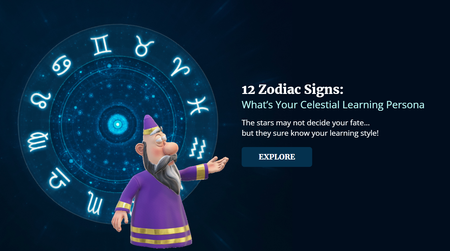
In this challenge, I used a listicle format inside a scroll panel to explore how the 12 zodiac signs connect to learning styles. Each sign reveals a short, scrollable insight into how that type of learner might thrive — whether you're a curious Gemini, focused Capricorn, or imaginative Pisces. Just scroll through the list and discover which celestial style speaks to you :) What’s Your Celestial Learning PersonaFind the Dog
Taking a breather after some intense experimenting with the morph transition! Here’s a simplified version of the classic shell game (I think that’s what it’s called?). I remember watching it as a kid — older guys would play it on the street, trying to earn a bit of extra cash. They’d use matchboxes, shuffle them around with a hidden object underneath. If you guessed right, you’d win a few coins. If not... well, better luck next time! I called it "Find a dog" for the purpose of this challenge. Find the DogStop Child Abuse
Hello Heroes, This animation was originally intended for the previous challenge. However, because it holds special significance for me, I decided to share it in this landmark 500th challenge instead. The criteria for this challenge differ slightly from my initial plan, so I incorporated a data comparison feature that activates when the ELC counter reaches 500 and the 'Facts' image is clicked, ensuring alignment with the challenge requirements. This animation is dedicated to all children affected by violence in our world today. There are not many interactions for you here – only an invitation to watch until the end, enjoy a song, breathe deeply, and hold them in your thoughts. Like these balloons drifting through the clouds, may every child find peace unburdened, joy unchained, and the freedom to soar. Hope you all enjoy it as much as I did! ELC#500 - Stop Child Abuse Project Description: In this project, I leveraged the JavaScript API in Storyline alongside the Web Animations API to create dynamic, smooth animations for hot air balloons. This included continuous swaying effects with adjustable rotation and downward movement speeds for more lifelike movement. For elements like clouds and birds—which reverse direction once the ELC counter reaches 500—I utilized motion paths within Storyline for seamless transitions. The ELC counter animation was implemented using GSAP, targeting the text variable for precise control. All graphics were designed and customized in Canva. The background features a children’s chorus performing a haunting rendition of Sting’s 1987 song "Fragile" (as heard in the Adolescence TV series). Additional sound effects and music were sourced from Pixabay.Helping out youth football (soccer)
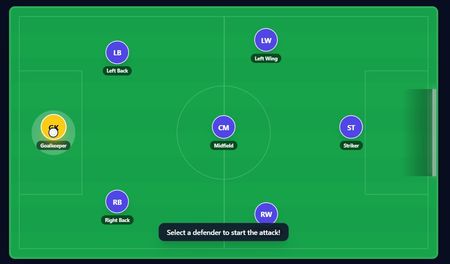
Late to this challenge - but now I've seen it it's a great opportunity to share a little side project I have been playing with. ⚽ My son is in an Under 10's football team that is struggling, as they are largely made up of players who have never been in a team. I know that simple knowledge content isn't going to reach them, and even listening to a coach often goes over their heads, but what about a little bit of gamified learning?! So I set about developing something for the Rise Code block. I've tried to stick to some fundamental principles of that level of football... Position, shape, and a basic move. In the game, you'll see a multi level progression, allowing kids to grow and evolve their knowledge. With more development I'd have developed the full rich story around the progression, and an ability to select a team role and explore some specifics of that role, so kids could choose their journey, but I just wanted to start with whether the concept was possible with some basic vibe coding. Thanks for my good friend Google Gemini for helping with the framework for me to build and develop from. I didn't get half as far as I wanted before my attention had to go elsewhere, but it has potential. Would love to hear people's thoughts. Give it a go!Football Manager
Hello there! 👋 I've been looking for different ways to start building out a portfolio and this weekly challenge caught my attention! I love football, despite supporting Everton... and wanted to trial some gamification in storyline! ⚽ Please have a look using the link and let me know your thoughts in the comments! 👇 Confession: I spent a bit more time on this than I planned! 😅 Enjoy! 😄 Link: Football Manager Module Website: 22Studio.ukWould you survive a 1912 physiology exam?
Hi everyone, I'm so excited for this challenge because this is my first project with Storyline 360. Take a look at my project. 👉 Would you survive a 1912 physiology exam? This challenge reminds me of the time at university, when I crammed all night to learn all the scientific terms and mechanisms to pass those biology and physiology tests. 😅 For this test, I don't want it to be too formal with no multiple choice and no instant feedback. Thus, I decided to add some interactivities with witty feedback and instant results. I also applied Bloom's Taxonomy to classify the questions. Feel free to share any thoughts or feedback! Happy to hear from you!Stop Answering Questions. Start Redesigning Them.
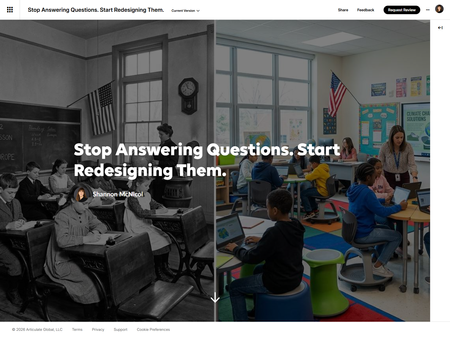
This week's E-Learning Heroes challenge dropped a fascinating artifact in our laps: the 1912 Bullitt County Schools eighth-grade final exam. And everyone's first instinct was the same: could I pass this thing? And honestly — maybe not. There's a grammar question asking students to write a single sentence containing four specific grammatical elements simultaneously. There's compound interest math done by hand. There's a civics question — "What is the proper basis of civil government?" — with no word limit, no rubric, and apparently no fear of what a fourteen-year-old might actually write. It's a fascinating artifact. And the obvious eLearning move would be to modernize it into an assessment. Swap the open-ended questions for multiple choice. Add a scenario. Slap on some feedback. Done. I went a different direction. What if the learner was the designer? Instead of asking people to answer the 1912 questions, we asked them to redesign them. Pick a question. Tag the instructional design strategies you'd apply — scenario-based, cause-and-effect, perspective-taking, transfer task, twenty options in total. Watch a live compatibility meter tell you whether your combination is a strong pairing or a bit of an overcrowded mess. Then get feedback: a scorecard rating your approach on cognitive load, authenticity, and transfer potential, plus a specific strength, a push-it-further nudge, and one genuinely hard reflective question to sit with. And at the end — a before/after reveal comparing the original 1912 question to an expert redesign, so you have something concrete to react to, agree with, or argue against. The whole thing runs in a single HTML file embedded in Rise via a Code Block. No frameworks, no dependencies. Why this framing works Most eLearning about instructional design is passive. You read about Bloom's taxonomy. You watch someone explain cognitive load theory. You take a quiz about it afterward. This puts you in the seat. You make a call — I'm going to apply scenario-based learning and cause-and-effect framing to this arithmetic problem — and then you get a mirror held up to that decision. The compatibility meter alone has a way of making you pause and ask whether you're building a coherent design rationale or just stacking strategies because they sound good. The 1912 exam is the perfect raw material for this because the questions are so far from modern practice that every design decision feels deliberate. You can't default to habit. You have to think. Give it a try below and let me know — which question did you pick, and did the compatibility meter surprise you? Built with Articulate Rise 360 and Claude by Anthropic. Stop Answering Questions. Start Redesigning Them.Welding Theory Course
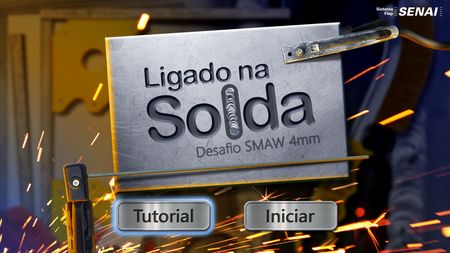
We created a game called "Connected to Welding" (in Brazilian Portuguese) so that students, in the welding technician course, could test their knowledge of shielded metal arc welding (SMAW) in a fun way. In the game, the student is guided by a supervisor woman who will be attentive to everything that will be done. This supervisor will also be the character who will instruct them in the tutorial. Game home screen 1. Initially, the student must check the Welding Procedure Specification (WPS), which, as the name suggests, are the specifications and guidelines to be followed for welding; 2. Subsequently, the student must select the Personal Protective Equipment (PPE), which must be used by the worker; 3. Selection of supplies: the welder must bring, in addition to the welding machine (inverter), to perform the welding and cleaning after completion; 4. Choose which type of coated electrode should be brought, which is defined in the Welding Procedure Specification; 5. Correctly connect the cables to the inverter, paying attention to which cable will hold the electrode, which will be attached to the metal flame, and their respective polarities; 6. Also, according to the specifications (WPS), calibrate the amperage of the inverter so that the weld does not pierce the metal sheet, nor is it too weak; 7. Once the weld is complete, it's necessary to clean the debris (slag) left in the process; 8. The last phase is the diagnostic stage, where the student will be presented with an image of a weld with problems. They must point out what problems were presented and why the weld presented such problems. I know it will be difficult to understand, as the vast majority of platform users are English-speaking, but I hope you appreciate the interactivity and the graphic design. Link to the game. Thanks for watching.87Views0likes0Comments