e-learning development
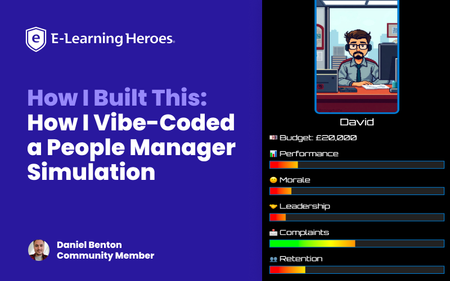
2120 TopicsHow I Built This: How I Vibe-Coded a People Manager Simulation
When the new Rise 360 Code Block (Beta) feature launched, I wanted to see just how far it could be pushed. Could you build something more than static content? That’s how the People Manager Simulation came to life – a fully playable, story-driven experience built entirely inside a single Rise code block, using only HTML, CSS, and JavaScript. In this video, I explain how it was created and how you can repurpose this approach in your own projects. Why I Made This In my day job, I design learning experiences for real teams, often around leadership, people management, and workplace decision-making. I wanted to create something that shows how these kinds of soft-skills topics can be transformed into immersive simulations without needing heavy development tools. The result is a game where you step into the shoes of a brand-new team leader, navigating real-world decisions that impact morale, performance, retention, and stress. Each choice has a trade-off, and yes, you can get “sacked” if you mismanage your stats. In the video, I mention that this project was built gradually, late evenings, after work, once my son was asleep. There were plenty of failed tests, odd bugs, and “why won’t this work” moments along the way. I did consider going back and documenting every single prompt and adjustment… but honestly, that would read like an increasingly impatient diary of me negotiating with ChatGPT! So instead, I wanted to share a simpler, more practical way for you to repurpose what already works. How I Built It Rather than starting from scratch, the method I show in the walkthrough involves: Uploading the existing working code of the simulation. Giving ChatGPT a single clear prompt that explains: This is for Rise 360’s custom code block. It should learn the structure and logic of the original simulation. It should rewrite the theme, dialogue, and characters for a new scenario. In the video, I demonstrate how to use the current People Manager Simulation code as context; use the download attached below. 📁 Download: People Manager Simulation HTML; attached below. You then give this to your LLM of choice as an attachment and provide your repurposing prompt; the one I used can also be downloaded below. 📁 Download: GPT Prompt for Repurposing Existing Demo; attached below. Key Takeaways Start from a working simulation instead of a blank page. Use a single, focused prompt to repurpose the entire code and story. Attach your full code as context so the model understands structure and logic. Re-use this workflow to adapt learning scenarios quickly—no coding expertise required. The Result Here’s the outcome of my own repurposing test from the walkthrough: a completely new narrative built using the same base code and single prompt. Is it perfect? No. But it’s a solid foundation—and all this came together in about ten minutes. 📁 Download: The Result — Full New HTML Code; attached below. Final Thought The best part of this approach is accessibility: you don’t need to be a coder to build something that feels custom. By starting with a working framework and iterating through clear, focused prompts, you can turn any learning scenario into a playable, data-driven experience. Whether it’s leadership, compliance, or customer service, this structure gives you the foundation to explore how choices shape outcomes, all inside Rise 360. My final ask is: please repurpose and improve on any of the ideas shared in this article. Let me and the wider community know how you get on. 💬 Ask Me Anything! I’d love to hear your feedback and answer any questions about the build. Drop your thoughts in the comments below—I’ll be checking in and responding! Want to Share Your Build? Do you have a project you’d love to share with the community? We’re always looking for more How I Built This stories. Whether it’s a game, interaction, or unique design, we’d love to feature your process. Drop a note in the comments or reach out to the community team if you’re interested!3.7KViews20likes7CommentsRise Canvas
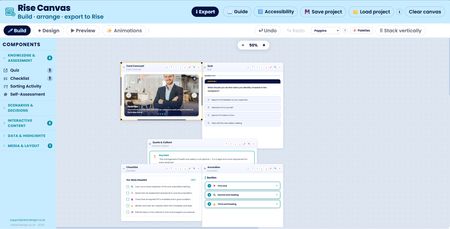
A drag and drop code block creator... the components can be resized and positioned anywhere on the canvas. Any number of different components can be added to the canvas… Output as HTML/JS to add to a code block Rise Canvas Rise Canvas is not affiliated with Articulate® or Rise 360®.1.7KViews19likes20Comments*ENTRIES ARE NOW CLOSED* GIVEAWAY: DevLearn is coming — want to join us? 🎉
DevLearn is almost here (Nov 12–14)! Whether you’re already going or hoping to, we want to celebrate with the learning community. To share the excitement, we're giving away TWO DevLearn 3-Day Conference passes valued at $2,395 (travel and accommodations not included, U.S. residents only). 👉 To enter: Comment below and tell us: 💬 Why you want to go and/or what you hope to learn! That’s it! We’ll randomly select two winners from the comments. ⏰ Enter by: Tuesday, October 28, 2025 8:00 AM PT 🏆 Winners announced: Wednesday, October 29, 2025 by 5:00 PM PT Already have your ticket? Drop a “👋 I’ll be there!” so we know who to connect with in Vegas! UPDATE: Thank you to everyone who shared their stories! We’ve loved reading your entries and seeing so many opportunities to collaborate and learn from this amazing community. 🎉 Congratulations to our winners: Kaitlyn-Skyline and larryvanwave-ff We’re so excited for you and hope to do more fun giveaways like this in the future. Thanks again to everyone who participated!2.7KViews19likes73CommentsPeer Pod Coming Soon: “New to Instructional Design” — Who’s Joining Us?
We’re kicking off a brand-new Peer Pod for anyone who’s new to instructional design and you’re invited! 🎉 Peer Pods are 4-week learning groups where community members explore a topic together through weekly prompts, curated resources, and shared discussion. Whether you’re a few days or several months into your role, this is your chance to connect with peers, reflect on key topics, and build confidence together. Here’s what we’ll explore: ✨ What to focus on as you get started 📦 Intro to Articulate 360 + course design best practices 🤝 Tips for working with SMEs 💻 Best practices for incorporating AI By the end, you’ll walk away with a stronger foundation and a group of peers cheering you on. 🗓 Start Date: Monday, January 12, 2026 Participants will be added to the private Peer Pod group about a week before we begin. 👉 Want to join? Fill out the registration form. 💬 Your turn: What Peer Pod topics do you want to see next? If you could join a focused 4-week learning group, what topic would you choose? Drop your ideas below so we can build pods around what you want most. 🙌1.9KViews14likes36CommentsRise Learning Journal / Notes
Update (04 June 2025) This project is now available open source at GitLab. I've included a quick glance at the License (Same as Moodle). License: GNU GPL v3 Type: Strong copyleft license Implications: ✅ You can use, modify, and distribute Rise Learning Journal freely. 🔁 If you distribute a modified version, you must also release the source code under the GPLv3. ❌ You cannot make it proprietary or incorporate it into closed-source software. ✅ You can use it commercially, but the GPL applies to any distribution. Instructions for implementation further down the page under the heading BETA Version Release. I've been working on a Learning Journal for Rise. I have an BETA version I'd like to share on SCORM Cloud. (trial account, limited to 10 users, ping me, mailto:[email protected], if it's maxed out and I'll clear users). The features we have included so far are: Comments persisted between sessions (SCORM 1.2 & SCORM 2004 3rd and 4th Ed) Save comments, associated with blocks individual blocks Comments are organised into topics/pages Edit existing Comments Delete Comments Print comments (to printer, or PDF is you have the required software installed) Export comments to Word (*.doc) Pagination (If comments exceed a defined number, they are split into pages) Add the functionality to individual blocks, or globally. There are some things that needs to be finalised which will not take a great deal of work to complete. Mobile compatibility WCAG 2.2 AA What I'm looking for is a bit of community input, as I know people have wanted this feature for quite some time. This is my best guess of how somebody might use a learning journal, but would love to hear any other examples of how it could function, or additional useful features that could be included. If you would like to check it out on SCORM Cloud. You can visit this URL: Rise Learning Journal on SCORM Cloud (trial account, limited to 10 users, ping me, mailto:[email protected], if it's maxed out and I'll clear users). Update (3rd December 2024) I have continued to work on this project and it is now SCORM 2004 compatible. Again, it is using the cmi.comments_from_learner. Unfortunately I found a significant issue with the Articulate implementation of the SCORM 1.2 and 2004 comments. I am in communication with support after logging the issue. I am hoping I can convince them that the implementation is incorrect, and the base script is updated. In the meantime, I am applying a patch to the Articulate "WriteComment" function to ensure comments are stored correctly for SCORM 1.2 and SCORM 2004. I have also made some cosmetic changes and updated the CSS for the HTML to ensure the application picks up the current Rise module theme (colours, fonts etc). I've fixed a few bugs I have found along the way with regards to deleting journal entries, and editing journal entries when not on the page they originated from. This all appears to be working really well now. My next priority will be working on the CSS to ensure it is mobile compatible. Once all of the HTML and CSS is finalised, I'll then work on the accessibility. I've been implementing aria attributes as I go along, but there is still some testing and development to be done on that side of things. I will be looking to release this as a BETA to a handful of people early in the new year. Update (9th December 2024) Accessibility Started work on accessibility. Currently implementing and then will be looking to test using JAWS 2024 and NVDA over the xmas holiday period. On track for BETA release Jan 2025. Update (09 January 2025) Accessibility & refactoring Still working on accessibility and refactoring. There is a little more work than first forecast. Yes, I know, you've never heard that from a developer before. I'm 50/50 as to whether I can get this out in January. It will depend on other work commitments, but I will keep this post updated. I have decided to simplify the colour scheme and move away from using the defined "branding" colours inherited from Rise, as I was finding this a bit unpredictable with colour contrast, and so in the interest of ensuring the content has the best colour contrast, I'll be hard coding the CSS rather than using the CSS variables defined in Rise. I'll re-visit this in future. Looking at the code, I need some serious refactoring as I think I found some redundancies and so need to delete any unused code that I added and then abandoned. Oh, and Happy New Year. Update (24 January 2025) Accessibility & refactoring Almost ready for BETA release. Should be ready for release next Tuesday. Accessibility just about completed. I think I could spend another few days improving things, but I think this will be a good first release. BETA Version Release Contact: [email protected] Minimum requirements: Rise course published SCORM 1.2 or 2004 (xAPI not currently supported) LMS Support for cmi.comments (TalentLMS cmi.comments implentation is not supported as the comments are not persisted between sessions). Release Notes: This is a BETA release, and is provided as is without any warranties and It should be used with caution and fully tested for your use case before considering for production. If you do find bugs, please report them to [email protected] (include browser, LMS, device) and I'll release a fix as quickly as possible. This is a side project and so does come second to our day job which can be busy, and so you may need a certain level of patience. Fixes can be expedited for your use case through engagement of our services for time critical projects. It has been tested on mobile, but not extensively (Google Pixel + iPhone). Win/Chrome has been the browser used for development, and testing has also been performed on Win/Firefox and Win/Edge. Features requests: If you require any features that deviate from the BETA version, they will be considered on their merit, but can only be guaranteed for your own implementation through engagement for our services. We have a long list of features that we would like to add if there is enough interest in the application and if it is viable. Accessibility: We made the decision to remove colors from the modal window theme to keep it simple and generic and accessible (high color contrast). The application has been tested with JAWS 2024 and is fully keyboard accessible and keeps assistive technology users informed of what is happening when interacting with the modal window. I'm always willing to make improvements to accessibility as a priority. Accessibility issues are treated as a bug and not a feature request. Implementation: Publish your Rise course to either SCORM 1.2 or 2004 Download the two files note.min.css and notes.min.js files to your computer. Extract your published Rise course to your computer and then copy the note.min.css and note.min.js files to the scormcontent\lib folder Open the scormcontent\index.html file in a simple text editor such as notepad and paste the following text just before the closing head element, which looks like this </head>. <link type="text/css" rel="stylesheet" href="lib/notes.min.css"> <script type="text/javascript" src="lib/notes.min.js" data-notes-per-page="5"></script> It will look something like this: // Excerpt of scormcontent/index.html starts window.__loadEntry = __loadEntry window.__loadRemoteEntry = __loadRemoteEntry window.__loadJsonp = __loadJsonp window.__resolveJsonp = __resolveJsonp window.__fetchCourse = __fetchCourse })() </script> <link type="text/css" rel="stylesheet" href="lib/notes.min.css"> <script type="text/javascript" src="lib/notes.min.js" data-notes-per-page="5"></script> </head> <body> <div id="app"></div> // Excerpt of scormcontent/index.html ends You can adjust the data-notes-per-page="5" attribute to determine how many notes should be listed in the viewer, before the pagination (note navigation) kicks in. Save the scormcontent/index.html file It's important to get this bit right, as the LMS expects the imsmanifest file in the root of the zip file you are about to create. Navigate to the folder containing imsmanifest.xml and then select all (CTL+A) and then select archive/zip/compress depending on the software you use the terminology can be different. It must be a zip file though and the imasmanifest.xml file must be in the root of the zip file. Update (28 January 2025) Print functionality improvement After some user feedback, I have adjust the print functionality so that there is less chance of the student losing the course window during printing. When print is completed or cancelled, the print page closes and the user is return to the course window. Update (30 January 2025) Fix: Added functionality to handle learn.riseusercontent.com cmi.comments implementation. The cmi.comments implementation is incorrect on the LMS and requires the application to retrieve all comments and save to the LMS rather than appending to existing comments. This could cause memory issues if users add multiple long comments over time. CSS: Improved CSS for mobile view (using full height of the screen to display the application. Update (31 January 2025) Bug: There is a known issue with TalentLMS. TalentLMS does not persist SCORM 1.2 cmi.comments between sessions. All comments are disregarded at the end of the session. For this reason, we cannot support TalentLMS unless TalentLMS changes the functionality of the SCORM 1.2 cmi.comments. CSS: Improved CSS for mobile view. Supporting devices with a minimum screen width of 355px wide. Update (07 March 2025) New configuration option: I have added a configuration option that allows you to determine where the note button should be inserted (instead of globally). In order to determine where the note button should be inserted, you need to follow these steps: Grab a copy of the latest version of the JS and CSS files. Wherever you would like to insert the note button, within the Rise authoring environment, simply add {RM.NOTES} to the top of the block, for example: Follow the Implementation instructions, outlined earlier in this post. When you come to add the script to the HTML file, you will need to add an extra data attribute to the <script> tag called data-notes-global and set the value as false. <script type="module" src="lib/notes.min.js" data-notes-global="false"></script> Update (12 March 2025) BETA Distribution files, including the README.MD document, are available to download. This will be the last feature addition for a while now. Bug fixes and stabilisation will continue, but any new features will have to wait or can be requested via [email protected]. Prompt You can now add a prompt to the note when defining a notes button using the {RM.NOTES} directive. The prompt is defined as a configuration option in the following way {RM.NOTES PROMPT="Prompt text goes here."}. It would look something like this in the Rise author environment. This would ensure that a notes button is inserted on this block, and when selected, will display the text input, preceded by the prompt "What should you include in your clinical notes?". In order to use the prompt, you must set the global flag to false using the <script> tag as follows: <script type="module" src="lib/notes.min.js" data-notes-global="false"></script> Note button position The note button default position is the top right of the target block. The button can now be positioned at the centre bottom of the target block. The position configuration can be used with the global flag set to true (buttons inserted automatically on blocks) or set to false (buttons only inserted where the {RM.NOTES} directive is present within the block. <script type="module" src="lib/notes.min.js" data-notes-button-centre-bottom="true"></script>4.2KViews13likes94CommentsWorried about AI taking your job?
Most people use AI the way they use a search bar. Type something vague, take what comes back. That's how poor course content gets made. This course is about using it deliberately. You'll practise briefing an AI properly, interrogating what it gives you, and deciding what your own expertise still has to supply. The AI Shift Tools used: Canva, Gemini and Rise Canvas386Views12likes10CommentsHow I Built This: I Developed an Award-Winning Ethics Course
Why I Built This: When I first learned about branching scenarios, something clicked for me that I hadn’t seen other eLearning developers execute: visually compelling, philosophically rich thought experiments. I studied Moral Philosophy in my undergrad and became obsessed with ethical dilemmas. Naturally, I decided to build an ethics course about technology. Think The Trolley Problem, only I wanted to pose questions about the growing reliance on AI and its implications by employing Instructional Design strategies. An opportunity came up through my Master’s program to attend DevLearn and compete in DemoFest, so it was time to start building my concept. I designed and developed a course in Storyline called The Agency Algorithm that confronts learners with issues regarding three main topics: algorithmic warfare (The Armory), AI assisted resource allocation (The Triage Garden), and surveillance (The Mask Archive). The Experience & Design Intent: A quick walkthrough of the multi-room experience. The Agency Algorithm is a multi-room interactive learning experience that blends instructional design, game-like mechanics, and philosophical inquiry. It immerses learners in ethically complex scenarios by leveraging branching logic, and integrating experiential aesthetics with conceptual depth. My primary goal with this project was to encourage critical reflection on the role of technology on human agency and autonomous choice. The concept itself was pretty clear to me, but I wanted to push the limits of Storyline visually, so I acquired a number of 3D assets from Adobe Stock, some of which I further modified in Adobe Dimension. I wanted the visuals to anchor the learner in a unique environment that did not feel reminiscent of traditional eLearning, and rather create space to explore and feel like a participant in something unfolding. There aren’t often black and white answers to ethical questions, and branching scenarios are an excellent way to illustrate this while offering learners a safe place to experiment and think through various outcomes based on their decision making. Visual Worldbuilding/Making It Not Feel Like eLearning: Initially, I intended to hand draw assets myself to really hone in on the human vs AI dynamic, but quickly realized the time I’d have to accomplish this was dwindling. While I drafted a few loose concepts in my journal, I ultimately decided to stick with digital assets. While I landed on 3D assets largely due to time constraints, the outcome is reminiscent of an old experimental video game or some sort of immersive idea gallery. As an artist, I often approach my work from a minimalist lens so this project was a fun way to really add some artistry that corporate training often doesn’t have room for. Variables, Multi-state objects, Cue points, and other mechanics: I relied heavily on multi-state objects to create hover states, “tip” cards, text labels, and more, for example in the circuits with definition reveals. I enjoyed building the “loading” effect in the Mask Archive, although it was a bit clunky and took a lot of trial and error! I learned a lot along the way and used a cue point on an orb with a glow effect beneath the mask and used triggers to cause the effect to work. The course overall has a few hundred triggers (slide, object, and variable triggers) and somewhere around 40 variables (mostly T/F variables). What I learned: I think it is important that we don’t hand-hold learners through every learning experience. I want users to think through complex challenges and autonomously choose and feel like a true agent in the process of acquiring knowledge. A lot of eLearning makes it too easy for the learner and we lose engagement when we undermine the intelligence of our audience. I learned SO much about how to leverage Storyline in new ways. I am still a relatively new user to the tool, so this project allowed me to freely explore and be guided by curiosity. Link to my portfolio: https://www.abigailvettese.com/1.5KViews12likes7CommentsStoryline 360 Pros — What’s Your Favorite “Hidden Gem”? 💎
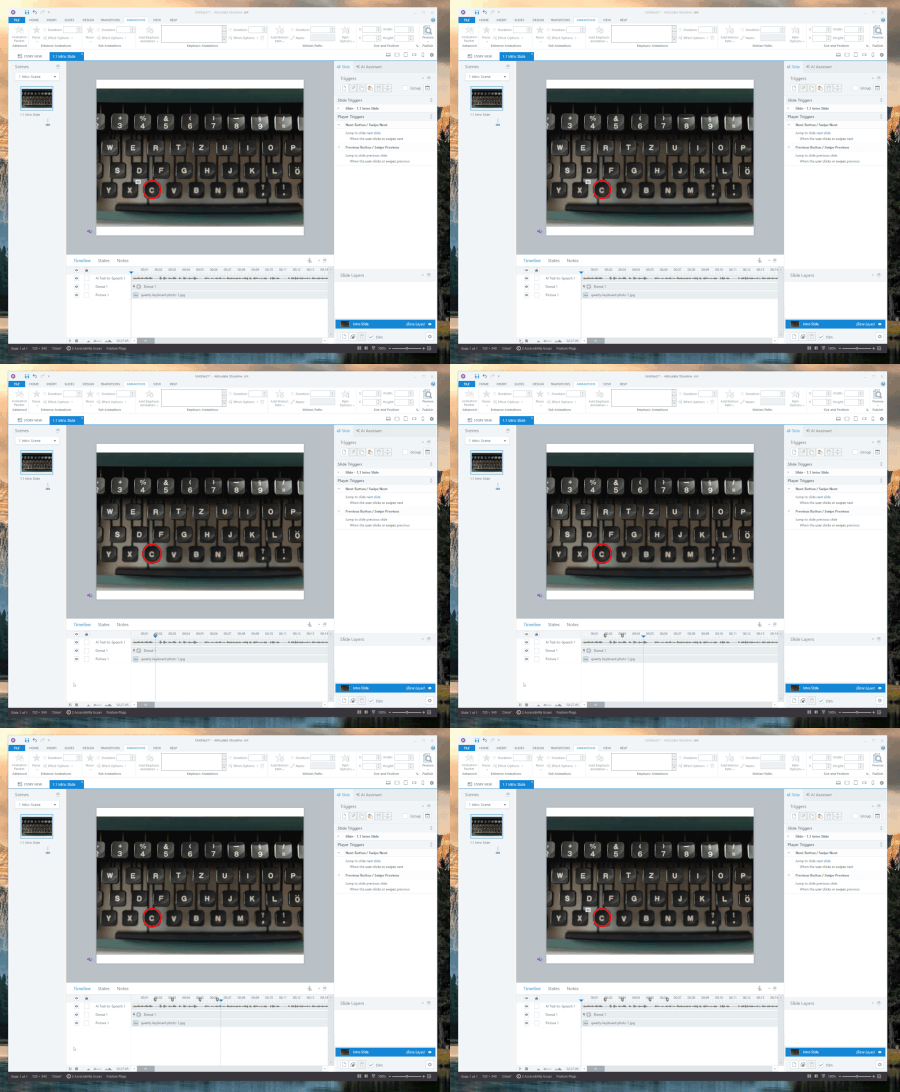
As someone who’s spent a lot of time working with (and on!) Storyline 360, I’ve come to appreciate the power in the little things — those lesser-known features that quietly make our lives easier. Here's one of my personal favorites: 🎧📽️ Cue Points with the “C” Key: I recently spoke with a customer who struggled to time trigger actions to audio and video media on their slides. They would preview the slide, make note of when a trigger should be fired, then return to slide authoring view to add a cue point to the timeline to tie into the trigger event. This would require a lot of manual back-and-forth between authoring and previewing. I often have to do the same thing, and there is an easier way. If you use stage preview (accessible via the "Play" icon" in the lower-left corner of the Timeline panel), Storyline will stay in the slide authoring view and play the timeline of the slide, including any audio or video media that's present. As it plays, you can press the "C" key on your keyboard to have cue points added to the current playback position. It’s a simple way to place cue points in real time, right where they’re needed — perfect for syncing trigger actions to specific moments in your media. cting Storyline 360's UI and using the "C" key to drop cue points on the timeline. Now I’m curious: What’s your favorite under-the-radar Storyline feature? Something small, subtle, maybe even a little obscure — but that you personally couldn’t live without. Drop it in the comments — I’d love to learn what little gems you rely on. 👇3.9KViews12likes40CommentsCAROUSEL in Storyline!
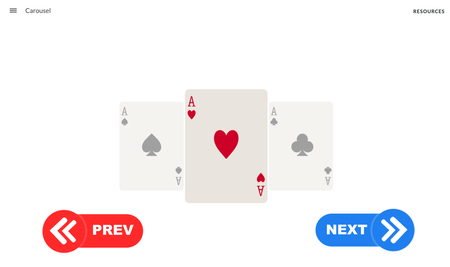
Ok over the last few weeks I've been learning to use JavaScript in Storyline modules and this is another great example of taking some of the functionality out of Rise and using it in Storyline. I've discovered how to create a really slick carousel. https://360.articulate.com/review/content/b2224974-b080-41ad-aa47-f874da152b14/review You can customize the code for size speed and motion. Just need to copy your object IDs into the code and you're good to go. Code should be able to be copied and pasted right into your project. Let me know how you like it!!!! // ------------------------------------ // STORYLINE CARD CAROUSEL // ------------------------------------ const CARD_IDS = [ "CARD_1_OBJECT_ID", "CARD_2_OBJECT_ID", "CARD_3_OBJECT_ID", "CARD_4_OBJECT_ID" ]; const PREVIOUS_BUTTON_ID = "PREVIOUS_BUTTON_OBJECT_ID"; const NEXT_BUTTON_ID = "NEXT_BUTTON_OBJECT_ID"; // ------------------------------------ // CUSTOMIZATION // ------------------------------------ // Horizontal center of the carousel. // Change these to match your slide. const CENTER_X = slideWidth() / 2; const CENTER_Y = slideHeight() / 2; // Distance between card centers. const CARD_SPACING = 330; // Appearance of the centered card. const ACTIVE_SCALE = 1; const ACTIVE_OPACITY = 1; // Appearance of cards beside the centered card. const SIDE_SCALE = 0.78; const SIDE_OPACITY = 0.45; // Cards farther away can be hidden. const HIDDEN_SCALE = 0.65; // Animation responsiveness. // Lower numbers are slower and smoother. const SMOOTHING = 0.14; // Whether Next from the last card returns to the first. const LOOP_CAROUSEL = true; // ------------------------------------ // SETUP // ------------------------------------ const cards = CARD_IDS.map((id, index) => { const item = object(id); item.style.transformOrigin = "center center"; return { item, index, currentX: item.x, currentY: item.y, currentScale: 1, currentOpacity: 1 }; }); const previousButton = object(PREVIOUS_BUTTON_ID); const nextButton = object(NEXT_BUTTON_ID); let activeIndex = 0; // ------------------------------------ // HELPERS // ------------------------------------ function clamp(value, min, max) { return Math.min(max, Math.max(min, value)); } function changeCard(direction) { activeIndex += direction; if (LOOP_CAROUSEL) { if (activeIndex < 0) { activeIndex = cards.length - 1; } if (activeIndex >= cards.length) { activeIndex = 0; } } else { activeIndex = clamp( activeIndex, 0, cards.length - 1 ); } // Optional Storyline number variable. // Create CurrentCarouselCard if you want to use this. // setVar("CurrentCarouselCard", activeIndex + 1); } // ------------------------------------ // BUTTON EVENTS // ------------------------------------ previousButton.click(() => { changeCard(-1); }); nextButton.click(() => { changeCard(1); }); // ------------------------------------ // CARD CLICK EVENTS // ------------------------------------ // Clicking a side card brings it to the center. // Clicking the active card can trigger your // normal Storyline action or open a layer. cards.forEach((card) => { card.item.click(() => { activeIndex = card.index; }); }); // ------------------------------------ // ANIMATION LOOP // ------------------------------------ update(() => { cards.forEach((card) => { const offset = card.index - activeIndex; const absoluteOffset = Math.abs(offset); let targetX; let targetY = CENTER_Y - card.item.height / 2; let targetScale; let targetOpacity; if (absoluteOffset === 0) { // Active center card. targetX = CENTER_X - card.item.width / 2; targetScale = ACTIVE_SCALE; targetOpacity = ACTIVE_OPACITY; card.item.style.pointerEvents = "auto"; } else if (absoluteOffset === 1) { // Immediate side cards. targetX = CENTER_X - card.item.width / 2 + offset * CARD_SPACING; targetScale = SIDE_SCALE; targetOpacity = SIDE_OPACITY; card.item.style.pointerEvents = "auto"; } else { // Cards farther away. targetX = CENTER_X - card.item.width / 2 + offset * CARD_SPACING; targetScale = HIDDEN_SCALE; targetOpacity = 0; card.item.style.pointerEvents = "none"; } // Smoothly ease toward the target values. card.currentX += (targetX - card.currentX) * SMOOTHING; card.currentY += (targetY - card.currentY) * SMOOTHING; card.currentScale += (targetScale - card.currentScale) * SMOOTHING; card.currentOpacity += (targetOpacity - card.currentOpacity) * SMOOTHING; card.item.x = card.currentX; card.item.y = card.currentY; card.item.style.transform = `scale(${card.currentScale})`; card.item.style.opacity = card.currentOpacity; }); });706Views11likes10Comments