e-learning development
2156 TopicsCustom HTML code blocks inside Rise 360: six short examples
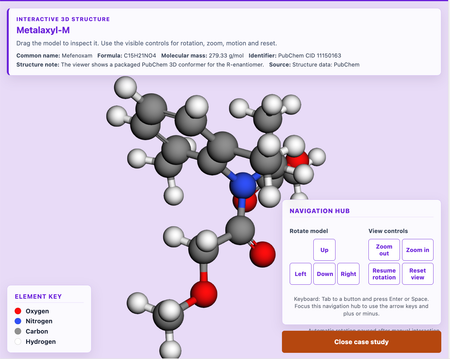
Hi all, As many have been doing, I’ve been building my own HTML blocks to sit inside Rise 360, and wanted to share where they’ve got to. Why build my own? Rise has some limitations and glitches, and it doesn’t always let me have full branding and style. I like the look of CSS and JavaScript branding tokens and behaviours... those micro-interactions that support the learner’s journey. Code blocks are also really useful for quizzes and knowledge checks. Build those in Rise 360 and an update tends to reset progress in some LMSs, even with a connected package. As a code block, it doesn’t cause that issue. What caught me out this round: • Mobile: getting every build working on phones, using a full device emulator as best as possible. • Glitches between pages, and not just pages, between clicks. Rather like Storyline, you just have to make sure everything’s lined up. Each course holds one block, as a learner would see it: • Confidence self-check: https://360.articulate.com/review/content/d58cf155-636e-4f43-82c9-1832035cd504/review • 3D molecule viewer with a case study: https://360.articulate.com/review/content/438ac80f-37c1-4fc9-9e63-bf352321f713/review • Reveal cards: https://360.articulate.com/review/content/ce4bf4c4-569b-4952-a194-979d0c778cec/review • Chart-choice swipe: https://360.articulate.com/review/content/f520b311-9cc7-49d2-aa67-f79c8dba84ff/review • Magnifier: https://360.articulate.com/review/content/52955237-15b1-4735-a948-9dd001060ae2/review • Reflection notepad: https://360.articulate.com/review/content/b9fdc4cf-8d53-4cf5-8200-828eba12524a/review The main thing I want to show is that you don’t have to step away completely from Rise 360. You can supplement and enhance it with bespoke blocks, once you understand the learner journey and those interactions... interactive WITHOUT being gimmicky. Happy to talk through how I built any of them and pass on my "coding" pitfalls 😁231Views3likes5Comments48-Hour Alexandria Weekend Planner – My First LXD Project
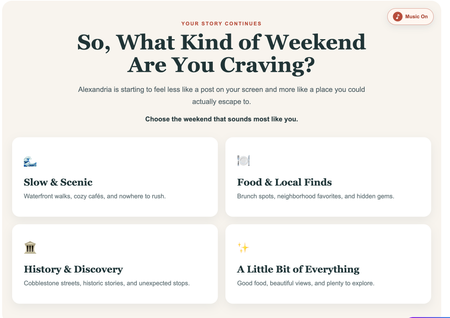
Hi everyone! I’m a teacher currently transitioning into LXD, and I recently finished my first larger e-learning project. I created a 48-hour weekend planner for Old Town Alexandria. The idea was to let users explore hotels, restaurants, and attractions while building a realistic weekend itinerary and staying within a budget. I built most of the experience in Rise 360 and also experimented with custom-coded interactions and video editing. This was my first time putting all of these pieces together into one complete project, so I’d really appreciate any feedback on the user experience, interaction design, and overall flow. Here’s the project: https://millie1017.github.io/my-project/ Thanks for taking a look!180Views4likes8CommentsIs Articulate moving away from Storyline?
With all of the latest updates they seem to be geared towards Rise, is Articulate moving away from Storyline? Doesn't make much sense to me considering Storyline is more geared towards developing for mobile, who wants to scroll on their cell phone forever? I have always like to develop more in Storyline because it seemed to make more sense to me but should I be focusing my attention more towards Rise or should I start looking for another solution?151Views1like9CommentsStoryline xAPI reporting issues with imported slides
One of our users imported Powerpoint slides and it seems that that has stripped away the capability for xAPI statements to be sent to the LRS system. The reporting shows no messages come through even when the xAPI triggers are entered directly to the slides. Does importing slides from powerpoint strip the xAPI reporting capability from the package, and if so is there any way to repair the package instead of recreating the entire course? All other xAPI packages created from scratch or templates report fine.Solved63Views1like5CommentsFormat Painter - Storyline 360
I have been a Storyline user since the software first came out. It has many great capabilities and I do appreciate the ongoing updates and enhancements but it would be awesome if some of the little glitches developers experience on a regular basis were addressed. A prime example is Format Painter and directly how it handles buttons. It would be great if it acted as expected for all buttons including custom, quiz and built-in. It is very tedious and time consuming to have to manually edit every state of a button in a project. Not to mention if a response changes in a MC/TF question that the updated response isn't carried through to the other states therefore making rollovers, etc. look like a drunken monkey programmed it. Let me create one and then leverage that one for every other button in a file. Seems like a simple ask to me although I am sure there are plenty of issues that I am unaware of that make that ask a challenge.Help requested on a Storyline limitation
hi, as per my (long) title i have a 6-hours, all-videos course that needs closed captions in 4 languages, but storyline only lets me add just one language for closed captions. And of course i cannot add layers or forms with text inside as it will be veeeery long to achieve. I cannot use Rise either. So looks like i have to replicate 4 times my 6-hours course to have a huge 24-hours storyline file just for this. Any idea of how to get out of this problem? thanks a lot24Views0likes2CommentsDecision Trees: Exploring the Road Not Taken
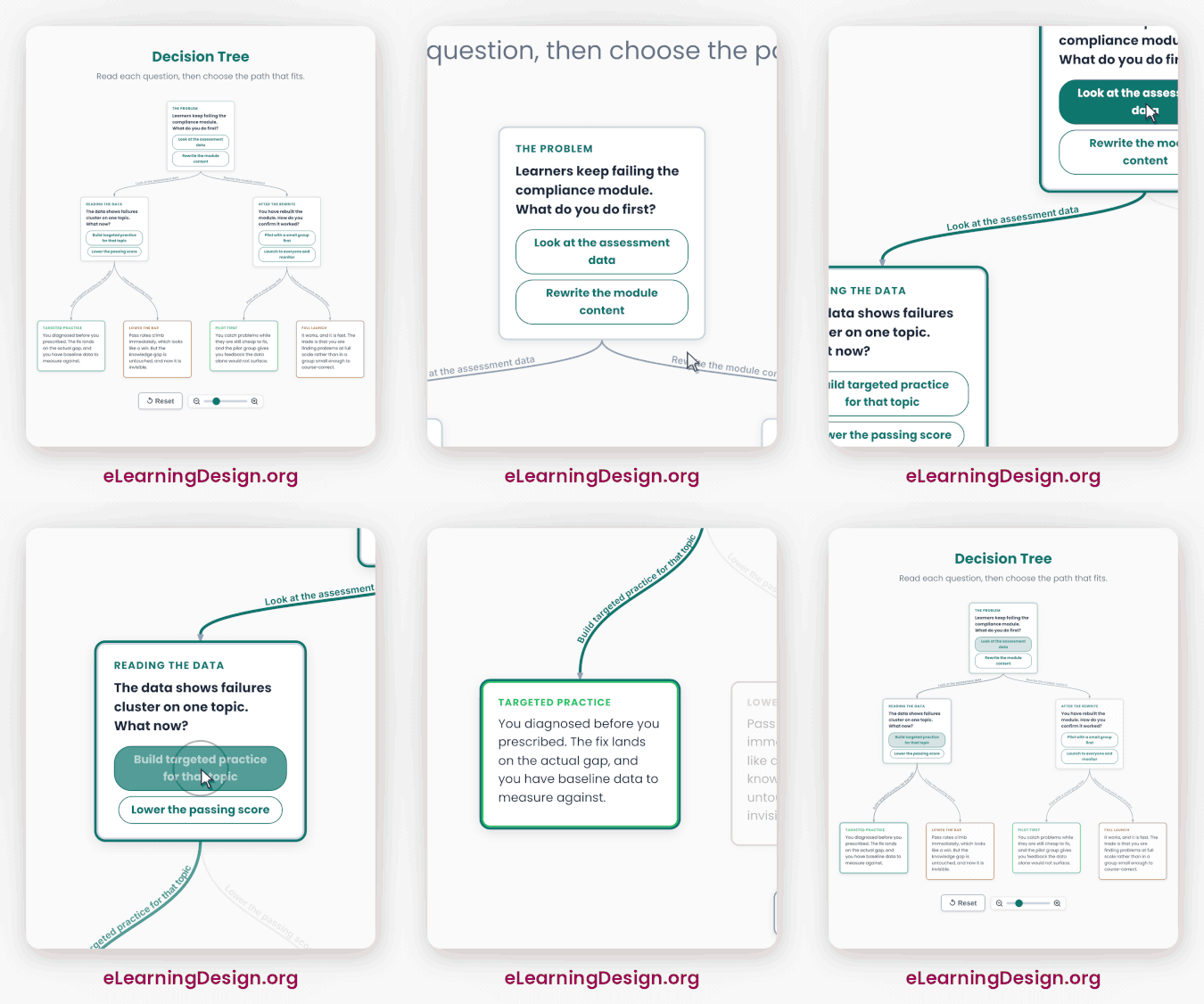
We ask learners to make decisions all the time. But how often do we give them the opportunity to see what would have happened if they'd made a different choice? That's one of the things I like most about decision trees. Instead of presenting a question, collecting an answer, and moving on, a decision tree allows learners to explore how one choice influences the next. They can follow a path to its conclusion, return to an earlier decision, and discover how a different choice changes the outcome. Sometimes the most valuable learning happens when they explore the path they didn't take. When would I use a decision tree? Decision trees work particularly well when decisions have consequences that aren't immediately obvious. A few examples: Troubleshooting: Explore how different diagnostic decisions lead to different solutions. Customer service: Follow the consequences of different responses to a customer situation. Leadership development: Examine how communication and management decisions influence team outcomes. Compliance and policy: Apply policies to realistic situations where context influences the appropriate response. Process training: Understand how an early decision affects subsequent steps, responsibilities, or outcomes. Why does this work for learning? What I particularly like about decision trees is that they encourage learners to examine the relationships between decisions and consequences. They're practicing more than recall. They're applying information, analyzing cause-and-effect relationships, comparing alternatives, and evaluating outcomes. These are the kinds of thinking we want learners to develop, particularly when the goal is sound judgment rather than memorizing information. There's also value in being able to backtrack. When learners revisit an earlier decision and explore another branch, they can compare outcomes and reconsider their original reasoning. And unlike real life, a poor decision doesn't require an incident report. About this interaction The example in the GIF explores decisions surrounding a compliance training problem. Learners follow different paths, examine the consequences, and return to explore alternatives. I built the interaction as standalone HTML, so it can be embedded into Articulate Rise 360 using an Embed block or incorporated into Storyline 360 as a web object. The content and visual design can be customized for different learning scenarios. I'm curious how others are using branching activities. Do you typically guide learners toward one correct outcome, or give them the freedom to explore multiple paths and compare what happens?122Views1like2CommentsAI generated/modified content in the Content Library 360
My company is currently introducing a policy regarding the use of dedicated watermarks displayed on multimedia contents that were created or modified using AI to comply with changing legislation. I would like to learn more about whether the content provided in the Content Library 360 could possibly be marked in a way that would offer transparency in regards to the use of AI during the creation process of these multimedia assets. Thanks in advance for any information!Seeking Feedback on My First Storyline 360 Module
Greetings, everyone! After twenty years as a classroom educator, I'm transitioning into instructional design and learning experience design. I've spent the last four months teaching myself Articulate Storyline 360 while developing my first complete eLearning module, Productive Feedback. The module is designed for charge nurses and introduces a simple, three-element model for providing specific, focused feedback to their staff. I've recently completed the first version and am beginning Alpha testing. I'd greatly appreciate feedback from fellow designers, particularly regarding the clarity of the content, learner experience, navigation, and overall instructional design. I'm especially interested in constructive criticism and suggestions for improvement as I continue refining the module for my portfolio. Review 360 link: https://360.articulate.com/review/content/9a37fa9c-6c32-4352-b0ba-884450b7ff5d/review Thank you so much for taking the time to look at my work. I truly appreciate any insights you're willing to share. Take good care! -KyleSolved210Views2likes7Comments