instructional design
1346 TopicsHello, E-Learning Heroes!
Crystal from South Dakota here! I have professional expertise in publishing, communications, design, and education. I've worked as a writer, editor, publication designer, and educator, and I'm now transitioning into instructional design and learning experience design. I love taking complex information, finding meaningful connections, and organizing it into something clear, engaging, and useful. I enjoy working with both the big picture and all the little pieces that make it work. Also, TYPOGRAPHY! Wanna talk fonts? Page design hierarchy? Yes, please. I've designed entire publications, developed curriculum and instructional materials, written assessments, and created interactive learning activities. I'm here to explore new tools and discover new ways to design learning experiences. Crystal2Views0likes0CommentsIssue with a slide in SL - click to reveal interaction
Hello - I am looking for some help for slide 1.8 in my project and the recurring slides on it. the text on the layers keeps disappearing and when i click the refresh button it plays the audies of the base layer and the layer it is on. can i add the SL file here? i know there used to be an option.27Views0likes2CommentsSpin the Plate: An Oktoberfest Beer Pairing Adventure
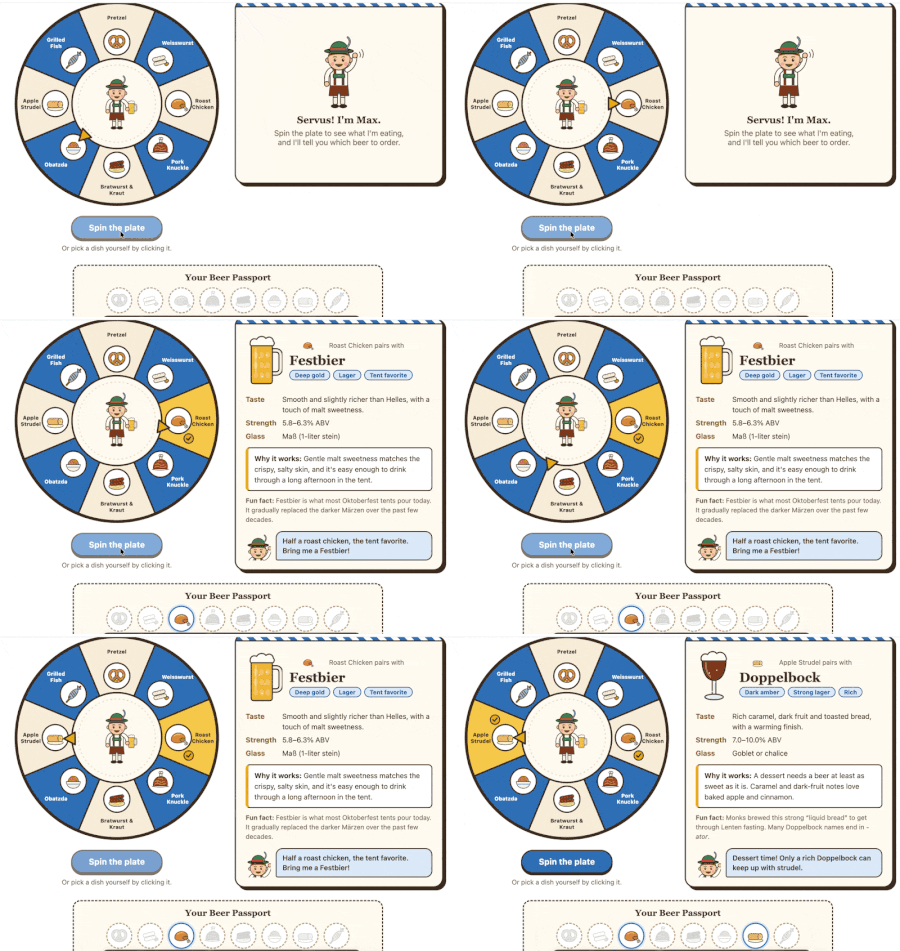
For this week’s challenge, I built a short Rise course that teaches first-time Oktoberfest visitors which beer to order with classic Bavarian dishes. Learners meet Max, a local guide who walks them through the tent, explains the difference between lagers and ales, and then hands them the plate. They spin to see what Max is eating, discover the beer that pairs with it and why, and collect stamps in a Beer Passport. A short quiz at the end checks whether they can make the pairings on their own. Tools: Rise 360 (Timeline, Tabs, Flashcards, Knowledge Checks, Quiz), plus a custom HTML/JavaScript spinner embedded in the course. I designed the interaction and content and used Claude to help with the code and illustrations. This is my first Rise project, so I’d love any feedback, especially on the flow and the spinner interaction! 🍺 view the course92Views1like3Comments48-Hour Alexandria Weekend Planner – My First LXD Project
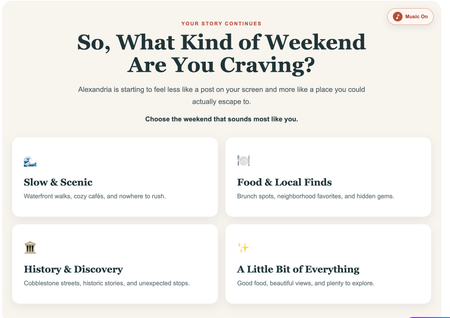
Hi everyone! I’m a teacher currently transitioning into LXD, and I recently finished my first larger e-learning project. I created a 48-hour weekend planner for Old Town Alexandria. The idea was to let users explore hotels, restaurants, and attractions while building a realistic weekend itinerary and staying within a budget. I built most of the experience in Rise 360 and also experimented with custom-coded interactions and video editing. This was my first time putting all of these pieces together into one complete project, so I’d really appreciate any feedback on the user experience, interaction design, and overall flow. Here’s the project: https://millie1017.github.io/my-project/ Thanks for taking a look!82Views1like3CommentsBest practices for maintaining a large library of Storyline system simulations
We’re exploring Storyline for building a library of software simulations, including processes that move between multiple systems that share data. For teams doing this at scale: How do you structure simulations for easier maintenance when applications change? Do you use screen recordings, screenshots, custom-built interactions, or a hybrid? What reusable templates/components have worked well? Are you using AI to identify UI changes, update simulations, or reduce maintenance effort? We’re particularly interested in approaches that remain manageable as the simulation library grows.11Views0likes0CommentsMajor AI Assistant Workflow Friction in Rise 360: Impact on Recent Updates
Hi E-Learning Heroes Community & Articulate Team, I am sharing feedback regarding the recent updates to the AI Assistant features in Rise 360. Even as a certified user, these recent changes to the interface and functionality have introduced major friction into my authoring workflow and are severely slowing down production: Top AI Menu Toolbar Restrictions: The main AI toolbar button at the top is now only Update text across your course or for specific lessons or blocks. Previously, this button opened a comprehensive drop-down list featuring all available AI actions in one central location. Now, that list is gone, and those options have been scattered throughout different areas of Rise. Instead of having a single, efficient menu, I now have to hunt through the entire interface just to find tools that used to be readily accessible in one place. Block Background Image Swapping Glitches: Swapping out the default mountain background visual on blocks has become frustratingly unreliable. It often takes multiple attempts, rather than a single attempt like prior, to replace the generic mountain photo with a custom image when setting up background visuals for block components. Reduction in Generated Image Variations: The AI image generation tool now yields only a single image option per attempt, down from the four distinct variations we used to receive. Storyline still provides four generated image options to choose from, but Rise 360 now yields only a single image option per attempt. This reduction requires repeatedly generating images from scratch, making the search for appropriate visuals far more time-consuming. Getting four options previously allowed us to quickly compare compositions and select the best fit. Loss of Image Prompt History: The system no longer saves, displays, or retains the AI prompt used to generate an image. Previously, we could easily open an existing generated image, view the exact prompt, and copy/paste it to adapt for subsequent images. Articulate needs to add prompt history retention to Rise and Storyline for images so we can iterate on past prompts and keep generated images aligned with the same brand/theme family across a course. These changes are directly impacting authoring speed, visual brand consistency, and daily productivity. Has anyone else encountered these friction points or found effective workarounds? I strongly urge the product team to consider restoring prompt history retention, four-option image generation, and the centralized drop-down menu for AI toolbar controls.515Views5likes9CommentsAI Tool for creating conversations
Hi everyone, I'm exploring the possibility of using text between 2 (or more) people to create an AI-generated audio conversation, in most cases between a CSR and customer. From my web search I see there's a utility called Musely that might work but my company's internet policies block me from seeing the page. So, I figured I'd poll this wonderful group of creators to see what they may know or could recommend. Thanks!45Views0likes1CommentI Built an AI Role Play With No AI (and Claude Was a Very Good Sport About It) 🤖🚫
Last week at an ATD conference, I watched a demo where learners talked to an AI avatar client, asked questions, and got real feedback at the end. My first thought: I need this. My second thought: my budget cannot afford this. 💸 So I did what any reasonable designer would do. I opened Claude and asked it to help me build an AI simulation... without any AI. Asking an AI to fake being an AI is a little like asking a chef to make you a microwave dinner. I half expected some pushback. Instead it said “totally doable” and then flagged everything wrong with my mockup and outline. Haha. Rude. Also correct. 😅 Meet Jordan Blake Jordan is an Operations Manager whose routing errors have tripled, and she wants a 45 minute mandatory course for 300 people. By Friday. You know her. We’ve all met Jordan. 🙃 The learner’s job is to run a discovery conversation and figure out if training is really the answer. (Spoiler: an IT update in September might be involved. Shhh.) So how do you fake a smart conversation? A big table. Like, a really big table. Every topic Jordan knows about (the errors, what changed, who’s affected, the data) has a long list of trigger words. When the learner types, the code scores their message against every topic and picks the best match. It’s the same basic idea as Copilot pulling from resources, minus the part where it actually understands you. 😂 Then we layered on the stuff that makes it feel real: Follow ups. Say “tell me more” or “why?” and Jordan goes deeper on whatever you just asked. Two questions at once. “Who’s affected and when did it start?” gets both answers. Typos. “Has anythign chnaged?” still works. Bless. Personality. Small talk, thank yous, and yes, if you ask “Are you a bot?” she tells you she’s a very real manager with a very real deadline. The right panel does the coaching Jordan’s Mood shifts live, from Open to Defensive. Meeting Clock counts down every turn, so rambling costs you. Case Notes fill in as you uncover clues, so learners can see their discovery building. At the end, a scorecard rates Discovery, Root Cause, Relationship, and Recommendation, with specific coaching for each one. The honest part It’s not AI, and I tell learners that on the Tips page. Jordan responds to key words, and if she misses, the suggested questions keep things moving. I’d rather be upfront than have someone think the “AI” is broken. Trust matters, even with a fake client. 😄 Want to build your own? Start with the real performance problem, then work backward to the clues. Write triggers the way people actually talk, then test with someone who didn’t build it. Let the twists react to learner choices, not turn numbers. Built in a Rise 360 Code Block, uploaded as a zip, zero API keys required. 🎉 Give Jordan a try and tell me what you’d ask her first! Is Training Really the Answer?205Views0likes8CommentsSocial interactions for a remote, digital audience?
I'm curious how others have used Storyline or have thought about using Storyline to promote social learning and social situations between remote learners? At least with the audiences I've largely helped in my time as an instructional designer, remote workers have been an outstanding majority. I was part of a team that developed a "two-player" eLearning, each person played the role of either a caller or a customer service representative, and the course was structured to guide them through the call in discrete steps. It was one eLearning with two pathways--cooperative Battleship in some ways. Learners would call each other over the phone and navigate the scenarios together. The Storyline course was essential to the entire thing working so well and really enabled the social interaction in the first place. I currently have in development a three-player resource management game, each player shipwrecked on a distinct island in an archipelago. All three need to work together to build a new ship and continue their voyage. Winning requires the players exchange resources between their games/eLearnings/islands. So how to exchange resources without paying for and configuring a server? A "courier" system--a popup form in the game into which the player says what they want to send, how much, and to which island to send it. That generates an encrypted short-code for the sender to give to the recipient. When the intended recipient enters that code into their receive-courier popup, the "sent" resources are added to the inventory. Some additional JavaScript maintenance adds the code to a list blocking any duplicates, and additional encryption when codes are generated ensures they can only be used by their intended recipients. It's shaping up to be a very effective team-building exercise (the principal design goal) made possible through the text input objects and a little JavaScript, and so (to restate) I'm curious how others have used Storyline or have thought about using Storyline to promote social learning and social situations between remote learners?22Views1like0Comments