reach 360
267 TopicsExplore the Newest and Most-Loved Features of 2024
This year, we rolled out over 120 features to help you create better courses faster. From AI Assistant to snapshots and emphasis animations, each feature was designed with you in mind. Check out the video below for a recap. But that’s not all! We’re excited to release even more new features to help take your courses to the next level. Keep reading to learn more about the features we released in the last quarter of 2024! Rise Accessible Matching Knowledge Checks and Quizzes We’re committed to ensuring everyone has equal access to learning opportunities, regardless of ability. We’re happy to share that matching knowledge checks and quizzes are now fully accessible. Want to learn more about this update? Read this article: Matching Knowledge Checks Accessibility. Accessible Scenario Blocks Looking to create interactive branching scenarios that every learner can enjoy? We’ve updated the scenario block to be accessible for all learners! Simply add scene descriptions to give learners the contextual information they need to complete the activity. For more info on this feature, check out this article: Scenario Block Accessibility. Storyline Resize Writer Dialog Window We’ve enhanced the writer dialog window to be more user-friendly. Now, you can resize the write and edit inline window to display more AI-generated content. Simply drag the window’s sizing handles to fit your needs. So helpful! Mark Favorite AI TTS Voices Storyline offers a wide range of AI-generated voices to help you quickly and easily add audio to your courses. And now you can save even more time by bookmarking your favorites for easy access. Simply click the heart icon in the voices tab to bookmark them. Note that favorite voices are saved to your computer, not shared across your subscription. Learn more about AI voices in Storyline here: AI Assistant: Producing Highly Realistic Audio. Display Recently Used AI Voices When you’re in a rush, every second counts. Save time and quickly find AI text-to-speech voices you’ve recently used from the View drop-down arrow. Get the details about AI voices in Storyline here: AI Assistant: Producing Highly Realistic Audio. Support for Multiple AI TTS Models If you’re creating courses in Hungarian, Norwegian, and Vietnamese, you’ll be thrilled to hear that you can now generate text-to-speech audio in these languages in Storyline. That’s right! We added an additional AI text-to-speech model to our toolkit, taking the number of supported languages from 29 to 32! To generate audio in Hungarian, Norwegian, and Vietnamese, simply select Turbo v2.5 in the drop-down menu. Want to learn more about the different language models? Read this article: AI Text-to-Speech Models in Storyline. Add Text-to-Speech Audio To Markers Need to quickly create audio for your interactive markers? Now that markers support AI and classic text-to-speech audio, you can easily generate narration and sound effects. Simply select your marker, go to the Format tab on the ribbon, click Audio, and select either Text-to-Speech or AI Audio. To find out how this works and get tips on adding text-to-speech to markers, check out this article: Adding Audio to Markers in Storyline. Reach Additional Reach Learner Interface Languages Delivering training in multiple languages with Reach? Good news: we added additional language options to the Reach interface! We now support: French France Canada German Germany Spanish Spain Mexico Latin America Portuguese Portugal Brazil Your learners will appreciate using a Learning Management System that speaks their language. Want to learn how to change the interface language in Reach? Take a look at this article: Managing Your Profile: Select Default Language. Wrap-Up We hope you’re as excited about these new features as we are! If you’re a subscriber, you can take them for a spin by logging in to your Articulate 360 account. And if you’re not, simply sign up for a free trial to check them out. Curious about what other features are currently in the works? Keep an eye on the Articulate 360 Feature Roadmap. And subscribe to our newsletter to get the latest product updates, e-learning examples, and expert advice sent directly to your inbox.26KViews3likes7CommentsReach 360: Manage Self-Registration
Free up admin time and give new learners easy access to your training content by generating a link that directs to a self-registration landing page. You can also have learners sign up and be added automatically to a group of your choosing. Enable Self-Registration Customize Self-Registration Create Group Self-Registration Links Disable Self-Registration Enable Self-Registration To enable self-registration, follow these steps: Select the Manage tab and click Settings. Toggle self-regisration to On. Click Save Changes. Click Download QR Code to download an image file of the QR code and Copy Link to copy the URL. Please note, existing users can't use the self-registration page. The link takes registrants to a landing page where they enter their email. If you've uploaded a logo and selected a brand color in your account settings, they're reflected here. Once learners click Create Account, Reach 360 sends an email invitation as if you'd manually invited them. Once they complete registration, they'll appear under the Users tab with a Self-registered tag. Self-registered users are invited as learners. Prior to them creating their account, you can manage their invitation as you would any pending user. These users also have the Self-registered tag. The auto-generated links are valid for new registrants only if self-registration is enabled in Settings. Customize Self-Registration Customize the header and body text of your self-registration page from the settings tab. With self-registration enabled, click Customize Page. Enter your title and body text in the appropriate fields. A preview displays on the right. Title text can be up to 100 characters, body text up to 600. Click Save to commit the changes. Click the back arrow to return to the settings tab. You can also gather additional information from registrants by using custom learner profile fields. Create Group Self-Registration Links One of the best ways to get learners into training quickly is by assigning them to groups. When a user is part of a group, they're automatically enrolled in all training that the group is enrolled in. Once self-registration is enabled for your account, you can create self-registration links that automatically add new and existing learners to a specific group. On the group tab, hover over an entry in the list and click Add a self-registration link. Click the Share icon. Click Copy to copy the URL and Download QR Code to download an image file of the QR code with the same name as the group. When learners use the generated link, they're automatically added to the associated group. These links are valid as long as self-registration is enabled on your account. Note: If you're using SSO, self-registration isn't available for groups you manage via your IdP. Disable Self-Registration To disable self-registration for a specific group, delete the links by clicking the trash can icon. To disable self-registration for your entire account, toggle self-registration to Off on the Settings tab and click Save Changes. You'll no longer be able to generate group self-registration links or customize your self-registration page. In both cases, users can still complete their account registration if they've used the provided links and generated an email invitation. Note: If you re-enable self-registration, non-group registrants will have to use the new auto-generated links. The previous links will no longer be valid. Group self-registration links remain valid. If learners have a problem with a group link after the feature was disabled and re-enabled, ask them to clear their browser's cache.8KViews0likes0CommentsStoryline 360: Publishing a Course to Reach 360
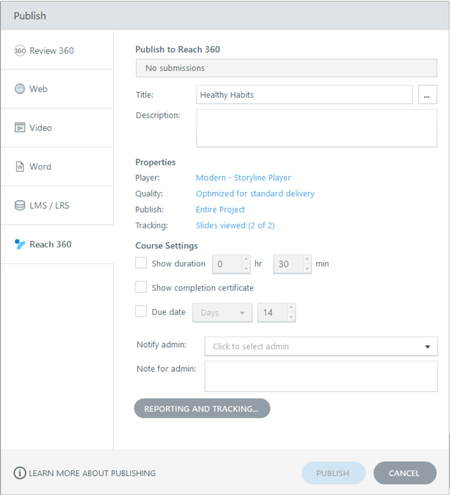
Want to "reach" more learners? Reach 360—a frictionless LMS—lets you easily deliver training to a broad range of learners and quickly analyze training data. How to Access Reach 360 To publish courses to Reach 360, install the April 2023 update or later for Storyline 360. Your Articulate 360 team must also activate Reach 360, or the option will be grayed out. Note that Articulate 360 Teams admins are not Reach 360 admins by default. Learn more about permissions in Reach 360 and Articulate 360 Teams. Read on to learn how to publish your course directly to Reach 360. Publish a New Item or Update an Existing Item Enter Title and Description Enter Additional Project Info (Optional) Adjust the Player Properties and Quality Settings Choose to Publish a Slide, a Scene, or the Entire Course Adjust the Course Settings Choose Reporting and Tracking Options Publish Distribute Your Published Course FAQs Step 1: Publish a New Item or Update an Existing Item Go to the Home tab on the ribbon and click Publish. When the Publish window appears, select the Reach 360 tab on the left. If this is your first time publishing the course to Reach 360, the status will show "No submissions," as above. Once a course has been published to Reach 360, the status will display the date and time of the last publish. Step 2: Enter Title and Description Enter the Title text as you want it to appear in Reach 360. (If you have a title placeholder on the first slide, the title defaults to the text entered in that title placeholder. If you don't have a title placeholder on the first slide, the title defaults to the name of your project file. You can change the title of your published course here without affecting the name of your project file or the title placeholder on the first slide.) The maximum length for a project title is 80 characters. Use the Description field to define the purpose of your course. This displays on the cover page for your course in Reach 360. Step 3: Enter Additional Project Info (Optional) Click the ellipsis button (...) next to the Title field to define additional project info. This info is for your reference only. Only the title and description will be visible in Reach 360. The Title and Description fields are the same as those on the Publish window (see the previous step). The image below the Title field is the course thumbnail. Note that the course thumbnail and course cover photo you set in Storyline 360 won't display in Reach 360. You can, however, set a cover photo for your course in Reach 360. Enter values for Author, Email, Website, Duration, Date, Version, and Keywords if you'd like. These values won't display in Reach 360. The Identifier is a unique string of characters assigned by Storyline 360 that Reach 360 and your LRS use to identify your course. If you're republishing a course that's already in Reach 360 and your LRS, don't change the value in this field. When you're finished customizing the project information, click OK to return to the Publish window. Step 4: Adjust the Player Properties and Quality Settings Use the Properties section of the Publish window to make last-minute changes to your course player and quality settings. The Player property shows the name of the player currently assigned to your project. (The player is the frame around your slide content.) To make adjustments to your player, click the player name to open the player editor. Note: Don't set your course to launch in a new browser window. This can lead to inconsistencies in the report data. The Quality property lets you choose adaptive or static video quality and control the compression settings for audio clips, static videos, and JPG images. The quality settings default to whatever you used the last time you published a course. To change them, click the Quality property, make your adjustments, and click OK. There are now two video quality options. Select Adaptive to automatically adjust the video quality (high, medium, or low) to the learner's internet speed and prevent buffering. Learn more. Choose Static to deliver videos with the same quality to all learners, which could cause buffering. Drag the Static slider to change the video compression. Note that higher values give you higher-quality output but also larger file sizes. That can mean longer download times for learners with slow connections. Lower values give you smaller file sizes and faster download times, but the quality will be lower as well. Drag the Audio Quality slider to adjust the compression settings Storyline 360 uses for audio. Mark the Optimize audio volume box to normalize audio throughout your course for consistent volume across all slides. Tip: If your course audio already has consistent volume, you can speed up the publishing process by unchecking this option. Drag the JPG Quality slider to adjust the compression settings Storyline 360 uses for JPG images. Click Reset to standard optimization to use the default settings: adaptive video quality, audio bitrate of 56 kbps, and JPG image quality of 100%. Step 5: Choose to Publish a Slide, a Scene, or the Entire Course By default, Storyline 360 will publish your entire course. However, you can publish a specific scene from your course or even just a single slide. This is helpful when you want to publish multiple courses from the same project file. Click the Publish property, then choose the entire project, a single scene, or a single slide. Step 6: Adjust the Course Settings Use the Course Settings section of the Publish window to manage the following: Show Duration: Mark this box to show the estimated course duration to the learner, then manually set the time on the right. (The default value for Storyline 360 courses is 30 minutes, which you can modify.) Show completion certificate: Mark this box to provide learners with a certificate they can download when they meet the completion parameters. Due date: Mark this box to set how long a learner has to complete the training after they've enrolled. Then manually set the date on the right. You can set a specific date or a custom timeframe. When an interval for a set number of days is selected, the time period begins when the learner is enrolled in the training. Notify admin: Use the searchable drop-down arrow to select a specific admin to notify by email. Note for admin: Use this field to add a note for Articulate 360 Teams admins who publish courses in Reach 360. For example, you could tell them whether this course should be visible in the Reach 360 library. Step 7: Choose Reporting and Tracking Options Click the Reporting and Tracking button to open the Reporting and Tracking Options window. From there, you can choose how Reach 360 reports and tracks learners' progress. You can also send learner data to your LRS in addition to Reach 360. Note: Storyline 360 always uses SCORM 2004 4th Edition when you publish courses to Reach 360—that means the standard option can't be changed. If you plan on reporting to an LRS as well, click the LRS tab on the left side of the window. Mark the box to Report to an external LRS, then choose one of the following options in the LRS Configuration section. Supplied at launch: Select this option when you don't want to store authentication credentials in your Storyline 360 project file or when you need the option to update the LRS endpoint or credentials without republishing the project. Learn more about supplying credentials at launch. Manual: Select this option to enter the LRS endpoint and credentials right in Storyline 360. The configuration details will be stored in your project file, and you'll need to republish the project if you change them later. Learn more about the manual option. Click the Tracking tab on the left side of the window and choose any combination of the following options. You can choose one, two, or even all three tracking options. Whichever option a learner completes first gets reported to Reach 360 and your LRS. Learn more about tracking multiple completion criteria. When the learner has viewed # slides: Mark this option to trigger completion when learners view a certain number of slides. You can choose a percentage or a fixed number. Then decide which slides get counted—all slides or just those with slide numbers. Learn more about tracking slides viewed. When the learner completes a quiz: Mark this option to track learners based on their quiz results. You can let Storyline 360 keep track of multiple quizzes and send results to Reach 360 for the first quiz each learner completes. Learn more about tracking quizzes. (This option will be grayed-out if your course doesn't have any result slides.) Using triggers: Mark this option to track learners based on course completion triggers you added to your course. (This option is grayed-out if your course doesn't have any completion triggers.) Step 8: Publish When you're finished making selections, click the Publish button to upload your course to Reach 360. The upload time depends on the size of your course and your internet speed. After submitting a course, you'll see the following Publish Successful window, depending on your permissions. If you're an Articulate 360 Teams admin, you’ll see two follow-up options: Manage in Reach 360: This opens the course you just submitted to Reach 360 in your default browser. Copy Link: This copies the link of your submitted course in Reach 360 to your clipboard. Articulate 360 Teams Admin Articulate 360 Teams User Publishing Tips Problems with a firewall blocking you from publishing directly to Reach 360 or want to customize the published output? Here's what to do: Publish your course for LMS/LRS using SCORM 1.2 or any edition of SCORM 2004 on your local computer. An admin can then upload the zipped file to Reach 360. Follow the same steps if you need to upload a new version of the course in Reach 360. Note that Reach 360 has a maximum size limit of 5 GB per project. If you'd like to check the size of your course before publishing to Reach 360, publish it on your local computer first. That will allow you to check the file size of the generated zipped package. Step 9: Distribute Your Published Course Now for the fun part! Once you've submitted your course to Reach 360, an Articulate 360 Teams admin can publish your training and enroll learners in it. FAQs What's the difference between “submitting” and “publishing” courses to Reach 360? Articulate 360 Teams admins and users can submit Storyline 360 projects to Reach 360. That allows admins to review the course before it's available for learners. Once reviewed and approved, admins can publish the course within Reach 360. Then admins can enroll learners and groups, or learners can discover it for themselves within the account library. How do I update an existing project in Storyline 360 and republish it to Reach 360? Here's how to publish updates to existing training in Reach 360: Open the original .story file or a copy of it, make your changes, and save them. Then republish it to Reach 360 by following the steps above. Note: To publish your project as a new training in Reach 360, save your project as a new file. Then publish it by following the steps above. What format does the publishing process use when publishing to Reach 360? Storyline 360 uses the SCORM 2004 4th Edition when you publish a course to Reach 360. What's the recommended workflow for collaborating on and publishing Storyline 360 projects to Reach 360? Make a copy of a project's .story file on your desktop and send it to other developers for collaboration. Copies of the original .story file contain the same project identifier, so publishing the copy updates the current version of the training in Reach 360.6.2KViews1like0CommentsReach 360: Access Your Training
The Learn page is where you access training assigned to you, review completed training, download certificates, access your account library, and create a list of favorites. Learner Sidebar My Learning Certificates Favorites Browse the Library Learner Sidebar In the learner sidebar, you'll find your statistics and assigned training. The total number of training deliverables you're enrolled in is listed next to Assigned. The list is ordered in descending order from most recently assigned. Click Show more to access the complete list. Select a title in the list to start or resume training. My Learning Under My Learning, you’ll see training in which you’re currently enrolled, have self-enrolled, or you've already completed. From here, you'll also be able to download certificates for the training you've completed. In-Progress By default, content on the In-Progress list is sorted by the date it’s due (or if nothing has a due date, the date you were enrolled), but you can also arrange content by enrollment date or title using the drop-down menu on the right. On the title card for each training, you’ll see the cover image and title, how long it will take to complete on average, and its due date (provided one is assigned). If you’ve started a training, a progress bar displays on the cover image. At a glance, you can see how far through the content you’ve progressed. Add it to the Favorites section by clicking the heart icon. Completed If you thought that the Completed list was where you’d find all the training you’ve completed, you’re right! Here, the title card displays your final quiz score (if applicable), the date you finished the training, and a link to your completion certificate. Add completed courses to the Favorites section by clicking the heart icon. Tip: Completed training that you start again isn’t added back to your In-Progress list, but you can always find them under Completed. About Course Due Dates Administrators can assign due dates to training. They’re listed on the title card and cover page. If something doesn’t have an assigned due date, it’ll say that too. Due dates start counting down on the day you’re enrolled. When you have fewer than 24 hours to complete a training or are overdue by less than a day, the due date changes to an hour counter. Once a training deadline has passed by more than 24 hours, the message displays by how many days it's overdue. You’ll see this reflected in the training summaries as well. You can still complete overdue training. Certificates To download a certificate for training you've already completed, find the course in the completed section. If you've satisfied the training's completion requirements, click the Download Certificate link. If the link isn't available, then quiz requirements weren't met, and you have no additional quiz attempts available, or the training doesn't have a certificate. Note: Need help finding a download link for a certificate that should be available? Reach out to your admin and ask them to download it for you. Favorites The Favorites section is a great place to save your favorites and access training you find in the library. Here, you’ll find all the training you've favorited, regardless of whether it's complete or in progress. To add training to your favorites, click the heart icon on a title card. Remove content from your favorites by clicking the heart icon again. Browse the Library Access your account library by clicking Browse Library. There you’ll find all the training available to you. It’s also where you can favorite training in which you haven’t been enrolled. Learn more here.6.1KViews0likes0Comments