General E-Learning
2939 TopicsStoryline Question | Reporting using SCORM 2004 - drag and drop interaction
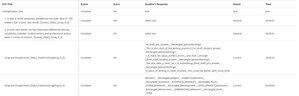
hello everyone! I'm a long-time lurker in this community and have found it to be an invaluable resource, so I'm hoping you all can help me deal with a sort of strange issue! I created an assessment consisting of four separate quizzes and a reflection for a course I'm currently designing. I managed to wrangle it into reporting student's short answer/essay questions to the gradebook in our LMS (Blackboard Ultra) so the instructor can grade their short responses by hand, seen in the cap below. This works great for all short answer questions, but the current minor issue I'm experiencing is that one of the quizzes has two drag and drop questions and it comes out odd on the LMS export end. This is what the gradebook shows when it reports: Do you all know if there's any way I can get SCORM 2004 to not report that ugliness while still capturing the "correct" result for the two drag and drop interactions? Even giving my objects nicer names doesn't really help in this case, so I'd like for it to be blank or for it to just report N/A or something similar. Is this even fixable in Storyline? Or is that something I have to try to deal with within the LMS itself? I'll attach my .story file to this post as well. Thanks in advance for your help! :)13Views0likes1CommentSplit Audio in Storyline 360
Hello, How can we split an audio in timeline in Storyline 360? In many video editors like Camtasia we do see a split button to split any object on timeline in desired parts. I want to split a long audio files in separate parts so that they can be put at desired places on timeline below relevant objects. thanks18Views0likes2CommentsRise 360 Sorting Activity-issue
Hi, We’ve received quite a lot of feedback about the sorting activity in Rise 360. Many participants struggle to drop cards accurately because targets register based on the mouse pointer position rather than the card’s frame. As a result, a drop can fail if the pointer (or a finger on iPad) isn't inside the drop-target frame when released. Request: Please update the drop-target logic so hits are detected using the dragged card’s bounding box/frame instead of the pointer location. Why this matters: Reduces failed drops and user frustration Improves accessibility and touch interactions (iPad/phones) Aligns with common drag-and-drop UX patterns Also, providing the option to let the learner see the activity-progress would be a useful addition. Thanks for considering this improvement. Happy to provide examples or help test a fix.Solved96Views1like5CommentsCustom "Back to Top" button (Skip navigation)
Hey All. I am creating a custom course with my own navigation buttons. I am using the Modern Player. I was not seeing the "Back to Top" button while doing 508 testing. I found that I have to have at least one of the "Player Tabs" within the Player menu selected for this to be used. We do not want to use the Menu and we have custom buttons for all of the other options (Resources, Glossary...). The only way of using Back to Top is by adding a New Player Tab like EXIT for example. This is frustrating. I don't want to do this. Is this the only way? I know I can create my own Back to Top button and use it to Set Focus but of course it only sets focus to items on the slide and NOT items from with the Master Slide. Also, how would I make the BtT button invisible and then visible when tabbed to? Any help would be greatly appreciated. Thanks!31Views0likes1CommentShow results of complex calculations involving multiple variables?
Say I have multiple (3+) variables that I want to use to calculate a "final score" for something; for example, ((A+B)/2)+(C-D)*100. Is there any way to output this as a number in a text box, and is there any way to use a combination of my own variables AND built-in values like "Slides Viewed"?Solved74Views0likes4CommentsContextual Feedback
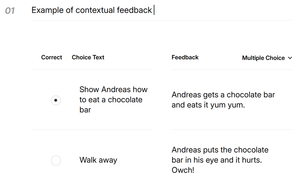
I’m currently reading Chapter 7 of Map It! by Cathy Moore and have a question about designing knowledge checks in Rise. I’d like to create knowledge checks with contextual feedback that doesn’t display “Correct” or “Incorrect” to the learner. It appears that Rise doesn’t currently support this functionality. The answers can still be tracked as correct or incorrect for reporting purposes, but I don’t want the learner to see those labels. I’ve attached two images as examples. I used the Feedback by Choice option, which is great because it allows custom feedback based on the learner’s decision. Is this functionality something Articulate is planning to add? It would be a big upgrade. As Cathy Moore writes: “A surprisingly large percentage of e-learning tools and quiz plugins don’t support contextual feedback... The tools’ creators seem to assume that the only time we’d want to ask a question is to see if the learner can correctly regurgitate a fact.” (Map It, p. 167) Screenshot from Editing a multiple choice question Screenshot from the Preview of the multiple choice question, showing that the "Correct" still pops up for the learner26Views0likes2CommentsHow long does it take to build a 20-minute e-learning module or course?
I had someone ask me how long they should tell their company to expect when building e-learning courses. This is a question I hear a lot from new instructional designers, and the answer isn't as straightforward as you might think. While you'll often hear that it takes about 40-50 hours to develop one hour of e-learning content (which is a good starting estimate), let's break this down into something more practical for you. For a 20-minute module, you might start by estimating 15-20 hours of development time. But here's the thing – several factors can stretch that timeline, and knowing these up front can help you plan better and set realistic expectations with your stakeholders. Here's what tends to affect your development time: Content Organization: Starting with messy content can really slow you down. Think about the difference between working with a clear training manual versus piecing together information from several email threads and meetings with subject matter experts. The second scenario will definitely take more time. Visual Design Needs: Using a template your company already has? Great – that'll save time. Need to create something from scratch or hunt down specific images? That's going to add several hours to your project. Level of Interactivity: Simple click-through slides are quick to build. But if you're creating scenarios where learners need to make decisions, or adding complex interactions, you'll need more time. Each interactive element you add means more development and testing time. Audio and Video: Adding narration isn't just about recording. You'll need time for editing, making sure it syncs with your slides, and often re-recording sections after reviews. The same goes for video content. Review Process: This one often surprises new developers. Getting feedback from stakeholders, making revisions, and going through multiple review rounds takes time. Sometimes a lot of time, especially if multiple people need to sign off on the content. Your Tool Experience: Be honest about your comfort level with your e-learning tools. If you're still learning Storyline, Captivate, or whatever tool you're using, build in extra time. What might take an experienced developer two hours could take you a full day – and that's perfectly normal when you're starting out. Testing Time: This is easy to forget, but you need time to check everything works right. Does your course work in different browsers? Do all your quiz questions give the right feedback? Do your animations play smoothly? Take the above tasks and assign an approximate time commitment to each. For example, organizing content may take 8 hours. Then add all those hours together and that gives you a good estimate. It also gives you a checklist you can offer your organization to show what steps need to be taken and why you made the estimate you did. Here's a tip from experience: whatever time estimate you come up with, add about 30% to it. This gives you breathing room for the unexpected things that always seem to pop up during development. Question for the community: What has surprised you most about development time in your e-learning projects? I'd love to hear about your experiences in the comments below.771Views3likes8CommentsAI image function only giving me images of white men
I've tried "diverse," "multicultural," "non-white" to generate an image of a middle-aged man thinking in a modern office, and I'm getting all but one white dude. I've already used a picture of a middle-aged white person and want to portray the diversity of my workplace, but this feature is not helping. I used similar prompts for the female images and had no issue. In the image below, you can see that the prompt is a "non-white middle-aged man in a modern office, thinking," created four white dudes. The AI needs some refinement regarding this issue.68Views0likes2CommentsStoryline JavaScripting - Tracking Multiple Quiz Attempts in SCORM
Hi all, I am wondering if there is a way to execute custom JavaScript in an SL file that is going to be exported into SCORM to track multiple quiz attempts in a Cornerstone LMS without a Learning Record Store (LRS) when there is a reset quiz results trigger at the end of the quiz (users get multiple attempts to pass the quiz, but we want to track each attempt). From what I understand, unless it is published in CMI5 and there is an LRS, this granular data cannot be documented to Cornerstone. I have attached an example file with some JavaScripting that isn't working properly, and I wanted to see if anyone can provide any information on this to assist with my research. Thank you!17Views0likes0CommentsEmphasize not working after exporting
Hi, In my project im working with some emphasize animations in my buttons, that work well when I preview them. I have exported now to CMI5 and uploaded to the LMS to test...and none of the emphasize animations on the buttons work. Why is this happening? anyone with a similar issue? How do I fix this?24Views0likes1Comment