code block
55 TopicsMeet Your Learner Persona
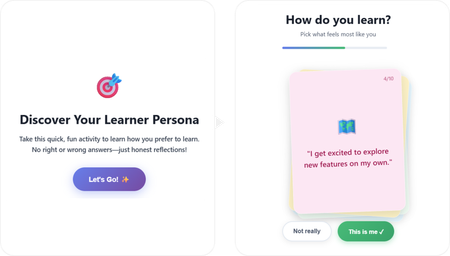
Hello there! 👋 Here's my project: A short, playful interaction that learners could experience at the beginning of a course, but not limited to that. I used both Lovable and ChatGPT as my buddies throughout this learning journey. The interactive code is embedded directly inside the course project. Check out the project here: Meet Your Learner Persona ✨The story behind As a newcomer to vibe coding, the experience was rewarding in the best possible way. I genuinely enjoyed every part of the process and learned a lot, especially about writing effective prompts, navigating code, and making small changes. I found a lot of inspiration by exploring visual and interaction design references on platforms like Dribbble, Figma, and Godly, which helped shape the experience's look and feel. Throughout the project, I experimented with both simple and more complex interactions. In the end, I found myself drawn to the simpler ones, those that quietly support the learning journey without adding unnecessary friction or contributing to cognitive overload. Try taking it to discover your type. 💻Here's also the prompt I used: Create a self-contained, embeddable HTML/CSS/JavaScript interactive learning game designed to be placed inside a Rise course code block. Concept: “Discover Your Learner Persona” – a playful, low-pressure personality-style interaction that helps learners reflect on how they prefer to learn. Experience goals: Fun, fast, and intuitive (2 minutes max) No right or wrong answers Feels like a game, not a test Encourages self-awareness and engagement at the beginning of a course Interaction design: Display one card at a time in the center of the screen Each card contains a short first-person statement describing a learning behavior Two buttons below each card: “This is me” “Not really” When the learner clicks “This is me”, assign 1 hidden point to a specific learner persona When “Not really” is clicked, move on without scoring After all cards are answered, calculate the dominant learner persona and display the result Learner personas (4 total): The Explorer – learns by experimenting, trying things out, discovering through action The Builder – learns best with structure, steps, and logical progression The Observer – prefers watching, reading, and understanding before acting The Connector – learns through discussion, stories, and social interaction Cards (8–10 total): Write short, relatable, first-person statements such as: “I like to jump in and try things out, even if I don’t fully understand yet.” “I feel more confident when learning follows clear steps.” “I prefer seeing examples before I start.” “Talking things through with others helps me learn.” Each card should clearly map to one persona behind the scenes, but never reveal scoring or categories to the learner. Result screen: Display the learner’s persona as a friendly title (e.g. “You are: The Explorer”) Include a short, encouraging description of what this persona means Add 2–3 practical tips on how this learner can approach the course effectively Include reassuring language that most people are a mix and there is no best persona Visual & UX style: Clean, modern, friendly Card-based layout with soft rounded corners Smooth transitions between cards Large, readable text Accessible contrast Neutral, welcoming color palette (colorful, but in light colors) Card layout and behavior: Display the cards as a stacked, slightly fanned card pile, inspired by a physical deck of cards. Cards should overlap each other diagonally, forming a small pile rather than a grid Only the top card is fully readable and interactive at any time The cards underneath should be partially visible, offset slightly in position and rotation Use subtle differences in rotation (e.g. -3°, +2°, -1°) to create a natural, tactile feel Each card should have rounded corners, a soft shadow, and a solid background color Interaction behavior: When a learner answers a card, animate it smoothly off the pile (slide or fade) The next card should move into the top position of the stack The pile should visually shrink as cards are completed Technical constraints: No external libraries or frameworks All HTML, CSS, and JavaScript in a single file Fully responsive (works well on desktop and mobile) Safe for embedding in Rise as a code block or zip package5KViews50likes14CommentsPaint by Num-Birds: Songbird Identification Tool
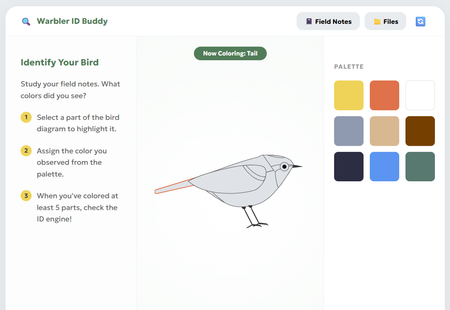
This interaction pushes learners to get curious and creative while identifying some of the most notoriously difficult bird species to spot - warblers! The paint-by-numbers interface paired learning materials (like snapshots, anatomy diagrams, and their own field notes) introduces learners to the fundamentals of bird identification, and allows them to explore this process of visually ID'ing a bird for themselves. Review Here: https://360.articulate.com/review/content/54d099bd-477a As a team with avid birdwatchers, trying to "onboard" people to the hobby always poses a classic blocker: "How do you tell the birds apart?" Though sound, habitat, and other factors play a role, visuals are the first pillar of identification that beginners start to familiarize themselves with. Using Rise's code block, we wanted to create a tool that went beyond flip cards, checklists, and other default interactions. Leveraging HTML/CSS, we created a workshop space that: Breaks down key features to note for ID'ing through an interactive diagram Offers as much or as little support they may need in the form of the snapshots, diagrams, and facts in the "Files" Provides a challenge to apply what they've learned by identifying the "Field Notes" recordings To build this block, we used a mix of vibe-coding and human code expertise! Once we had refined our idea on our own, Gemini was enlisted to help create the basic UI and functions. The functionality was refined and adjusted many times for user ease and clarity. Finally, we looped human experts back in to polish the code, refine the diagram, and squash any stubborn bugs. It was a whirlwind learning experience! Some takeaways: Having the AI refine snippets of the code ensured overall block integrity. We made the mistake at the start of having Gemini spit out a whole new HTML file to adjust minor pieces; we found it changed things that we hadn't asked it to, and actually got "lazy", condensing body text and dressing down UI elements increasingly with each iteration Knowing when to use AI, and when to call in a human expert was our superpower. Gemini deeply, SERIOUSLY struggled trying to create an SVG of a bird. So, we took the monstrosity it outputted and edited the code ourselves to create an image we were happy with! We also enlisted our senior developer to jump in and fix some serious coding errors that had made the block totally un-playable. Not all AI's are made equal: Canva's AI was very promising for vibe-coding at first, but Gemini ultimately became our tool of choice as it provided the most accurate and useful responses. We chose this activity because as bird lovers, we know that warblers in particular have such subtle differences - a black eye ring on one bird might make it a totally different species from the next! The ability to paint and visually describe these tiny differences seemed like the perfect learning opportunity for this challenge (and get our other coworkers on board with birding)! Let us know what you think! Were you able to paint a perfect match? Created by Aamir Aman, Tal Castillo, and Ryan Young.4.2KViews37likes15CommentsAccessibility Reality Checker (3 - minute Simulator)
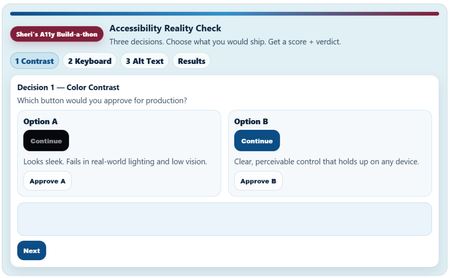
Link to Rise Course (Quick Share) Accessibility Reality Checker Copy /Paste Link: https://share.articulate.com/kdeNT__CFskcknh1QTeIp Project overview I created this project because most accessibility training fails in a predictable way. It explains rules, but it doesn’t change decisions. Teams ship inaccessible experiences because the tradeoffs are invisible in the moment. I worked to build something that puts some of those tradeoffs out into the open. Instead of building a tutorial, I built a short decision simulator: three common, high-impact accessibility choices (contrast, keyboard navigation, and alt text). I framed each choice under the question “Which would you ship?” The simulator allows the review to choose and get immediate consequences, then see an “accessibility” score. I made the simulator small, fast, and opinionated because that is how product decisions and learning content approval happens in the real world. This is not and was not intended to be a comprehensive accessibility course. It’s a pressure test for everyday judgment. Prompts and constraints The Build-a-thon prompt was to explore what the Rise Code Block can really do. My personal guide was: “Can I build something that feels like a real product review decision instead of another accessibility checklist?” My constraint and format drivers were: No long explanations up front No hidden scoring Do not pretend or ignore nuances The review must make a decision and live with the result Tools and implementation Built entirely in Articulate Rise 360’s Code Block Plain HTML, CSS, and JavaScript only Custom UI, state management, scoring logic, step flow, results meter, and share text are all handled in the Code Block Intentionally used: Semantic HTML Keyboard-operable controls Visible focus states High-contrast color choices The experience itself is designed to model the behaviors it’s teaching. The experience had to go beyond just talk about the experiences. What I learned I need to spend a lot more time upskilling on HMTL and JavaScript. Vibe Coding can be fun. Rise’s Code Block is capable of much richer, multi-step interactions than I use it for. Using the Code Block require you to be disciplined about structure, focus management, and state. Small UX decisions (focus order, feedback timing, contrast, visual hierarchy) have a big impact on whether a user experience feels accessible, useable, or sloppy. Accessibility cannot be taught in 5 minutes, but a quick accessibility review can expose bad decisions and highlight options for better user experiences instincts This type of tool/ format is good for awareness, decision calibration, but not for deep technical training. I like to call this a “feature” of the simulator not a bug. I acknowledge simulator has some real limitation for real work use in it’s current state.3.2KViews30likes11CommentsAI Prompt Practice
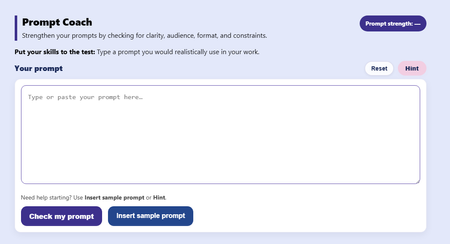
I have a coworker working on an AI prompting course and it got me to thinking about adding a Code Block that could take what a user prompts and give simple feedback. I worked with ChatGPT to get this up and running and to adjust criteria. While I was working on it, I did encounter where it didn't always figure out that something like "a paragraph" is a constraint or "email" is a format. I got ChatGPT to add those in so it does count now. Here's my Review Link: Code Build-a -thon: AI Prompt Coach | Review 360 In my Rise course I have added my code for anyone to use and adjust. Some metrics for those interested: It probably took 3 hours for me to work on this and I prompted more than 40 times. With those metrics, I didn't have a full idea of what I wanted to do - once I had it, I kept prompting to refine the idea and look. Here's my initial prompt: "I'm thinking a code block interaction to help users prompt. So we have a box for prompting. They type their prompt and then get feedback and point out what could be improved on that prompt?"799Views3likes2CommentsNYT Connections Clone
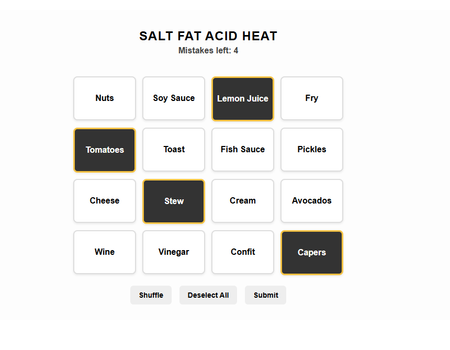
I've heard a lot about vibe coding over the last year, but this was my first attempt at building anything. I've got to say, it's incredible how quickly this came together with only a few prompts and zero clumsy attempts from me to try to remember various HTML elements and attributes. With a little inspiration from my cookbook shelf and the New York Times Games app, I had a fully functional Connections clone in a Rise course in about an hour. The possibilities for this are endless and I'm eager to see where people take this going forward. Click here for the Review Link701Views4likes4CommentsWizard Maze Game
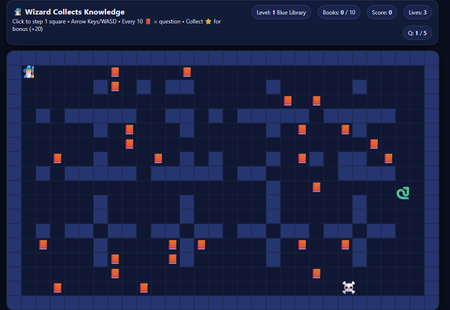
I've seen some people have been successful making 8 bit games while vibe coding so I wanted to give it a go! This was a fun one to build and adjust! I really wanted a character to go through a maze and try to collect the books. After 10 books, you answer a question and it continues through 3 levels of maze over 5 questions (if you get them right). Code Build-a-thon: Maze Game Knowledge Check | Review 360 I was inspired by the Hoppy Adventures Coin Capture Hoppy Adventures: Coin Capture | Articulate - Community. Kudos to desterly1kenobi! This build was a roller coaster. First, ChatGPT said I couldn't do it. Fought me. Once I found the Hoppy Adventures, I saw that it CAN be done! So, I started a new chat with ChatGPT and within one prompt, I got a game. I kept adjusting til I got everything I wanted in place. There's some minor tweaks I want to make but, I'm pretty happy with it and it's fun! I'll have to find a project to incorporate it in.700Views5likes2CommentsCustom Tab Interaction (Code Block)
Link to Example For this Code Block Build-a-thon, I wanted to experiment with translating a custom tab interaction I originally built out in Storyline into a reusable code block for Rise. My goal was to create a version of the interaction that doesn't require Storyline experience so others can easily use it in their courses. I walk through my step-by-step process of prompting AI to show how I approached building and refining the interaction. A copy of the code is available at the end of the course.699Views5likes3CommentsNew Code Block Game
It's been a long time since I shared my work, but I'm really pumped up about the potential of the new Code Block in Rise. I started with a basic idea and then started vibe coding. It's amazing what can be achieved in a short space of time, and have been resisting the temptation to just have fun, and instead focussed on keeping my work learning focussed. A couple of learnings: The power of the code block will be really unlocked if Articulate can... Allow us to upload zip folders with images in them. Everything says you can, but I have yet to have a single successful upload. Provide code/facility to allow a code that can report course completion based on the code i.e. when a game is completed completion can be sent - even better if scores can be included. When course continuation can be linked to code block completion it enables true gamification. Not being able to include images is a limitation, but not a blocker - you will notice I have included some very rudimentary graphics by encoding the images as base64, however it seems Rise has a limitation of not being able to read base64 strings longer than 500 characters at present. As I suspect will be the case for many others, I, work for a company with very stringent security policies, so we aren't allowed file storage solutions. If there can be a basic image storage allowance for zip code blocks, that changes the game! Would love your feedback you wonderful humans. Review Link636Views4likes1CommentValentine's Express: The Romance Master Class
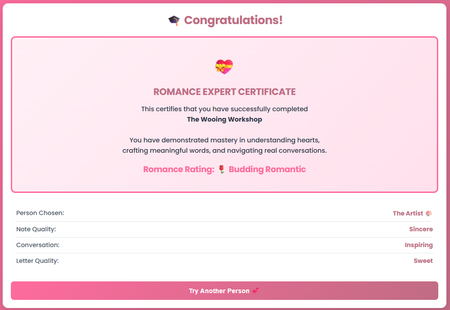
It's February, the month of love. And I bet you're wondering: how do I express my feelings authentically? How do I say what matters most in a way that truly lands? So I built something for that. This is my entry for the Code Block Build-a-thon! Valentine's Express is an interactive experience where users navigate through personality-based scenarios and craft handwritten notes and love letters. They choose a personality type (The Dreamer, The Artist, The Intellect, The Adventurer, or The Kindred Spirit), then receive personalized feedback as they write. This is my first time building with code blocks in Rise, and I'm blown away by what's possible. The interactivity, the personalization, the ability to create something that feels truly custom, all within a code block. What's Inside 5 unique personality profiles with custom feedback Interactive note and letter writing with real-time scoring localStorage integration for seamless progression across 4 code blocks Automated Romance Expert certificate upon completion Why I'm Sharing This I'm uploading the code so you can try it, remix it, and explore what's possible. Whether you build something romantic, playful, or educational, the interaction patterns here can work for any content. Ready to express your heart? Check it out here and let me know what you think! 💕603Views4likes5Comments