storyline 360
29215 TopicsActions based on opening Resources?
Hello, In a project I'm working on, there is an ask to have two job aids in the WBT, however, they do not want the job aids uploaded to the LMS or SharePoint link. I used the resources area in the player to attach them. They want the job aids in the resources to launch by having the user click on a slide object or button. Is there a way to launch a resource document by setting up a button or object on the slide? Currently, I see no triggers that offer this but wondering if there is possible a variable set up I can do? Or is there a way via JavaScript (if that's still a thing)? Thank you, Michelle256Views1like10CommentsNo audio on mobile device
Hi I have discovered that audio isn't playing on mobile on several of our projects created in Storyline 360. The courses are created from the same template, but the problem only persists on some courses and not others. The project contains both slides with animated video and slides programmed in Storyline. The problem is only on slides with animated video. There are no problems when playing any of the courses on desktop. I have tested both in Safari, Edge and Chrome on iPhone 11 IOS 17.0.3 with the audio button turned on/off and bluetooth turned on/off. Additionally I have tested running the courses from both our LMS and directly from our webserver. The problem is the same everywhere. /Rasmus57Views0likes2CommentsOn the iPad, the audio in the Storyline course stops
On the iPad, the audio in the Storyline course stops playing under the following scenario: Open the Storyline course in the iPad browser. Then, switch to another application and return to the course. In this scenario, the course audio does not play. Thanks!82Views0likes2CommentsTrigger not launching email in LMS player
I developed a course that includes a hotspot. The learner is supposed to click on the hotspot which triggers a "send email to" action. The items work in review 360 but do not in the lms player (vi LMS). Any suggestions on how to get the trigger/hotspot to work?100Views1like5CommentsAI Avatar generation in Storyline
Hi there, I am currently using HeyGen for avatar creation. I started this about 1.5 years ago. The stock voiceover quality is good, and the stock avatars also good. At the time I started this, I tried to use the Storyline voiceover and found it severely lacking. Now with the recent changes to Storyline, including the ability to insert an avatar, I'd like to try it out to see if it can replace HeyGen. The interface exists in Storyline, but when I try and create an avatar, after hitting the "generate voiceover" button it looks like it's doing something but the voiceover is not generated. I then realized it has something to do with credits, I went online and saw that it's possible to make a test video, but it defaults to the Rise interface. To be honest, I've made hundreds of courses, but only in Storyline - basically for LMS integration. ...so when will the AI generation actually work in Storyline, and how does the credit system work?69Views0likes3CommentsBug: learner_response shows underscores for Non-Latin Languages in LMS Tracking for Survey Question
Hi Team, I have encountered an issue with Survey Questions in Storyline 360 (Version 3.109) when publishing to SCORM 2004 (3rd Edition). When a learner answers Survey Pick One, Pick Many, or Short Answer questions in non-Latin languages such as Russian, Chinese, Japanese, Korean, Thai, or Arabic, the "cmi.interactions.n.learner_response" value is stored as underscores (__________) instead of the actual response text in the SCORM Cloud LMS. Here is attached screenshot for the reference. Please find the attached screenshot for reference. However, the "cmi.interactions.n.description" field correctly stores the localized text, indicating that the LMS and SCORM Cloud support Unicode characters. Expected Behavior: The learner_response field should display the selected response in the original language instead of underscores. Could you please confirm whether this is a known issue or limitation in Storyline 360? If so, is there a recommended workaround or fix?138Views0likes5CommentsStoryline not publishing to Review
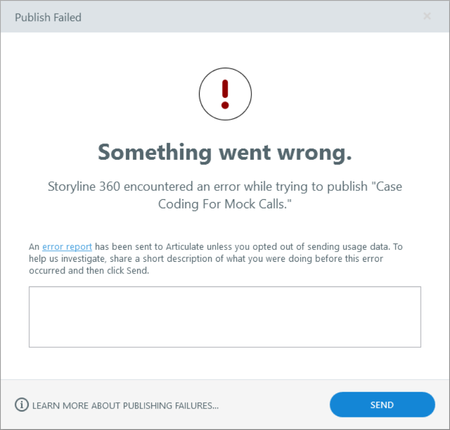
Hello all, My team and I have been trying to publish some storyline files to review today, but we keep getting an error. I didn't see anything on the Articulate Status page, so I thought I would check in here to see if anyone else is having this issue today? Any help would be greatly appreciated! Thanks so much!Solved1.3KViews6likes28CommentsKeyboard accessible drag-and-drop help
I've created a keyboard accessible drag-and-drop exercise in Storyline using these instructions which has worked great for both users who click & drag with a mouse and users who select with a keyboard. My challenge is when I try to add animation so incorrect responses are returned to their original position while correct responses remain in the drop field. I used these instructions to make that happen. And it works but only for users who click & drag with a mouse. Any ideas on how I could return incorrect drag-and-drop answers so it works for those using a keyboard as well?11Views0likes0CommentsUpdate to the content of training courses that had already been translated
Hello, Currently, I have teams using the translation system, but they’re encountering an issue with training materials that had already been translated. Let me explain: We have existing training materials that were published in X languages (before the translation system was implemented). When we try to translate updates to these modules, the entire module ends up being translated all over again. The problem is that the previous translations had already been approved by the business teams, and they are now being overwritten. Are you considering a way to translate specific parts of the content so we can combine them with existing, already-approved translations? Or is there a workaround that we haven’t identified yet? Thank you in advance for your feedback. Etienne.116Views1like5CommentsVery Weird Table Issue
This is a weird one. I've created a course with a simple layer and a table on that layer. Nothing special here. It's a 2 column 12 row table showing food temperature limits for a food safety course. The table looks fine in the build and when I run it locally, but when I compile the course and run the course from an LMS the table is missing some (not all) row text. The cells are just blank. I've tried the usual suspects of changing font's, clearing cache's but it still displays wrong. UPDATE*** - I replaced the table with a new one which seems to have resolved this issue but the issue below remains. Further more, (and if someone else can confirm this for me that would be great), if I create a table, lets say 2 columns by 8 rows, enter basic text into each cell and then lets say I want to change all of the text to bold. Select the text in the table from the top down and press the bold button, only the first 2 rows will bolden. It appears to be a bug but I need someone to confirm this for me. Any help would be really appreciated. Graham.