ai assistant
427 TopicsCan the AI Assistant implement character limits in CC segments?
Hello, Articulate community! Just wondering if the Storyline or Rise AI Assistant can implement character limits in CC segments. Our team abides by DCMP guidelines, which advise no more than 32 characters (including spaces) and a max of two lines per segment. I haven't tried asking the AI Assistant this myself, but if this capability exists in Storyline and/or Rise, can anyone recommend an effective prompt to use to achieve these results? If this feature doesn't yet exist, could I submit a feature request for future versions of SL and Rise? Thanks much in advance. :)143Views13likes11CommentsTeaser: Storyline "Chat To Animation"
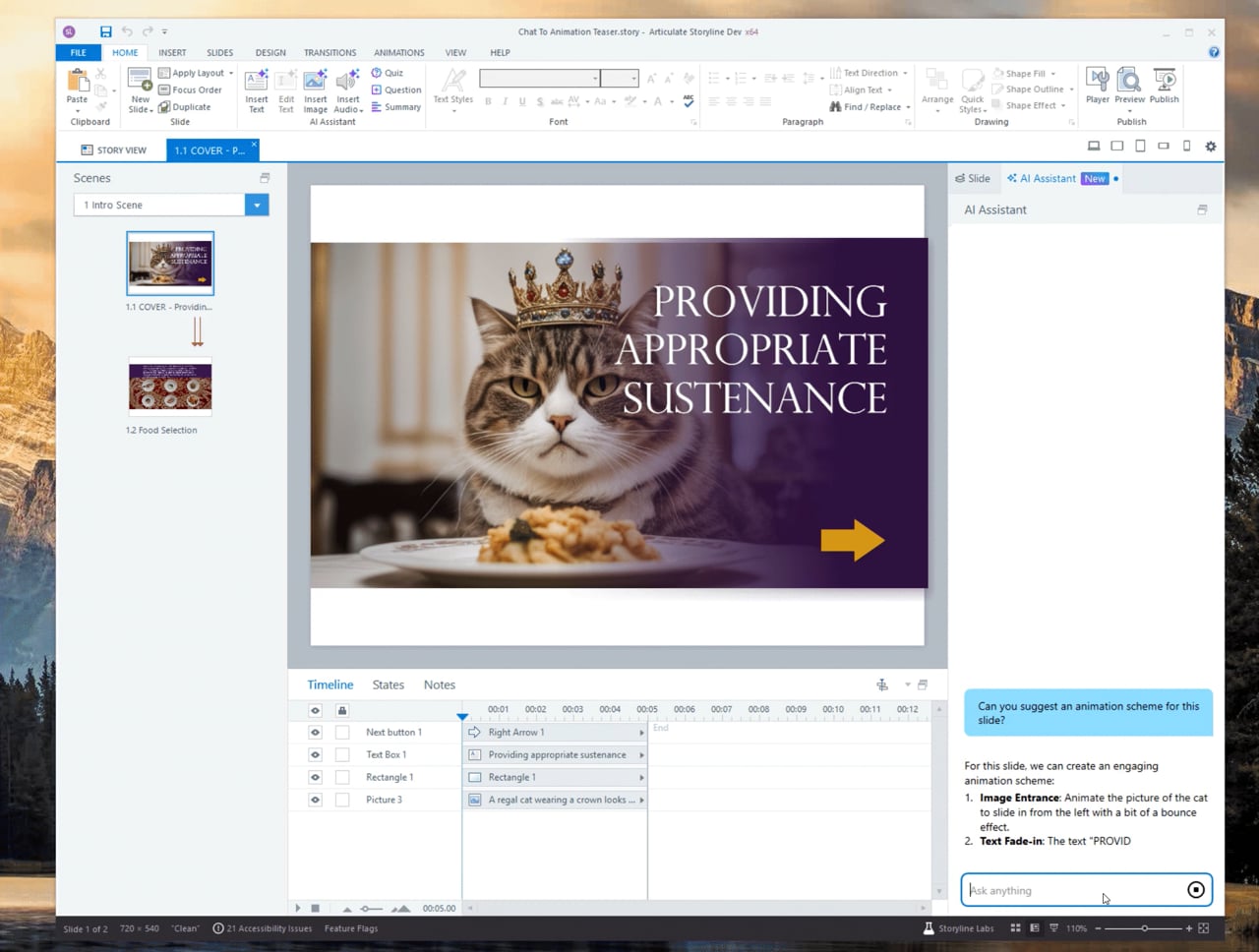
🚀 Big things are coming to Storyline 360. Last month at the Articuland Summit in Boston, our COO Brian Gil gave a sneak peek at something our team’s been quietly working on: AI-powered animations inside Storyline. We've been calling this feature "chat to animation" internally. The idea is simple but powerful: talk to Storyline's AI Assistant about how you want your slide to animate, and it helps bring your vision to life. The attached video shows a little preview of this feature in a fun "Feline Overlord" themed Storyline course. 🐱👇 On the first slide, I entered this prompt into the AI Assistant chat: “Can you suggest an animation scheme for this slide?” It broke down the suggested animation effects for each object, then asked if I want to create a trigger for them. After responding, "yes", the AI Assistant wrote the JavaScript code to create the animations and automatically associated it with the "When timeline starts" event. It also surfaced a "Preview" button that jumps into Storyline's preview mode so I could see the animation in action. Notice that the AI Assistant window stays visible during preview. This means I can refine the animation while previewing to home in on the exact look and feel I want. In this case, I wanted to delay the slight "pulse" of the yellow next arrow to begin after the image and text animations completed, so I entered: “Great! Can you delay the animation on the next arrow a bit so that it starts after the other objects have animated in?” The AI revised the JavaScript in the trigger and immediately replayed the slide again so I could see the change and tweak further if needed. That ability to preview, refine, and replay instantly is what makes this experience feel so magical. If you'd like to see the published course in action, you can find it on Review 360: Chat To Animation Teaser | Review 360 This feature should land in private beta soon, and we'd love to get your feedback. If you want to help shape how this evolves, email [email protected] to get started!645Views11likes3CommentsNew in Storyline 360: Editing Images with AI Chat
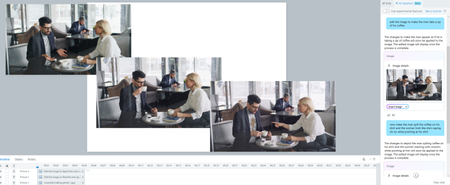
Ever wish you could edit an image without starting over? Now you can! Just describe the changes you want in the chat box and watch your image update. Change the background, adjust clothing or appearance, add a new element, and more. Explore different ideas and variations while your original image stays unchanged. Here are some examples: To build out a scenario, I started with a Content Library image, then changed the actions (talking → drinking coffee → spilling it) to match my story I tried different background settings by generating an image in the chat and changing it until it looked right before inserting on the slide Instead of generating a brand new image, I asked AI to add, edit, and remove specific elements from an image already on my slide Learn more: AI Assistant in Storyline 360: Editing Images with AI Chat As you try the feature, tell us what’s working, what’s not, and what you’d like to see next. Share your feedback in the comments below or take our survey. We’d love to hear from you!605Views9likes3CommentsAI Voices
Just my two cents, AI Voices were good because we didn't need to go back to our live voice to get something redone, or if we wanted to update 1 slide or add something to a presentation. Now we are seeing voices being removed so the advantage of the AI voices is reduced. I see 2 posts this morning and it's not even lunch time from people that need to make updates to 1 or 2 slides, change a word, or add something and the voice is gone. Maybe we need to look at AI again.Solved1.7KViews9likes17CommentsMeet Your New Teammate: First Impressions of Articulate’s AI Assistant
Introduction: Why AI Built for eLearning Changes Everything AI is everywhere these days — from writing emails to generating images, creating videos, and more. We all know tools like ChatGPT, Midjourney, DALL·E, Grammarly, Synthesia, and plenty more. They’ve quickly become part of our daily workflows — or at least, they have in mine! But if you’ve ever tried using these tools to help build an eLearning course, you’ve probably noticed something… They’re smart — but they don’t really get what we do. That’s why I was both excited and curious when I heard that Articulate was introducing an AI Assistant, built right into Storyline and Rise. Finally, an AI tool designed specifically for instructional designers and eLearning developers. I’ve been working with Articulate tools for over 14 years, and like many of you, I’m always looking for ways to speed up my workflow without sacrificing creativity or quality. So the big question was: Could this AI Assistant actually help me design or improve my courses — in a way that generic AI tools can’t? Spoiler alert: It can. And it did. This is the first post in a series where I’ll share how Articulate’s AI Assistant is changing the way I approach course development — making everyday tasks faster, smoother, and honestly, a bit more fun. So let’s take a closer look at why having AI built specifically for eLearning really makes a difference. Why Use Articulate’s AI Assistant Instead of Other AI Tools? Like many of you, I’ve used my fair share of AI tools — from ChatGPT for brainstorming to DALL·E for generating creative visuals. These tools are great, but they’re generalists. They don’t know (or care) that I’m building an eLearning course. That’s where Articulate’s AI Assistant stands out. It’s designed inside Articulate Storyline and Rise, for people like us — instructional designers, eLearning developers, and content creators. No copy-pasting between tools, no explaining to a chatbot what a "learning objective" is every single time. Here’s why I immediately saw the benefit of having AI built right into the tools I already use: It understands context. You’re not starting from scratch with every prompt. The AI Assistant knows you’re working within slides, quizzes, scenarios, and learning objectives. It fits seamlessly into your workflow. No need to bounce between apps or worry about formatting. You stay in Storyline or Rise, focused on creating — and the AI is right there when you need a boost. It’s tailored for eLearning tasks. Whether you’re drafting instructional text, generating quiz questions, or adjusting tone for different audiences, it’s built to support tasks we handle every day. Other AI tools are powerful, but they weren’t made for eLearning. Articulate’s AI Assistant feels like it was built by people who understand the little challenges that come with designing courses — and that makes all the difference. What Impressed Me Right Away I went in with low expectations — I mean, AI is cool, but it’s not magic, right? Well, after just a few prompts, I found myself genuinely impressed. Articulate’s AI Assistant is fast and simple. No manuals, no guesswork. You type, it helps. It felt less like learning a new feature and more like having a colleague nearby to bounce ideas off. Articulate’s AI Assistant gets you moving. The hardest part of creating content is often just getting started. The AI Assistant hands you a decent draft so you’re not stuck wondering how to begin. From there, it’s all about tweaking. Articulate’s AI Assistant understands eLearning. This isn’t some generic writing tool — it gets that you’re creating learning content. Whether it’s suggesting learning objectives or drafting quiz questions, it speaks the language of eLearning. By the end of my first session, I realized this tool isn’t just about saving time — it’s about keeping me in that productive flow state. Less overthinking, more doing. Wrapping Up — And What’s Next After just a short time using Articulate’s AI Assistant, I knew it was going to be part of my daily routine. It’s not here to replace creativity — it’s here to remove those little hurdles that can slow us down. No more blank slides. No more overthinking simple tasks. And the best part? I’m only scratching the surface. In my next post, I’ll show you how I’m using the AI Assistant to speed up writing — from slide content to quizzes and even branching scenarios. That’s where things get really interesting. Have you given the AI Assistant a try yet? I’d love to hear how it’s working for you — or if you're still wondering how to fit it into your workflow. Drop a comment below and let’s share ideas! Stay tuned — more AI-powered tips coming soon! About me: Paul Alders LinkedIn Profile The eLearning Brewery1.1KViews9likes6CommentsTranslation / localization
Hi, We currently have our course in English only, but more and more we get requests to translate the content. The content is mostly text and speech (generated with the text to speech feature). I know about the feature on how to export, translate and import again, but now with AI and LLM and translation tools like DeepL is there a smarter and easier way to do it than duplicating slides and courses in different languages? Anyone with ideas, experience or suggestions? I am happy to hear what you think.799Views8likes13CommentsStoryline's 2025 Year In Review
🎉 Wrapping up 2025 with a grateful (and honestly pretty tired) smile. It’s been a big year for Storyline 360, so I wanted to share a few highlights before we close the book. This year was about making Storyline more helpful in very real, practical ways, not just adding shiny features for the sake of it. A few things I’m especially proud of: 🚀 AI started pulling its weight This wasn’t about slapping a chatbot into the product. We focused on tangible wins that save time and reduce friction. Things like high-quality text-to-speech, automatic captions for audio and video, AI-generated alt text, image generation, and even quiz question generation. These are the kinds of tasks that used to slow authors down but should now feel easy or even trivial. We also introduced AI-generated JavaScript entrance animations, which might look like a small feature on the surface, but it’s actually a big deal for the future of AI in Storyline. We reworked how the AI Assistant chat works and laid the foundation for a whole new wave of AI-powered features. In 2026, we’re excited to keep pushing this further, helping you create objects and triggers, sync things on the timeline, and design better, more interactive courses without needing to be a power user on day one. ♿ Accessibility made meaningful progress The new Accessibility Checker, better screen reader support, Set Focus triggers, and captioning improvements were all driven directly by customer feedback. There’s still more to do, but this year delivered real improvements that authors and learners can feel. 🎨 More expressive interactivity and design tools Fluid morph transitions, new emphasis animations, shape merging, and a new JavaScript API opened up a lot of creative space. Courses don’t have to feel static anymore, and we’re seeing authors do some really impressive things with these tools. 🎥 Media just works better now We made some investments in media support this year for cleaner caption workflows, better playback reliability, and fewer weird edge cases. We also snuck in support for WebM, which enables videos with transparent backgrounds and unlocks some really fun design possibilities. A lot of unglamorous work here, but it makes a big difference day to day. 🛠️ A mountain of fixes and polish Hundreds of quality-of-life improvements landed this year. Some tiny, some massive, all aimed at making the authoring experience smoother and more predictable. None of this happens without customers pushing us, questioning us, and telling us when something feels off. That feedback keeps us honest, so please keep it coming. If you’ve used any of these features, I’d genuinely love to hear what’s working for you and what still feels rough. Tell me straight. What helped the most this year, and where did we miss? Here’s to an even better 2026!834Views7likes5CommentsIntroducing AI Chat + JavaScript Entrance Animations
Now you can chat with AI to generate simple JavaScript animations for your slide, making it easier to bring your ideas to life. Update to the latest version to give it a try and let us know what you think! To help you get started, we have a video walkthrough, a tutorial course, and documentation to learn more about how it works, see sample prompts, and animation examples that can all be found here. Why JavaScript? This update is our first step in helping authors experiment and push creative boundaries. Based on your feedback, we’re already working on support for built-in animations—and we’ll be sharing a preview soon! We’re also exploring more ways AI can handle tedious tasks for you, so let us know what you’d like AI Assistant to be able to do for you! Try It Out! Use AI Chat to make an object fly in from the right side of the screen after one second. Feel free to get creative—frisbee flying across a park? Plane flying across a cloudy sky? Sky's the limit (see what we did there?)! Share your example in the comments below!1.7KViews7likes14CommentsStoryline 360's AI image generation got a major upgrade!
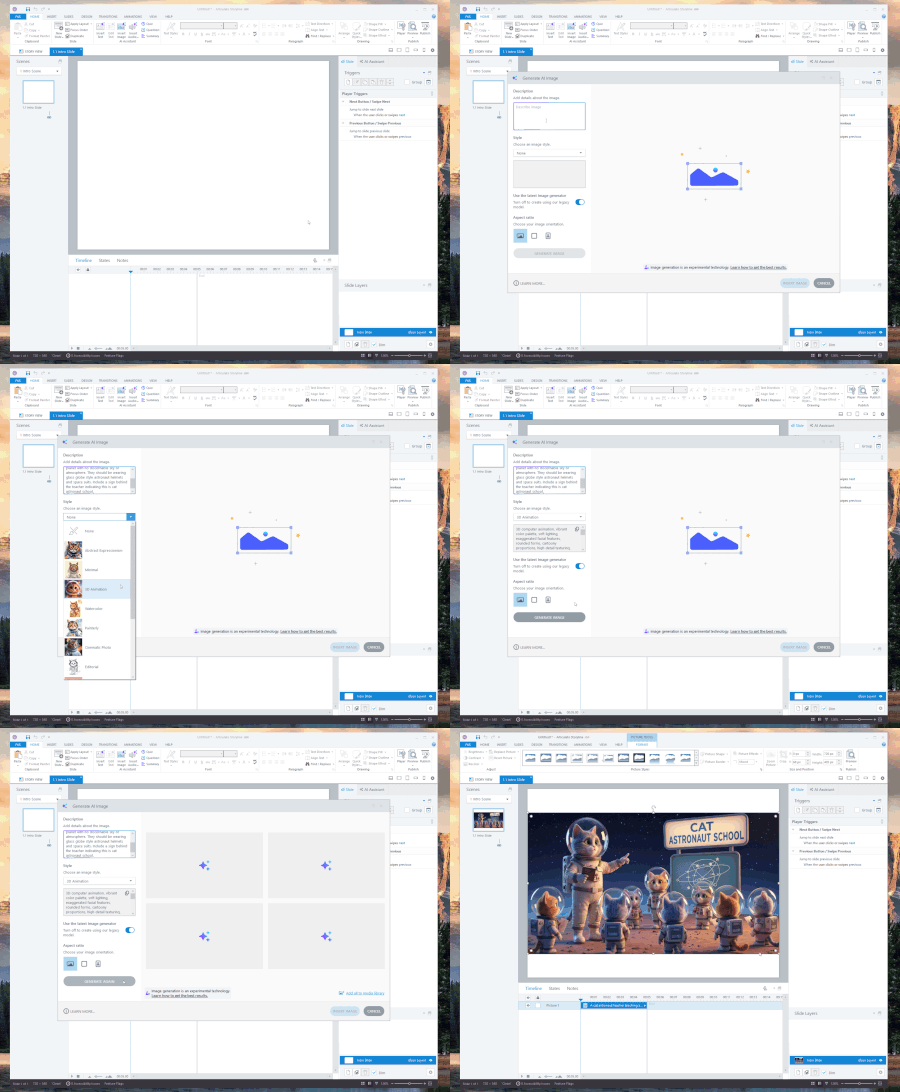
We’ve introduced a new image generation model that’s sharper and more realistic with improved text rendering. In this quick GIF, you’ll see the new model toggle in action (so you can switch between the legacy and latest versions), and the results from this prompt: “A cat astronaut teacher teaching kitten astronauts about space travel and planetary physics while on a distant planet with no discernable sky or atmosphere. They should be wearing glass globe style astronaut helmets and space suits. Include a sign behind the teacher indicating this is cat astronaut school.” The new model nailed every detail — even the classroom sign. That’s something the previous version really struggled with, and it’s such a huge step forward for anyone creating custom art and course imagery inside Storyline. This new image generation model is available in version 3.105.35604. Have you updated and played around with the new model yet? What kind of prompts have you tried?376Views7likes2Comments