other
532 TopicsAI and decreasing Quality Assurance review time and found errors
Hello, I am a QA Coordinator and have been asked to evaluate the potential impact of incorporating an AI agent into our Articulate 360 QA process. I would like to identify which tools or capabilities within Nova and Frontline could support and enhance quality assurance including decreasing time and documentation of comments. Specifically, I’m interested in capabilities that can assist with: Spelling, grammar, and consistency Specialized spelling and use of industry-specific terminology Font, layout, and design consistency Closed captions and caption-content accuracy Alignment of course content and assessments with stated learning objectives Verification of working hyperlinks Navigation and functionality Quiz functionality and completion requirements Identification of other potential quality or accessibility issues The goal is to understand where AI could supplement our existing QA process, improve consistency and efficiency, and identify issues that may still require human review. THANK YOU!8Views0likes0CommentsHow can I start a motion path where it ended in a previous slide?
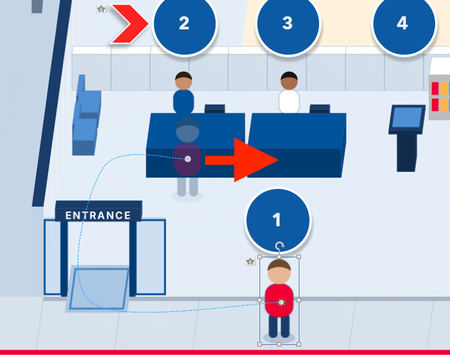
I created a curved motion path for an icon in slide one. In slide two, I want that curved motion path to be a straight-line motion path, starting where the curved motion path ended in the previous slide. How do I accomplish this?48Views0likes8CommentsNo feedback/answer key section showing when publishing as PDF in Rise
When I tried publishing the rise file, I found that the PDF has the assessment part neither marking the correct/incorrect answers nor showing the correct and incorrect feedback as it does while publishing in Storyline 360. Is it possible to add the feedback/answer key section for assessments in rise when publishing as PDF.317Views3likes10CommentsOption to prevent Articulate 360 updates from recreating desktop shortcut?
Hello, Is there a setting or installation option to prevent Articulate 360 from creating a desktop shortcut during updates? On my corporate managed Windows computer, the shortcut is recreated after an update even when I have deleted it. It (probably) appears in C:\Users\Public\Desktop, so in our corporate environment a standard user cannot remove it without administrator assistance. I appreciate that shortcuts may be useful for some users, but I prefer to keep my desktop clear and can launch Articulate from its existing location. Could you advise whether there is a supported way to stop the shortcut from being created, or consider adding an option to disable it? Thank you.73Views1like6CommentsArticulate Sign in "Couldn't Open Port"
Launched my Storyline 360 desktop app and was prompted to sign in. Typically clicking 'sign-in' launches a browser window where I sign in and then have access on the desktop as well. Today I received the attached message in the application when I clicked sign-in. "Couldn't Open Port" "Unable to open a port for authentication responses." Steps taken: Closed out and relaunched desktop application Restarted entire computer and relaunched Went directly to Articulate360 website to sign in Got into website, but did not connect me to the desktop app. Peers in my organization are not experiencing the same issue. Thoughts? Thanks!2.3KViews0likes14CommentsLaptop Advice for running Storyline 360
I have Gaming Desktop with tons of horsepower for my everyday use but I want to be able to work while mobile and do not want to get a Laptop that can’t handle this software. Is necessary to have a Laptop with a 4GB or larger Graphics Card (like an Nvidia 4070, etc.) or if the Laptop’s Integrated Graphics is going to be enough? (Its not mentioned on Articulate website). Computer Hardware Requirements preferred for Articulate 360 AI including graphics specs? Do you need to have a powerful graphics card (Nvidia 4070) to run Articulate 360 AI on a Laptop? Suggested Hardware Specs? Thank you for your help.783Views0likes4CommentsAI Avatar GUI needs work
The AI Avatar generator needs some tweaks. First when opening the program, my screen is locked onto that GUI. I can't switch back and forth between storyline and the GUI. Need to fix this. Second, when exiting I am told that I have unsaved changes with the option to 'cancel' and continue working or 'discard unsaved changes'. Will someone please tell me how to 'save'. I have scoured the GUI and can find no way to save. I would like to, I keep having to reset Avatar and voice each time I launch it. George112Views0likes7CommentsEmbed Youtube Video - Error 153
Hello, Has something changed in Storyline?! I'm trying to embed a YouTube video using "iframe". I'm copying the embed code from YouTube, but it says 'Watch video on Youtube - Erro 153...'. I used: <iframe width="560" height="315" src="https://www.youtube.com/embed/dqaN76shzJE?si=F_NwSZruLu5BJAU6" title="YouTube video player" frameborder="0" allow="accelerometer; autoplay; clipboard-write; encrypted-media; gyroscope; picture-in-picture; web-share" referrerpolicy="strict-origin-when-cross-origin" allowfullscreen></iframe> Any/all help would be appreciated. Thanks2.4KViews0likes17CommentsRise courses across US & EU: Why are we still unable to transfer courses between data centers?
Articulate users working with clients in different regions (US + EU), did you know that you may hit a serious limitation in Rise? You can’t transfer Rise courses between data centers. Here’s the situation Articulate introduced the EU data center. Good move. But in practice, this split European users into two groups: Long-time users → most likely still on the US data center (unless they explicitly switched) Newer users → most likely on the EU data center (the new default for Europe) The problem? Rise courses cannot be shared across data centers. And Articulate’s solution? There isn’t one. Yes, you can switch from the US to the EU data center, but then you’re stuck: No migration path No export-import for Rise courses Switching data centers = rebuilding everything from scratch (!!!) What this means in real life For anyone working across multiple clients, this creates a real headache: Established European clients often stay on the US data center. Not by choice, but because rebuilding everything isn’t realistic. Newer European clients are most likely on the EU data center. Freelancers and agencies working across both end up stuck in between. Articulate’s “solution”? Ask your client to pay for an extra seat so you can work in their environment. Pay for two licenses yourself (US + EU). I think both are unacceptable. For a tool so widely used across Europe, the inability to move content between data centers is a significant gap. And I genuinely don’t understand why Articulate doesn’t prioritise finding a solution (a real solution!) to this issue. What I’d like to hear from European users Are you staying on the US data center because switching isn’t realistic? Has anyone actually switched to the EU data center? How are you dealing with this in client projects where you are on different data centers? And how do you feel about how Articulate is handling this?664Views7likes21CommentsHelp Embedding Interactive Storyline Map into SharePoint Online
Hi! I'm hoping someone can help me figure out how to display an interactive map I created in Storyline directly on my company's SharePoint site. I'd love for my colleagues to be able to interact with the map right on the SharePoint page rather than having to download it/open it separately. Is this possible? I've looked at these two posts from before, but it still didn't work: https://community.articulate.com/discussions/discuss/embedding-storyline-into-company-sharepoint/1021044 https://community.articulate.com/discussions/discuss/viewing-articulate-360-content-in-sharepoint-online/774255 A few of the comments mentioned converting the story.html file to story.aspx, so once I did that and uploaded it, it wouldn't let me select it through the File and Media web part. Then when I tried to embed, it launched File Explorer instead. Has anyone successfully done this recently? Thank you!!